Arburg launches new hybrid press, controller at K
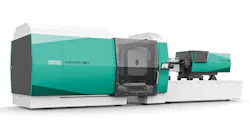
At the K show, Arburg GmbH, Lossburg, Germany, unveiled a new model in its hybrid Allrounder H series that features a new control system and overall design. The machine is the largest injection molding press the company offers. Arburg also rolled out a new machine series specifically for use with molds that have two parting lines.
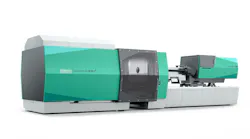
The company's new Allrounder 1120 H electric toggle-clamp machine provides 715 tons of clamping force and upgrades the performance of the injection and clamping unit compared to prior models in the Allrounder H line. Like prior models, it combines the speed and precision of electric drives for mold movements with the power and dynamics of a hydraulic circuit for injection, but both aspects have been optimized to deliver a dry cycle time of 2.4 seconds, said Heinz Gaub, managing director of technology and engineering. Other specifications of the new press include tie-bar spacing of 1,120mm and a maximum clamp opening stroke of 1,050mm.
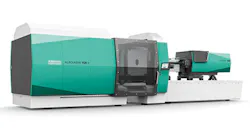
New features of the Allrounder 1120 H include fold-out steps built into the clamping unit that make the clamp and platen more accessible. LED strips incorporated into the body panel of the clamping unit change color to indicate the operating status of the machine. In addition to the integrated optical signaling elements, the machine incorporates ergonomic handles and sliding doors for access to the pneumatic, electric, hydraulic, lubrication and temperature-control systems. The safety doors of the unit move on linear guides for smooth operation.
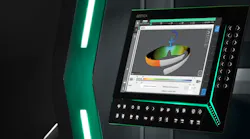
With the Allrounder 1120 H, Arburg introduces Gestica, its new control system based on its Selogica control but designed for easier and more intuitive operation. Gestica uses an identical hierarchical structure, graphical programming system and data sets as Selogica, making the systems fully compatible with each other.
However, Gestica incorporates the company's new Ergonomic Arburg System or Easyslider operating element, which allows users to set up and control machine movements using gestures common to smart phones. Machine movements can be sped up or slowed down with a swipe of a finger along the on-screen bar.
The Gestica control has a glass front, a high-resolution, high-definition 15-inch screen and industrial-grade multitouch technology through which a user can adjust programming operations. Users can also assign specific operating functions to programmable hardware keys located on the panel of the control unit. The control panel is mounted to the machine on an arm that can be adjusted for user comfort, Arburg said.
At the show, an Allrounder 1120 H with a size 4600 injection unit produced an eight-piece, 2.4-pound folding step stool from PP in about a 60-second cycle. A new Arburg Multilift V 40 linear robot system with cantilever design introduced at the show placed the parts molded by the Allrounder 1120 H on a rotary transfer table in a connected assembly station. The Multilift V 40 has a moving demolding axis and a maximum payload of 88 pounds.
The new machine also has an updated look, with angles that are repeated on the side panels, control cabinet, injection unit and clamping unit. New graphics and a new color scheme visually emphasize the advanced technology of the machine, Gaub said.
CUBE SERIES DEBUTS
Arburg also introduced a new machine series for high-speed applications that use four-sided cube molds. While Arburg's new Allrounder Cube machines are designed for use with cube molds manufactured by mold maker Foboha, Haslach, Germany, they are potentially compatible with other suppliers, as well.
The machines have servo-electric toggle clamp units. The machines also have four servo-electric axes of motion, with one servo motor for clamping or form closure, two servo motors for material dosing and a servo motor for rotating the cube mold. Core pull and other mold functions are hydraulically driven, Arburg said.
The Allrounder Cube series delivers 10 percent shorter cycle time with 25 percent less energy consumption, when compared to a hydraulic machine running a cube mold, Arburg said.
Arburg worked with Foboha, a business of Barnes Group Inc., Bristol, Conn., to develop the servo-electric rotating cube mold, which has independent sliding axes and fully automated removal and setdown. Those features help optimize the tool and machine for producing an overmolded, insert-molded or assembled part. Arburg offers the Allrounder Cube machine in two sizes, including the Allrounder Cube 2900, with 319 tons of clamping force, tie-bar spacing of 820mm and a mold installation space of 1,900mm. The Allrounder Cube 4600 has 506 tons of clamping force, tie-bar spacing of 1,020mm and a mold installation space of 2,400mm. The machines operate with Arburg's Selogica control.
Cube molds have four sides and two parting lines. This allows the molder to dedicate individual steps of the molding process to a certain parting line, allowing filling, cooling and part removal to take place simultaneously. The design of the cube mold allows the user to incorporate assembly, insertion and testing operations without increasing the cycle time.
Arburg Inc., the German firm's U.S. subsidiary, is headquartered in Rocky Hill, Conn.
Mikell Knights, senior correspondent
Contact:
Arburg Inc., 860-667-6500, www.arburg.com