Epson, a major industrial robot maker, unveils its first collaborative robot
Key Highlights
- Epson’s new AX6, the company's first collaborative robot, can be used for injection molding machine tending and palletizing applications.
- Power- and force-limiting features enable greater worker interaction without traditional safety barriers, following a proper risk assessment.
- The AX6’s ISO Class 5 cleanroom rating supports plastics manufacturing applications involving life sciences and medical devices.
- No-code programming, manual teaching buttons and easy redeployment simplify collaborative robot setup for injection molding and other applications.
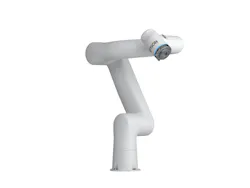
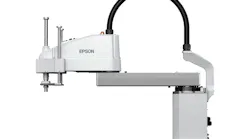
Epson Robots has expanded its six-axis robot lineup by introducing the AX6, the first collaborative robot from the company that has traditionally focused on SCARA and industrial six-axis robots.
Unlike traditional robots, the AX6 includes power- and force-limiting features that, with a proper risk assessment, allow greater worker interaction without traditional safety barriers, according to the company. As a result, the collaborative robot is also easier to redeploy to new locations and tasks.
Epson expects injection molding machine tending and palletizing will be common applications in the plastics industry.
Traditional Epson industrial robots, unlike this collaborative model, emphasize speed and performance maximization.
A lightweight carbon-fiber structure and ISO 5 cleanroom rating allow use of the cobots in places with limited space and where controlled environments are essential, according to the company.
“One of the unique things about this is ISO Class 5,” James Shimano, product manager for Epson Robots, told PMM. “A big part of plastics right now is manufacturing containers and stuff for the life science and medical device industry. Within the handling of those types of materials, the ISO Class 5 is something that's relatively unique in collaborative robots. We're not aware of other collaborative robots that have that class rating.”
While the AX6 is currently the only collaborative robot from Epson, that may change.
“We are launching a single unit right now, but we are planning to expand this line in the future,” James Shimano, product manager for Epson Robots, told PMM.
Cobots are finding a niche in the industrial automation market. The Association for Advancing Automation (A3) reported that North American companies ordered 2,774 collaborative robots valued at $114 million in the first half of 2026, accounting for 15.4 percent of all robot units ordered and 9.8 percent of the total order revenue.
A3 EVP Alex Shikany told PMM in February that “collaborative robots remain a relatively small but growing part of the mix” in the plastics and rubber sector.
Ease of use is key for new AX6
The AX6 includes what the company calls easy-to-use no-code software with an intuitive user interface. Epson’s AX Portal collaborative robot software offers users a comprehensive range of development tools to address diverse automation needs, according to the company.
In addition to the no-code (or block programming) software, advanced users can program the robot using Python-based software, a programming interface that allows users to control and automate robotic arms and upload custom libraries and modules to develop more complex robotic applications.
The block programming software allows someone without programming knowledge to work with and reposition a collaborative robot.
“It's basically kind of a teach-and-repeat type method, where you move it here, move here, open gripper, close gripper, etc.,” Shimano said. “It's very simple, very easy to redeploy and interface with those teaching buttons on the end. Someone even without programming experience can do this.”
End-of-arm buttons include three customizable and two dedicated buttons, allowing a user to easily teach positions by manually moving the robot in free space and using the teach buttons, according to Epson.
“Using the plastic industry as an example, if you're unloading an injection molding machine, you normally have to just teach the point where the robot's going to engage with the part, and then it's going to drop it off in some sort of container,” Shimano said. “That is very easily taught just at the end of our tooling. You don't need to go and use a jog mode in order to do that.”
The end of arm also has an Ethernet port and pneumatic connections to simplify end-of-arm tooling attachment for grippers, dispensers and other tools.
An end-of-arm multicolor LED ring conveys the robot’s status.
3D simulator software allows users to test programs in simulation before running them in the work cell.
The AX6 supports 110-240 volts AC or 48 volts DC.
Contact:
Epson Robots, Los Alamitos, Calif., 562-981-3840, www.epsonrobots.com
Vital Statistics: Epson AX6
|
Reach |
35.4 inches |
|
Maximum payload |
13.2 pounds |
|
Controller |
RC-A101 |
|
Environment |
ISO Class 5 |
Further reading
 A white industrial robot arm with a gripper end-of-arm tool
About the Author
Bruce Geiselman
Lead Reporter
Senior Reporter Bruce Geiselman covers plastics processing technologies and end markets including automotive and packaging. He also writes features, including In Other Words and Problem Solved, for Plastics Machinery & Manufacturing and The Journal of Blow Molding. He has decades of experience in daily and magazine journalism, including eight years at PMM, and is the recipient of a Jesse H. Neal Award, among other recognitions.