Plastics processors, analysts see uncertainty in 2026 outlook
Key Highlights
- 73 percent of plastics processors who responded to PMM's annual survey plan to purchase new primary processing equipment in 2026, mainly for capacity expansion.
- Despite economic challenges, 56 percent of respondents intend to spend $1 million or less on equipment.
- Tariffs and trade policies are viewed negatively by many industry players, with some companies exploring less tariff-sensitive markets and supply chains.
- Companies like Mack Molding are investing heavily in automation and new presses, driven by strong demand in medical and industrial sectors.
- Labor shortages and rising tooling costs due to tariffs are prompting firms to focus on automation and reshoring efforts to maintain competitiveness.
What's ahead in 2026?
• OEMs also have divergent opinions about the year ahead, citing tariffs, ongoing economic worries and turmoil in end markets.
• The labor shortage is still the top concern for plastics processors. New machinery features, automation and training for human workers are helping them cope.
By Lynne Sherwin
The headlines tell the story of 2025:
Could Trump tariffs help or hurt plastics businesses? Economic turmoil worries manufacturers. Tariff chaos is hurting plastics processors. Volatility roils tool making industry. How to manage your business through chaos.
All of these and many similar stories appeared in Plastics Machinery & Manufacturing (PMM) over the past 12 months, as the industry was buffeted by the constantly shifting winds of tariffs, interest rates and labor shortages.
In such an uncertain climate, it’s hard to know how to plan for next month, let alone next year. But processors who responded to PMM’s annual survey of equipment investment plans for the upcoming year showed signs of optimism, even in the face of multiple challenges.
The survey, conducted in October 2025, showed that 73 percent of respondents plan to buy primary processing equipment in 2026. That’s the highest percentage in the seven years PMM has been running the survey.
Optimism has its limits, however: While the number of processors who expect business to be better in 2026 than in 2025 remained fairly steady at 56 percent, compared to 58 percent in the 2024 survey, the number expecting business to be worse rose to 17 percent, from 10 percent in last year’s survey.
Among the respondents, 63 percent utilize injection molding; 49 percent make or repair molds or tools; 27 percent work with additive manufacturing; 15 percent each, blow molding and recycling; 12 percent each, compounding, film or sheet extrusion, and thermoforming; 10 percent, pipe, profile or tube extrusion; and 5 percent, rotomolding. (Respondents could choose more than one answer.)
Of those planning to buy primary equipment, 54 percent said it is for expansion of capacity, and 22 percent for replacement. Fifty-six percent plan to spend $1 million or less, and 29 percent expect to spend $1 million to $3 million.
Is it time to invest in new equipment?
Perc Pineda, chief economist for the Plastics Industry Association (PLASTICS), said capital expenditures in plastics dropped from $7.36 billion in 2023 to about $6.95 billion in 2024, so, “I think it’s about time that the processors would need to be increasing their investment spending, particularly now that there are some signs of an increase in domestic manufacturing because of the current tariff situation.”

He said he sees companies considering expanding their footprints in the U.S., along with some reshoring.
“We have some automakers, for instance, that have been very vocal in their plans to increase their production in the United States. That’s a positive for the plastics industry. And downstream, there are some spillover effects,” he said.
Pineda’s December economic analysis for PLASTICS attributed much of the industry slowdown over the past three years to high borrowing costs. But in August and September 2025, the Industrial Production Index for plastic products manufacturing rose 1.4 percent and 0.8 percent, respectively, from the previous month, and capacity utilization has risen from 73 percent in July to 74.3 percent in September, after hitting a five-year low of 72.2 percent in January 2025.
“It looks like the industry is finding their footing. Despite all this noise on tariffs and the scare of ‘we might go into a recession’ ... that never happened. Yes, capacity utilization is still low at the moment, but I think there are some signs of improvement,” he said, which should accelerate as interest rates come down.
“There is a resilience in the U.S. economy that I think has surprised many, and in our conversations with some of our members, they also say that the processors seem to be getting adjusted to the higher cost of equipment and higher cost of doing business because of tariffs,” he added.
Pineda noted that the impact of tariffs levied on imported machinery has been somewhat blunted by changes in tax regulations that allow processors to take a 100 percent first-year deduction on capital equipment.
In an economic analysis posted in December on PLASTICS’ blog, he noted that “tariff impacts are uneven, highly product-specific, and deeply influenced by evolving bilateral negotiations,” and that imports of plastics machinery and molds actually increased in 2025, with machinery reaching $2.7 billion (up 5.3 percent from 2024) and molds $1.5 billion (up 7.1 percent).
Laurie Harbour, a partner at Wipfli and longtime consultant to manufacturers, including molders and mold making shops, sees more clouds than sun on the horizon for 2026. Tariffs are making major processing equipment more expensive, and data compiled by Wipfli across a sample of about 300 manufacturing facilities, the majority of them plastics processors, shows utilization rates of around 55 percent — much lower than what PLASTICS’ data reveals.
“This has been what I’ve been talking to my processor clients about: ‘Guys, why are we buying new equipment? How about we run what we’ve got?’ Now, I understand if there’s a particular piece of equipment that I need, or something that’s specific for a tonnage, or something based on a new piece of business that I want. But the reality is, we like to buy equipment, and we don’t run it at its full capacity,” she said.

The high percentage of respondents to PMM’s survey saying they plan to buy primary processing equipment for expansion “may be a function of optimism, like maybe they’re just thinking, ‘Hey, we’re so confident that things are going to turn around in 2026 that we want to be prepared.’ I’m not. ... This market is not rebounding the way people think it's going to rebound in the new year,” she said.
While some shops are doing well and expanding, others are holding off on capital investments, trying to keep their current machines running longer while they wait to see if the tariff situation improves. That could create a ripple effect that extends to machinery makers, Harbour said.
“These equipment manufacturers are going to have to reduce labor and scale their plants back because they don't have demand. So, then, all of a sudden, somebody tries to order a piece of equipment, and that lead time is going to be even longer. So, there’s long-term ramifications,” she said.
Harbour believes 2026 will be flat or slightly better than 2025, but “it’s going to be ’27 before we really start to see things turn around.”
Trade policy brings mixed results
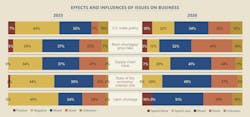
Only 7 percent of processors who responded to the PMM survey said U.S. trade policy has had a positive effect on business in 2025, while 44 percent said it had a negative effect. Twenty-two percent said they would likely spend less on equipment in 2026 because of U.S. trade policy. Interest rates and the state of the economy also drew a 44 percent negative response.
“Tariffs are a struggle for all involved in the supply chain,” one commented. “Tariffs are a killer for our traditional business, and we are exploring opportunities which are less affected by tariffs,” said another. One respondent mentioned issues with international students obtaining visas, and another noted “shifting regulatory goal posts on international and domestic plastic policy.”
Mack Molding is one business that has bucked the industry’s downward trends.
“Probably our biggest challenge right now is just keeping pace with the growth. Customer demand and program complexity continue to increase,” said Larry Hovish, the company’s director of communications.
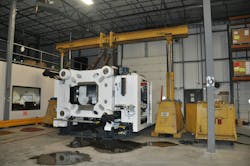
Mack Molding operates more than 120 presses, in sizes ranging from 28 to 4,000 tons, across plants in Vermont, North Carolina and South Carolina. The company specializes in complex, highly engineered plastic components, as well as full contract manufacturing, for markets including medical, automation, industrial commercial equipment, energy, utilities and transportation, such as heavy trucks, agriculture and recreational equipment.
In the past 18 months, Mack has invested over $3 million in new presses, auxiliary equipment and automation to keep up with demand, with more to come in the new year, both for expansion and replacement of older equipment.
“When you get the new equipment, you’re dealing with new efficiencies, higher quality, improved energy performance, all that stuff you want to get when you get into the new equipment,” Hovish said. “So, that’s pretty exciting.”
He pointed out that the privately owned Mack reinvests its profits into the company and can buy equipment without borrowing money, which has insulated it from the issues surrounding high interest rates.
“We’re scaling capacity with equipment buys and things like that, and investments in the people to support that momentum. We really see 2026 [to be] about managing opportunity and not headwinds. We see strong demand — particularly in medical robotics and industrial markets — continuing,” he said.
Mack has seen “strong domestic interest in reshoring ... a lot of uptick in interested companies looking to either move or just start programs here. So, that’s been driving part of this growth period that we’re in,” Hovish said.
Ken Parker, CEO of Tech-Way Industries in Franklin, Ohio, said his company is seeing increased quoting activity as interest rates have come down, which is “usually a sign of an economy that will start to pick up in about six months.”
However, he said, equipment and tooling prices are rising, and he has seen “very little” reshoring.
“Tooling prices from overseas have jumped due to tariffs, but even with the tariffs, we still see much higher prices on tooling in the U.S. than from overseas,” he said. “Our concern is that so much of the tooling business has left the country, that it will take years to bring that back to the level it was before the year 2000. Many qualified toolmakers are retiring, and there is not much interest in the younger generations to pursue this type of career.”
Injection molding machines are mostly manufactured outside the U.S., and while sending tooling work to China, India and elsewhere over the last 30 years helped American manufacturers cut costs, “with the tariffs, the prices are increasing, and this is causing re-evaluation of machinery purchases.”
Tech-Way is a custom molder specializing in short runs that might be too complicated for other shops, including microparts. It serves a variety of markets, including the medical, food processing and aerospace industries. According to Parker, many of the shop’s 50 presses are older, as Tech-Way has personnel in-house with the expertise to maintain and adapt them to suit the plant’s own specific requirements.
Parker said Tech-Way is planning to invest in automation equipment to improve efficiency and help compensate for the lack of skilled workers.
“We have confidence that things will pick up,” he said.
New markets, new presses, automation
Marne Plastics is also investing in automation — including plans for two new robotic assembly cells, along with a new Arburg injection molding machine, according to company President Mike Fitzsimmons. That equipment will be more expensive thanks to the tariffs, since it comes from Germany, she said.
In May, the company increased its plant floor space from 36,000 square feet to 58,000 square feet, and added two IMMs, bringing its stable to 17 Arburg machines and one Sumitomo IMM.
Capacity is “close to full,” running 24 hours a day, five days a week, and while the company currently has all the staff it needs, “it is difficult to find fully qualified people,” Fitzsimmons said.
Regarding reshoring, “some business was planned to go to Japan and it stayed in the States. We’ve received multiple requests to move jobs from China, [but] nothing has been awarded yet. We’ve received one request to move from Vietnam. One of our customers is looking to source local material instead of Japan,” he said.
Based in Grove City, Ohio, Marne Plastics makes parts for Japanese automotive manufacturers and is looking to expand beyond that market.
Reducing reliance on the automotive sector is also a goal for Jeff Ignatowski, president and owner of Champion Plastics in Auburn Hills, Mich., which over the past year has diversified into markets such as precision plumbing parts, “to help offset any low points in automotive... It’s now down to about 60 percent. It was much higher than that, but with our efforts, we’re not as dependent on it as we used to be.”

Ignatowski said Champion has managed to avoid most of the detrimental effects of tariffs and even seen some benefits.
“We’ve been pretty fortunate as far as reshoring. We have and continue to see a lot of quoting activity. I can’t say that we’ve received business as a result of it yet, but I do see that forthcoming,” he said.
Buying the new equipment, he said, “we did get lucky. We typically purchase Haitian equipment, as well as some of their associated robots, and the purchases we made recently, they had it already in stock in the U.S., and so those were not subject to tariff whatsoever.”
Tooling is another story, as the company’s molds are made in China and “for a while it was a moving target.” Sometimes, the tariffs changed between the ordering of a tool and its shipment. And some customers are asking to amortize the cost of tooling, which Ignatowski sees as a concerning sign of customers’ financial struggles.
But overall, he’s one of the optimists for 2026.
“We’ll probably continue to see growth,” he said. “So as long as we don’t have these little hiccups, I’m feeling pretty confident and looking forward to it.”
About the Author
Lynne Sherwin
Managing Editor
Managing editor Lynne Sherwin handles day-to-day operations and coordinates production of Plastics Machinery & Manufacturing’s print magazine, website and social media presence, as well as Plastics Recycling and The Journal of Blow Molding. She also writes features, including the annual machinery buying survey. She has more than 30 years of experience in daily and magazine journalism.