Machinery OEMs express optimism, worry for 2026
Key Highlights
- Plastics machinery OEMs are experiencing a mix of cautious optimism and hesitancy, with some seeing opportunities in reshoring and modernization, while others see customers prioritize extending existing equipment lifespans.
- Tariffs and trade policy shifts are impacting costs, supply chains and investment timing, creating a complex environment for OEMs and customers alike.
- Market segments such as building products and packaging show steady growth, with increased focus on recycled materials and energy-efficient solutions.
- Automotive markets face delays and restructuring, but growth in electric vehicle components and infrastructure offers new opportunities for injection molding and extrusion equipment.
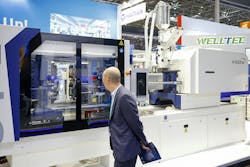
What's ahead in 2026?
• Many respondents to PMM's annual machinery investment survey plan to expand capacity in 2026, but not everyone is so optimistic.
• The labor shortage is still the top concern for plastics processors. New machinery features, automation and training for human workers are helping them cope.
By Lynne Sherwin
Plastics machinery OEMs are expressing a mixed-to-cautiously-optimistic outlook for 2026.
While nearly three-quarters of the processors who responded to Plastics Machinery & Manufacturing’s (PMM) annual survey said they plan to purchase primary processing equipment in 2026, and 65 percent plan to buy auxiliary equipment, OEMs aren’t celebrating just yet.
While some markets are growing, in the closing months of 2025 machinery manufacturers saw a volatile trade situation and macroeconomic uncertainty as potential roadblocks.
At a press conference at K 2025 in October, Michael Hehl, managing partner for Arburg, summed it up this way: “In volatile times like these, it is of course more difficult than ever to take a reliable economic look into the future.”
He noted a slight recovery and some larger orders in the previous six months, but said, “Due to the fragile global economic situation, it is still too early to take stock of the current year 2025 or to make a reliable forecast for 2026.”
“While the market environment remains challenging and uncertain, we do believe we are approaching a bottoming out, with the potential for a slight recovery in 2026,” said Stefan Engleder, CEO of the Engel Group. “A significant influencing factor continues to be geopolitical developments, particularly tariffs, which are affecting investment timing, cost structures and regional sourcing decisions for many of our customers.”
In PMM’s survey, the percentage of respondents expecting business to be worse in the coming year rose to 17 percent, from 10 percent in the survey conducted in late 2024. Those expecting business to be better in the coming year stood at 56 percent, compared to 58 percent last year.
The recent third-quarter report from the Plastics Industry Association’s Committee on Equipment Statistics revealed good news for injection molding equipment makers, showing a 30 percent increase in shipments from the second quarter, although both single-screw and twin-screw extruder shipments fell 4.9 percent and 28.9 percent, respectively, in the same period.
Some OEMs are seeing cautious optimism among their customers, while others are seeing just caution.
Representatives from Wittmann and Absolute Haitian both referred to having “weathered the storm” in 2025.
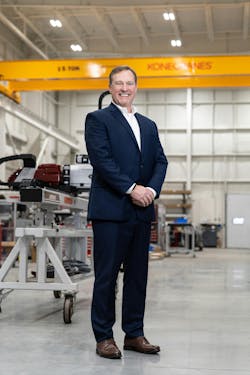
Wittmann can withstand large swings in the market since auxiliaries and automation tend to go up when injection molding machine sales are down, and “customers still need efficiency gains even when there isn’t an increase in capacity required,” said Sonny Morneault, president of Wittmann USA.
The company is forecasting conservatively for 2026, anticipating a 10 to 15 percent increase in new business, due to ongoing uncertainty about tariffs, geopolitical issues and supply chains, he said.
Glenn Frohring, co-owner of Absolute Haitian, called 2025 “challenging,” but said the company saw good results in 2025 and expects 2026 to be better.
Processors still had some open capacity after investing in equipment at record-setting rates during the COVID-19 pandemic, and budgets set at the beginning of 2025 didn’t account for the higher cost of equipment from overseas once tariffs went into effect, he said.
“I think that customers’ budgets were absorbed very quickly because of increased top costs due to the tariffs. But at the same time, opportunities are increasing because of production in the U.S., so [in 2026], they’re going to be better prepared to invest in injection molding machines. We’ve got a lot of projects lined up,” he said.
He sees reshoring and new projects requiring a specific size of equipment as driving investment in 2026, along with improvements in smart technology, process control and energy efficiency.
“Customers still have a lot of older equipment that was built at a time where they were utilizing fixed-volume pumps and machine technology that utilized a lot of energy. By disconnecting those machines and buying new equipment, there’s a huge, huge gain in energy savings,” he said.
Peter Gardner, the outgoing president of LS Mtron Injection Molding Machine USA, said his company has seen increased quoting and project development activity, after achieving 101 percent year-over-year growth in North America as of late September 2025.
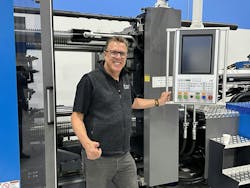
“What stands out is a shift toward strategic modernization — replacing older hydraulic platforms, improving energy efficiency, integrating automation and strengthening process stability. ... Overall, the indications point to a healthy investment environment next year,” he said.
He said LS Mtron’s customers are interested in all-electric IMMs in larger tonnages, along with lower operating costs, improved process stability, smart controls, better ability to run recycled or PCR materials, ease of use and a strong parts and service structure.
“Many processors are planning investments, but they are clearly prioritizing projects that directly improve efficiency, operational stability and total cost of ownership, often delaying or re-scaling less critical initiatives,” Engleder said.
Marko Koorneef, president of Boy Machines Inc., said, “I see expansion for new products that have been developed, as well as replacement of very old equipment.”
“Entek is lofty on our projections for 2026,” said Linda Campbell, VP of sales for the twin-screw extruder manufacturer. “Large turnkey projects were very strong and have increased year over year, and we believe will continue to do so.”
Customers hesitate to invest in new equipment
But some OEM representatives are sounding more ambivalent, and others are downright pessimistic.
“Customers have been rather restrictive in buying new primary equipment,” said Martin Baumann, president and CEO of Arburg Inc.
“The ROI calculations have changed, and many customers are telling us that ‘extending life of existing machines’ is more of a priority compared to buying new and state-of-the-art machines. Our refurbishment and spare parts business is doing, relatively speaking, better compared to new machine business,” he said, adding, “We do believe this can’t go on forever and 2026 could be the year when customers start buying at normal levels again.”
At the K show, Tobias Baur, Arburg’s managing director of sales and after sales, noted the uncertainty in the U.S. market surrounding tariffs and a resulting reluctance to invest.
Tederic Machinery CEO Terry Zheng cited “investment restraint” in injection molding at a K 2025 press conference but said he is seeing signs of stabilization and expects an upturn in 2026.
During a K show press conference, Shigetomo Sakamoto, president of Shibaura Machine Group, also predicted recovery in the injection molding market in the first half of 2026.
Charlie Martin, president of extruder maker Leistritz, said he’s “moderately pessimistic” about 2026, citing economic uncertainty and tariff chaos.
Masa Miyajima, president of Nissei America, said, “If [the] tariff issue continues, it will be worse than this year [2025]. Many customers are reportedly thinking about freezing their capital expenditures.”
But Mac Otsuka, Nissei America’s marketing manager, reported a “substantial number of inquiries” at the K show.
“Cautiously optimistic” was the prediction of Manuel Heusinger, Kautex’s VP of sales and service for the Americas: “We anticipate increased clarity regarding trade policies and a reduction in interest rates, both of which are expected to stimulate demand for new equipment.”
Like Arburg’s Baumann, Heusinger said Kautex’s service business has flourished, experiencing double-digit growth as customers look to extend the lifespan of their existing blow molders. The company is also “actively evaluating opportunities to establish machine manufacturing operations in America and to open an additional service center within the region,” he said.
Rocheleau Tool & Die has a “generally positive outlook” for 2026, according to President Steven Rocheleau.
“Both quote activity and backlog are up compared to a year ago, with particularly strong momentum in food packaging. That aligns with what we are hearing from customers: Companies running older equipment are beginning to move forward with upgrades, while others are exploring capacity additions to support growth,” he said.
Tariffs are a mixed bag for OEMs
Machinery providers are reporting both positive and negative consequences from tariffs.
Some are seeing signs of an uptick in business from reshoring. Imported equipment costs more, which is intended to benefit domestic machinery makers — but many types of machinery are no longer made in the U.S., and those domestic manufacturers are being hit by tariffs on components. And the frequent shifts in trade policy are hard for everyone to keep track of.

Campell believes U.S.-based Entek has benefited from the tariffs, “although we have experienced headaches around tracking tariffs, communicating to our customers, and understanding the timing and percentages. There still is some ambiguity with which items we buy, whether or not they are applicable to tariffs,” she said.
KraussMaffei Corp. has had similar issues, according to Brett Greenhalgh, president and CFO.
“Although contracts now are clearer regarding changes to tariff rates and Incoterms [rules that manage international transactions] are carefully negotiated, the additional cost burden caused by tariffs has an important impact on our business. Clear processes and accurate information regarding the Section 232 tariffs are still elusive,” he said.
“The constant shift of policies and tariffs have significantly impacted our new business and the way we do procurement here in the States,” Morneault said.
Earlier in the year, Wittmann made the pitch to customers to buy from the inventory that was already in stock in the U.S., but now, “most of that inventory that didn’t have these high tariffs are gone and customers are left to deal with a 15 percent to 30 percent increase in capital equipment prices,” he said.
Absolute Haitian also benefited from stocking up on IMMs ahead of the tariffs, and from having the flexibility to manufacture in Japan and Mexico, not just China, Frohring said.
Customers can’t plan their purchases around a shifting trade policy, Baumann said, “but what they are doing is holding back investment because of the uncertainty. Some of our customers have indicated additional business due to reshoring, but it isn’t a rush of new projects, [and] that new project business is to some degree offset with overall economic uncertainty.”
Kautex, which is based in Germany, had to pass on the cost of importing equipment to its U.S. customers, according to Heusinger.
“It is not feasible for an equipment supplier in our segment to absorb the impact,” he said.
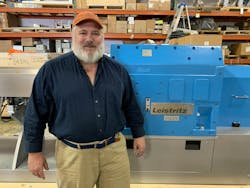
Martin said Leistritz has suffered from the constant shifts in policy, and most customers “are in a holding pattern, at least until the midterms. Tariffs should be applied in a targeted and thoughtful way, strategically and rarely,” he concluded.
Miyajima said Nissei America is seeing both sides of the coin.
“There are certainly instances where the acquisition of equipment has been delayed until the following year,” he said, but at the same time, “we have received information about certain clients relocating production back to the country, including the return of molds. We hope to see the tariff issue gets resolved quickly.”
Gardner called reshoring and near-shoring “real forces,” with North American mold makers and processors expanding and modernizing to shorten supply chains. He said LS Mtron expects to make “meaningful progress” in 2026 on its plan to build machines in the U.S.
Rocheleau called the impact of tariffs difficult to quantify.
“They have clearly affected our cost of goods, as global component supply chains touch nearly every manufacturer. It is less clear whether increased activity is tied to potential tariffs on European or Asian competitors. We are seeing more inquiries related to new plants and possible reshoring, but many of those discussions remain exploratory rather than firm expansion plans,” he said.
Morneault said Wittmann’s customers in several markets saw reshoring activity in 2025, which he expects to continue in 2026, although paradoxically, tariffs could also slow that activity.
“On one hand, I am in favor of reshoring and bringing back critical manufacturing and steel production to the U.S. On the other hand, in order to produce more goods, hire more staff, reshore more production, businesses will need capital equipment to do so,” he said.
“If they have to pay 20 percent to 30 percent more for those machines, it simply won’t happen. We’d like to see an exemption, exclusion or rebate for machines sold into the U.S. that have an economic impact.”
End markets: Building and packaging strong, automotive slower
The automotive market, one of the major pillars of plastics production, is still in flux as car makers contend with losses and cutbacks in their ambitious electric vehicle (EV) programs and return focus to hybrid and internal combustion engine (ICE) models.
“Automotive is still one of our biggest markets, but some of the big investment has yet to come. Programs have been pushed back a little. Some of the EV projections by the U.S. manufacturers were a little bit light. Initiatives are changing,” Frohring said.
“Planning is particularly challenging in the automotive sector, where development of new e-mobility platforms is progressing more slowly than expected,” said Engleder, of Engel, in a press conference at the K show.
Morneault said the sector is moving slowly, but “we are hopeful based on our analysis that the automotive industry will come back strong once they identify themselves as EV or ICE producers, which will create opportunities for new equipment,” he said.
Sven Skowronek, KraussMaffei’s VP of sales and project management – IMM, said the company has seen increased demand for injection molding and reaction processing equipment from the market for electric battery for vehicles.
Gardner said LS Mtron is experiencing growth tied to new factory construction and EV-platform expansion across North America, but Miyajima, of Nissei America, reported “a considerable downturn” in the automotive industry.
Building products are on the upswing, according to several OEMs.
“Construction and infrastructure remain strong drivers,” said Peter Zut, KraussMaffei’s VP of sales and service – extrusion. He anticipates growth in wire and cable and energy-efficient building materials, driven by regulatory changes and sustainability initiatives. Demand for PVC foam board and thermoplastic polyolefin (TPO) roofing is growing, along with demand for HDPE and PVC water and pressure pipes, and conduit and corrugated pipes.
“Overall, 2026 looks like a year of stable volume with pockets of strong growth where innovation and material efficiency are emphasized,” he said.
Injection molded parts for data center infrastructure are in demand, according to Baumann, of Arburg.
Campbell said building products and packaging, the core of Entek’s customer base, have been strong, and “we are placing our bets that in 2026, automotive, home goods and building will turn around as inflation lowers.”
Morneault said the reshoring of white goods due to tariffs has been Wittmann’s most active end market, and he expects that growth to continue in 2026, along with reshoring of more medical products, which could be affected by new Section 232 investigations. (In September, the Commerce Department announced it was investigating whether imports of items including industrial machinery, robots and medical devices constituted a threat to national security and should be tariffed at a higher rate.)
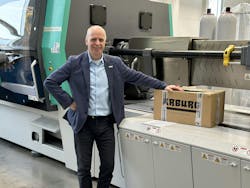
“Medical is slowly coming out of the overcapacity build-up from COVID and returning to investing in new machines again,” Baumann said, and at K, Engleder also referred to medical technology as “normalizing after the pandemic-driven peak.”
Skowronek, of KraussMaffei; Frohring, of Absolute Haitian; and Martin, of Leistritz, noted strength in medical and life sciences applications, as well.
Packaging, another tentpole for plastics production, appears steady, with sustainability more often becoming part of the discussion.
“In packaging, everyday applications remain stable, while new regulations increasingly influence material choices and product design,” Engleder said at K.
Zut and Skowronek of KraussMaffei both mentioned interest in recycled materials and circularity in an active packaging market.
Heusinger said Kautex has identified a “growing demand for smaller industrial packaging containers (20- to 30-liter jerrycans) as well as small and medium-sized machines designed for rapid changeover within the consumer packaging sector.” The company launched the new KEB20 Green blow molding machine at the K show to help meet that need.
Consumer packaging such as thin-wall containers, caps and closures is driving interest in fast-cycle, energy-efficient all-electric machines, according to Gardner. Larger parts that were traditionally molded on hydraulic machines — totes, bins, pallets, reusable packaging and household storage products — are also moving to all-electric platforms, he said.
Rocheleau said his company is also getting more requests for electric machines, although demand for hydraulic equipment remains strong.
“One notable trend is an uptick in customers that self-manufacture packaging,” he said. “Supply chain pressure is pushing companies to take greater control over container production, which is driving investment in in-house equipment.”
OEMs acknowledge that their forecasts for end markets, like those for machinery sales, are subject to change as economic and geopolitical winds shift, and their job is to be prepared.
“Staying flexible in a constantly changing economic environment is key to success — we are doing exactly that,” Baumann said.
“These are turbulent times and to be successful, we will need to be proactive and reactive as this administration throws new curveballs our way,” Morneault said. “However, I do think in the long run our country will be more productive than it has been in years, and our economy will flourish.”
About the Author
Lynne Sherwin
Managing Editor
Managing editor Lynne Sherwin handles day-to-day operations and coordinates production of Plastics Machinery & Manufacturing’s print magazine, website and social media presence, as well as Plastics Recycling and The Journal of Blow Molding. She also writes features, including the annual machinery buying survey. She has more than 30 years of experience in daily and magazine journalism.