AI features offer competitive edge: Talking Points
Key Highlights
- AI is moving from trade-show buzz to baseline expectation; most plastics machinery will embed it soon.
- Engel’s Inject AI signals a shift toward autonomous, self-regulating molding cells using 1,000+ real-time parameters.
- For most OEMs, near-term AI value centers on capturing tribal knowledge, maintenance optimization, and faster troubleshooting.
- Predictive maintenance is the easiest on-ramp: sensor data plus baselines can prescribe service actions and parts lists.
- Plastics adoption lags broader manufacturing, but investment is accelerating; ignoring AI now risks competitive disadvantage.

Artificial intelligence (AI) was on the minds and booth signage of many plastics machinery manufacturers at the K show last year, but a few did not want to talk about it unless specifically asked.
“No one wants to pay for it yet,” or more often, “our customers are not asking for it,” were the replies when I asked if they were including AI technology in their latest machines.
That was October 2025. I expect the story was different in late April at Chinaplas and will be different at IPF Japan in December and NPE 2027 next May. We are at the turning point for AI-powered manufacturing, and it will soon be part of most of the equipment in your plant.

Engel made a splash at K 2025 when it introduced the first autonomous injection molding cell, powered by Inject AI, Engel’s evolution of the now-ubiquitous Inject 4.0. The new AI system analyzes more than 1,000 parameters in real time, detects deviations and gives recommendations for corrective action.
“We are showcasing the world’s first industrial solution for an autonomous, self-regulating injection molding cell,” said Stefan Engleder, Engel Group CEO. “The machine autonomously produces high-quality parts with AI support.”
There is not much difference today in the injection molding machines, extruders, thermoformers and blow molders I saw when I first visited processing plants more than 35 years ago. The hardware looks strikingly similar.
But the software and control systems have seen huge changes and improvements. That is how machinery companies have differentiated themselves from competitors.
So adding AI to control systems is a next natural step in machinery evolution.
Machinery builders at the K show seemed to be thinking about AI for three processing functions: Training and capturing institutional knowledge from retiring employees; improving machinery maintenance programs; and troubleshooting processing problems. Most were not as ambitious as Engel and there was not much talk of AI-powered machines making autonomous decisions on the plant floor.
“Probably one of the bigger things that we’re going to see in our lifetime is AI troubleshooting, maintenance programs and things like that,” industry veteran Randy Wendling, director of aftermarket operations at Absolute Haitian, told Senior Reporter Karen Hanna for one of her stories on machinery maintenance in this issue.
Improving a maintenance program seems like low-hanging fruit for AI. It can analyze the data collected by machine sensors, compare it with baselines and in seconds tell an operator what is likely happening, when it will likely happen and what service is needed. And it can provide a parts list for the service.
Michael Duff, director of business development and aftermarket sales for auxiliary equipment maker ACS, said, “Our goal is practical application of these tools to simplify maintenance and improve responsiveness, not technology for its own sake.”
Forward thinking processors are already embracing AI as another tool to improve production efficiency.
Oxmaint AI, which provides industry-specific AI maintenance solutions, said AI-powered maintenance systems can reduce machine breakdowns by 70 percent, reduce overall maintenance costs a 25 percent and lead to faster repairs.
It is surprising that there is still a reluctance to embrace AI-powered solutions. Rockwell Automation, in its “2025 State of Smart Manufacturing” report, said that 95 percent of manufacturers surveyed said they have invested or plan to invest in AI machine learning, generative AI or casual AI in the next five years.
The report, which surveyed 1,500 manufacturing executives worldwide, found that introducing AI and automation were most often cited — about 41 percent for each — as part of their strategy to address their skills gap and labor shortages.
The plastics processing industry often lags behind other industries in adopting big changes. Five years ago, Rockwell said more than 80 percent of AI use cases focused on predictive maintenance. Now, the primary uses, particularly in large companies, focus on quality control and cybersecurity and on creating efficiency and streamlining processes.
It looks like the plastics industry is just coming out of the AI starting gate while some manufacturers are already going into the second turn.
Using all the best tools available seems to me to be part of the definition of smart, efficient manufacturing. How do you assess your operation?
If you roll your eyes and tune out when someone mentions AI, you are not doing any favors for your business.
Maintenance is a good starting point for your AI journey. This month's series on maintenance, linked below, explain why that is true and how to get started. Give them a read.
More on maintenance
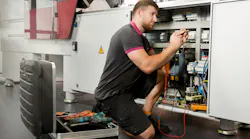
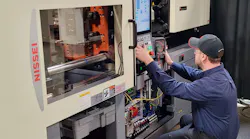
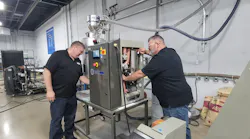
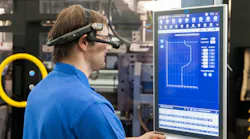 A Bekum technician uses Industry 4.0 tools to look over a machine. Increasingly, Christian Richard, corporate communications manager and sales administration manager for the OEM, said, “Maintenance in extrusion blow molding is no longer reactive — it is strategic.'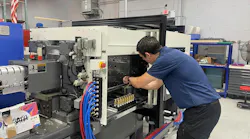
About the Author
Ron Shinn
Editor
Editor Ron Shinn is a co-founder of Plastics Machinery & Manufacturing and has been covering the plastics industry for more than 35 years. He leads the editorial team, directs coverage and sets the editorial calendar. He also writes features, including the Talking Points column and On the Factory Floor, and covers recycling and sustainability for PMM and Plastics Recycling.