'Run till it breaks' gives way to predictive maintenance approaches
Key Highlights
- Predictive maintenance uses IoT sensors, analytics and AI to forecast failures, reducing downtime and improving equipment reliability.
- Reactive maintenance costs nearly five times more than planned interventions, while predictive programs significantly lower overall maintenance expenses.
- Condition-based monitoring triggers maintenance based on real-time machine data, reducing both over-maintenance and unexpected equipment failures.
- Manufacturers adopt connected platforms and digital tools to monitor performance, identify root causes and improve overall equipment effectiveness.
- Workforce shortages and rising costs accelerate adoption of automated, data-driven maintenance solutions across plastics processing operations.
By Karen Hanna
Just as some people go to the doctor only when they’re sick, some plants still run machines till they stop working.
But as health trackers for data ranging from heart rate to glucose levels are gaining popularity, so too are technologies for monitoring machine health, with experts warning: Don’t wait until your equipment has failed. According to one source, the cost of waiting to fix equipment once it’s broken is almost five times greater than doing the intervention based on a plan prepared in advance.
“Organizations are moving beyond traditional ‘fix-it-when-it-breaks’ models and embracing predictive maintenance powered by IoT sensors, analytics and explainable AI,” said Scott Mason, director for technical field support for Milacron. “Modern systems analyze equipment behavior in real time, forecast failures before they occur and reduce alert fatigue by providing clear reasoning behind recommended actions.”
Michael Duff, director of business development and aftermarket sales for auxiliary equipment provider ACS Group, agreed.
“Over time, we have seen plant machinery maintenance evolve from being primarily reactive and department-specific to becoming more integrated and data-driven,” he said.
Maintenance approaches mature
Crises and schedules — typified by the old trope of changing a car’s oil every 3,000 miles — are no longer the only drivers of maintenance.
In a blog post, “The role of AI in predictive maintenance,” Vrunda Gadesha, an AI advocate and technical content author at IBM, lays out the evolution in maintenance approaches, from reactive to preventive to artificial intelligence (AI)-driven predictive maintenance.

“Reactive maintenance is the equivalent of an emergency room visit after a major health crisis. Preventive maintenance is a generic annual check-up,” she wrote.
With the first approach of running until failure, unplanned downtime is inevitable, and lasting machine damage is possible. But the second approach is flawed, too, with the possibility of doing work even when it’s not necessary; Gadesha calls that an “efficiency gap.”
“Organizations traditionally relied on preventive maintenance. This method involves performing service based on fixed maintenance schedules — for example, replacing a bearing every six months regardless of its actual wear. While this method reduces the frequency of machine failure, it is inherently inefficient. It leads to ‘over-maintenance,’ where functional parts are discarded prematurely, and it still fails to prevent malfunctions that occur between scheduled checks,” she wrote.
Some assets also can deteriorate faster than maintenance schedules anticipate, leading to under-maintenance, according to a blog post by Oxmaint AI, which provides industry-specific AI maintenance solutions, including a computerized maintenance management system (CMMS) that uses internet-connected sensors to continuously monitor asset health.
On average, 12 to 18 percent of costs associated with predictive maintenance are unnecessary, due to over-maintenance, Oxmaint AI says in “Predictive vs. reactive maintenance in manufacturing: cost comparison.”
Condition-based monitoring is an approach that better zeroes in on when maintenance is actually needed, according to the company's post. When sensor readings of variables related to machine health, such as vibrations, temperatures, pressures and oil state, deviate from norms, the monitoring system triggers maintenance work orders.
All of that is a step toward predictive maintenance, which uses machine learning models to analyze sensor patterns, historical failure data and operating conditions to predict failures weeks before they occur, as Oxmaint AI’s post explains.
“Condition-based maintenance (CBM) triggers work when a measured parameter crosses a threshold — vibration exceeds 10 [millimeters per second], temperature rises 15 [degrees Celsius] above baseline. Predictive maintenance (PdM) goes further by modeling the trend to estimate when failure will occur, allowing intervention to be timed optimally rather than reactively to the threshold breach," it states.

Using Industry 4.0 technologies — including artificial intelligence (AI) — manufacturers can streamline their maintenance processes, limiting tasks to when they’re required on a schedule that suits business needs.
“By using predictive maintenance solutions, an organization can optimize its entire maintenance lifecycle. Instead of guessing when a machine might fail, data scientists and engineers use accurate predictions to schedule repairs during planned lulls in production, effectively eliminating unplanned downtime,” Gadesha wrote.
According to a separate Oxmaint AI post, “AI maintenance strategy: reactive to prescriptive guide,” only 27 percent of manufacturing plants are at the predictive stage.
Prescription for savings
An ER visit is expensive, disruptive and stressful. A wellness visit is more doable.
The same is true on the shop floor, where a move away from reactive maintenance can reduce downtime and help optimize production, with less waste and machine damage.
According to Oxmaint AI's “Predictive vs. reactive maintenance” blog post, the savings can be huge: “Research consistently puts the fully loaded cost of reactive maintenance at 4.8 times the cost of the same intervention planned in advance.”
For manufacturing facilities with between 50 and 100 production assets, the average annual cost of unplanned downtime is $260,000. But companies can cut their maintenance costs by 38 percent within 18 months of deploying predictive maintenance programs.
The payoff is impressive, according to Oxmaint AI, which lists, “Typical ROI ratio for predictive maintenance investment — $10 saved per $1 invested in sensor and CMMS infrastructure.”
“If we talk about the core benefit, which applies to most of the plants or major industries or in several domains, first is that 20 to 30 percent upfront reduction in the maintenance cost,” IBM's Gadesha said during an interview with Plastics Machinery & Manufacturing (PMM). “If we consider the [need for] maintenance as a crisis, then we need to pay two different costs: One is the repair cost, and another is the downtime cost. ... When the crisis happens, if it is not planned, definitely, production has stopped. ... The workforce and resources are also idled. We can eliminate that, use our human resources, as well as the machine resources more efficiently, more productively, if we have these things planned.”
A further evolution of predictive maintenance, according to Oxmaint AI, is prescriptive maintenance. This next-level approach uses AI to not only detect when an asset is deteriorating, but to recommend specific actions and provide optimal timing for remediation that takes account of the plant’s production schedule. The post says this approach “reduces the cognitive burden on maintenance engineers and [optimizes] the intervention decision across competing operational constraints simultaneously.”
Compared with standard predictive maintenance, prescriptive maintenance can save an additional 15-22 percent, according to Oxmaint AI.
Catalysts for change
OEM representatives say their customers are seeking the benefits of moving away from reactive maintenance. In addition to the need to minimize downtime, manufacturers are struggling to find workers with the skills to perform maintenance on ever-more-sophisticated equipment. But the new technologies are creating opportunities, too.
“Maintenance in extrusion blow molding is no longer reactive — it is strategic,” said Christian Richard, corporate communications manager and sales administration manager for blow molding machine maker Bekum Maschinenfabriken GmbH, Berlin. “Customers seek maximum uptime, energy-efficient operation, long machine lifecycles [and] data transparency.”
Injection molders are prioritizing preventive routines, Milacron's Mason said.
“We’re seeing a significant rise in demand for proactive maintenance support,” said Jonathon Phillips, a senior product manager for Milacron. “Customers increasingly want data‑driven insights, faster response times and tools that reduce unplanned downtime. There's also strong interest in remote service capabilities, especially as plants operate with leaner teams. The broader trend is clear: Manufacturers want reliability, transparency and long-term stability from their equipment investments, and they’re looking to partners like Milacron to provide smarter, more connected maintenance solutions.”
With skilled workers scarce and the costs of materials, energy and labor rising, manufacturers’ patience for downtime has declined, said Randy Wendling, director of aftermarket operations for Absolute Haitian.
He and several other OEM representatives cited workforce challenges — which have led OEMs to increase their training and service outreach to customers — in discussing how companies’ approach to maintenance is changing.
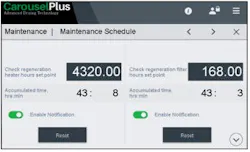
Moving away from reactive maintenance can simplify the process, said Gio Moya, a business development manager at Conair Group.
“Conair’s built‑in technological tools help automate and simplify maintenance," he said. "For example, the DC‑B Premium Control, which is available on Conair’s Carousel Plus desiccant dryers, includes an onboard Preventative Maintenance Scheduler that automatically tracks runtime hours and triggers maintenance alerts for key components like process filters, regeneration filters, after-cooler coils, heaters and the desiccant wheel, helping operators stay ahead of issues, even with limited staffing. These alerts are customizable, can be reset after service and provide clear step‑by‑step screen guidance through the touch-screen interface, reducing the expertise required on the floor.”
New technologies can help fill the skills gap, said Kyle Kluttz, VP of the customer service division and operations for Engel North America, which like other injection molding machine makers offers a slew of smart technologies to help machine users.
Answering the call
Machine makers across a wide range of processes — including blow molding, injection molding and extrusion — regularly announce new technologies that advance the maintenance evolution.
Graham Engineering, for example, recently released an update to help users of its Revolution MVP rotary wheel blow molding machine manage their machine maintenance. Available as a retrofit, the Preventive Maintenance package uses sensors installed in the wheel to provide data for a subscription maintenance service.
But adding sensors is just a first step.
Machine data and communications are critical to the transition.
“I think there are many business reports that companies are moving from workforce or manual logging to a digital automation kind of thing,” Gadesha told PMM.
Smart auxiliary equipment has been important to Conair’s customers, service manager Gerald “Jerry” Fleming said in an email.
“Manually logging data, even on a computer, can be a time-consuming process. Now, there is an alternative approach — automated system monitoring — that uses Industry 4.0 tools (i.e., Conair’s SmartServices), to track, record and analyze real-time equipment data and trends. Such tools also allow you to set digital thresholds on key equipment performance parameters or differentials/changes in temperature, vibration, throughput, pressure, flow rates and more. The system triggers automated notifications if the parameters stray beyond threshold values,” Fleming wrote.
“Solutions like this move processors toward predictive maintenance approaches by signaling early warning signs for maintenance actions,” he continued.
Conair isn't alone in seeing growing interconnectivity between machines.
“We're seeing customers which through OPC-UA communications, they're using plant monitoring systems to monitor the performance of the machines, where they can dial into specific aspects of the machine, whether it's cycle time, whether it's injection rate, whether it's scrap rates, things like that, that they monitor. ... There's a lot of that going on with the older equipment using modern-day monitoring systems with older control types,” Absolute Haitian's Wendling said.
Milacron is also facilitating the change.
The company's technologies, for example, connect Industrial Internet of Things (IIoT) systems, software and AI‑powered diagnostics. Using IIoT, the company’s M-Powered digital platform runs sophisticated algorithms to monitor machine operations and alert operators before potential issues arise. It gives users a clearer picture of overall equipment effectiveness (OEE) and helps them identify the root cause of downtime, quality issues and production inefficiencies, according to Mason.
One of the benefits of monitoring machines and accumulating all that data is the collective wisdom it can inform.
Factors like wear patterns provide real-time data in determining what’s best for each machine.
“Digital connectivity enables continuous monitoring and performance evaluation, shifting service from reactive intervention toward ongoing operational support. As machine complexity and workforce challenges grow, integrated lifecycle frameworks become an important differentiator,” Kluttz said.

That's the idea behind Engel’s E-connect platform, which provides a centralized overview of Engel equipment operations. With the platform, users have access to machine data, service history and spare parts management, Kluttz said
He said the company’s E-connect.monitor system provides a look at performance trends critical to the molding process, including the condition of oil and pumps.
He said remote maintenance tools and augmented reality-based assistance enable rapid issue resolution.
“Condition monitoring solutions such as E-connect.monitor transform experience-based assessments into structured, data-supported decision models,” Kluttz said. “Recurring wear patterns and service cases are captured and analyzed, allowing accumulated field knowledge to become accessible across sites and teams.”
Rather than waiting till something fails, or going 365 days since your last doctor’s visit, that kind of approach provides real-time insight as moment-by-moment wear accumulates and deviations steer further from optimal performance.
According to Gadesha, that facilitates a “continuous loop of data collection, analysis and decision-making.”
With all that going on, there’s no need to stop for downtime.
Room to grow
But taking a new approach to wellness isn’t a straightforward process, as many people figure out when New Year’s resolutions go stale.
Wendling, along with experts at other companies, said they still see the gamut — from running till a machine breaks, all the way to predicting and fixing what might go wrong before it ever does.
However, they say machine makers and users are headed in the right direction.
“Preventive maintenance remains essential,” Kluttz said. “Customers increasingly rely on machine and process data to anticipate wear, reduce unplanned downtime and plan resources more efficiently, but maintenance decisions are becoming more transparent and less dependent on fixed schedules alone.”
While processors continue to make the shift to predictive maintenance based on real-time monitoring, OEMs stand ready to support whatever maintenance approach they take.
“We support reactive, preventive and predictive maintenance strategies based on connected machines and structured diagnostics,” Kluttz said.
More on maintenance

About the Author
Karen Hanna
Senior Staff Reporter
Senior Staff Reporter Karen Hanna covers injection molding, molds and tooling, processors, workforce and other topics, and writes features including In Other Words and Problem Solved for Plastics Machinery & Manufacturing, Plastics Recycling and The Journal of Blow Molding. She has more than 15 years of experience in daily and magazine journalism.