On-site maintenance services gain traction as plastics processors tackle downtime, labor gaps
Key Highlights
- Plastics equipment OEMs expand on-site “house call” services, delivering faster repairs and preventive maintenance to minimize costly production downtime.
- Labor shortages and high turnover drive demand for external expertise, with OEMs acting as extensions of in-house maintenance teams.
- Service programs combine in-person support, remote diagnostics and AI tools to improve uptime and reduce unplanned downtime by 30–50 percent.
- Preventive maintenance plans increasingly include hands-on training, helping processors build internal capabilities while maintaining equipment performance.
- Subscription and data-driven services enable earlier detection of wear, supporting predictive maintenance and longer equipment life cycles.
By Karen Hanna
Demand is growing for a service that in a bygone era was offered by doctors, rather than manufacturers — house calls. With the escalating cost of downtime and the diminishing availability of experienced professionals, maintenance packages that usher experts directly to your shop are on trend.
Bay Plastics Machinery (BPM), for instance, is expanding its at-your-service operation, offering new routes for its strand pelletizer rotor sharpening and feed-roll recovery services in Georgia and Tennessee, in addition to Michigan, Ohio, Kentucky and Indiana, where it began its pickup-and-dropoff services. As part of the service, BPM personnel travel in vans to repair customers’ rotors and upper feed rolls and deliver spare parts and other essential components.
In January, the company also opened a new warehouse in the Atlanta suburbs to store components for customers.
“Our customers have really appreciated the speed and personal touch of our in-person pickup and delivery service since we launched it in 2025,” said Jim Forgash, VP of sales for BPM. “We’re always evaluating our service protocols to ensure we keep our customers up and running with the best components and our exceptionally experienced pelletizer repair team.”
BPM isn’t alone in this maintenance-concierge approach. And emergency repairs aren’t the only reason processors are turning to their machinery suppliers for help.
“We’re seeing a growing demand from customers for support that helps them better manage ongoing maintenance in an environment defined by high turnover and stretched internal resources,” said Gio Moya, a business development manager for Conair Group.
Like many OEMs, Conair offers customers service plans with a range of options, from machine health assessments to software updates, repairs, training and discounts on parts. With Conair by their side, users can “increase uptime, extend equipment life and prevent unplanned downtime by as much as 30-50 percent,” Moya said.
On the road
Manufacturing repairs veteran Bert Banaszak, the president of three Pirtek franchises, a hydraulic hose replacement businesses, in Illinois and Iowa, said the plastics industry has struggled to fill maintenance roles.
“The plastics industry isn't what it used to be, unfortunately. ... People are running on a much more shoestring budget,” he said.
Pirtek's traveling technicians visit manufacturing plants, repairing cylinders, valves and other components of hydraulic equipment. Banaszak said about half of his Pirtek business involves customers responding to a crisis, while the rest involves customers who are trying to maintain equipment before it fails.
While molders once made up about 40 percent of his business portfolio, they now make up only about one-tenth, Banaszak said.
He said he’s noticed that there’s not much interest among young people in maintenance, especially for hydraulic machinery. That means people who can do it are in demand.
“I personally know a few guys who have specialized over the years in being basically maintenance-for-hire guys, where they were just smart dudes who came from a plastics background, who everybody knows their phone number.”
As he spoke with Plastics Machinery & Manufacturing, he was at a gas station in a rural area, traveling for a job. The maintenance and miles pile up constantly; some jobs come at midnight or 3 a.m. — “long hours ... crazy hours” — to fix lines that just can’t be allowed to go down.
“The name of our game is to get people up and running as fast as possible, or to prevent future downtime by fixing things before they break,” Banaszak said.
Partners in training
OEMs feel processors’ urgency, too, and helping them cope with voids in their maintenance teams. In addition to offering artificial intelligence (AI)-powered tools that can walk novice technicians through the troubleshooting and repair process, OEMs are helping teach maintenance on the shop floor.
“We are seeing increased interest in structured support programs. Our Preferred Maintenance Program (PMP) allows us to partner with customers on preventive and routine maintenance. Through scheduled visits, we perform key maintenance tasks while also providing hands-on training to plant personnel. This approach helps customers maintain performance standards while strengthening their internal capabilities,” said Michael Duff, director of business development for aftermarket sales for auxiliary equipment maker ACS Group.
ACS Group’s varying levels of service allow the company and its customers to establish the partnership that makes the most sense, according to Duff.
“In some cases, we act as an extension of the plant’s maintenance team, performing specialized tasks that may not be prioritized internally. In other situations, we function more as a strategic adviser,” he said.
Often, technicians can resolve customers’ problems over the phone, said Randy Wendling, director of aftermarket operations for Absolute Haitian, which also provides on-site maintenance. Specialists can trade pictures back and forth electronically, or schedule a video meeting.
In an average week, Absolute Haitian has its experts in two or three customers’ plants.
In addition to providing customers with checklists of maintenance tasks and when they need to be done, Absolute Haitian technicians perform a lot of side-by-side education and maintenance with injection molding companies’ workers. Training is available both at Absolute Haitian’s five training facilities, as well as at customers’ molding shops.
For one customer last year, Wendling said, Absolute Haitian performed around 60 preventive maintenance (PM) checkups across three facilities. Afterward, Absolute Haitian provides certification for each machine, as well as recommendations for further service, as required. Along with that, technicians offer some hands-on insights.
“We'll tell the customer, ‘Hey, have a few of your guys shadow our guy, and we'll go through every step of the PM program with them,’ ” he said.
Expertise at the ready
Liberating processors from the turmoil and cost of unscheduled downtime is one of the goals of service packages.
The packages, covering a range of options, from PMs and warranty work to crisis repairs, can be structured to customers’ needs. OEMs offer both in-person help and remote assistance.
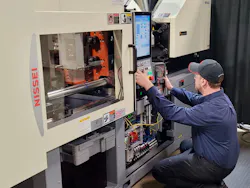
“Since the end of last year, we have been actively promoting preventative maintenance and inspections plans to our customers. We also offer yearly calibration and certifications, if needed,” said Joe Kendzulak, executive technical adviser-GM of Nissei America.
To help its customers, Engel has made a commitment to hiring and training technicians as it’s noticed “customers request Engel technicians to work alongside their maintenance teams for longer periods of time,” said Kyle Kluttz, VP of the customer service division and operations for the company’s North American subsidiary. With customers’ workforces stretched, a big focus of that work has involved automation and robotics.
Engel also staffs a 24/7 hotline for its customers.
“By combining physical service presence with intelligent digital tools, we help customers increase operational reliability and protect long-term asset value,” Kluttz said.
For users of Milacron machines, like users of Haitian's, maintenance resolution is just a phone call away. Through the company’s M-Powered digital platform, Milacron specialists can see data regarding pressure, temperature and cycle machine performance.
The company, which supplies injection molding machines, extruders and robots, offers on-demand field service, subscription maintenance and remote monitoring. Service plans are available to both Milacron customers and processors using machines from other suppliers.
“With a phone call, the Milacron team can troubleshoot the issue in real time by watching the machine cycle or looking at the on-demand diagnostics package to see where the machine is problematic,” said Scott Mason, director for technical field support for the company. “Whether it be a tweak of a setpoint, parts or scheduling a service visit, unexpected downtime can be reduced considerably.”
One company expanding its remote-assistance approach is Graham Engineering, which recently announced a maintenance-related retrofittable update to its Revolution MVP rotary wheel blow molding machine. The new Preventive Maintenance package uses sensors installed in the wheel to provide data for a subscription maintenance service. According to the company, subscribers benefit from earlier detection of performance changes and component wear.
Graham Engineering’s subscription services are compatible with its Navigator machine controls, which provide remote monitoring and diagnostics. Through the services, users can take a proactive approach to their maintenance needs, a company spokeswoman said.
Building relationships
While much of the plastics industry goes high-tech, some things remain the same.
Sometimes, machines break. Hoses leak. Production slams to a stop.
For Banaszak, that’s business. While Pirtek specializes in hydraulic machines, Banaszak said it’s not losing business to all-electrics — they have hoses, too.
What’s harder to find — for both OEMs and manufacturing plants — is the people who know what to do when something goes wrong.
“Nothing's changed in 60 years of hydraulic service. There may be new controls. ... It's a pump, a coupler and a motor, and it's very basic stuff, but nobody wants to deal with it,” Banaszak said.
“The one problem all of us have is finding people and keeping people.”
It’s a dilemma that’s creating business OEMs are clocking.
Traveling maintenance crews can be ambassadors, as well as a source of expertise, assistance and relief. For BPM, they’re filling a demand for a personal touch that A.G. Fath, VP of manufacturing for the company, said was amplified by the COVID-19 era.
An on-call service also addresses the pressure and urgency of downtime.
With a turnaround time for repairs of two to three weeks, BPM — like the other OEMs and Banaszak — is striving to get its customers back online faster.
“BPM feels it is important to not only provide the basic parts, but also listen to our customers so we can provide a more tailored approach that focuses on what the customer really needs,” Fath said. “Visiting in person on a routine basis allows for improved communication, and a more positive experience.”
More on maintenance
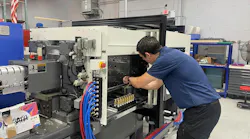
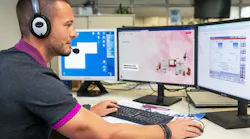
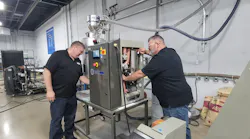
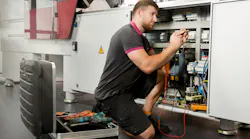
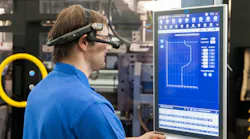 A Bekum technician uses Industry 4.0 tools to look over a machine. Increasingly, Christian Richard, corporate communications manager and sales administration manager for the OEM, said, “Maintenance in extrusion blow molding is no longer reactive — it is strategic.'
About the Author
Karen Hanna
Senior Staff Reporter
Senior Staff Reporter Karen Hanna covers injection molding, molds and tooling, processors, workforce and other topics, and writes features including In Other Words and Problem Solved for Plastics Machinery & Manufacturing, Plastics Recycling and The Journal of Blow Molding. She has more than 15 years of experience in daily and magazine journalism.