Plastics equipment owners must decide: Repair, replace or retrofit?
Key Highlights
- Plastics processors are increasingly choosing maintenance-plus-upgrades, extending asset life while capturing efficiency, safety and quality improvements.
- High capital costs, long lead times, weak demand and tariff uncertainty are delaying full machine replacement decisions.
- OEMs report a shift toward modernization/retrofit programs — controls, drives, connectivity and energy-efficiency upgrades — over outright replacement.
- While North American machinery shipments rose in Q4 2025, buyers remain cautious.
- Equipment decisions are increasingly ROI/OEE and total-cost-of-ownership driven; inspections and targeted upgrades guide staged lifecycle strategies.
By Karen Hanna
To repair or replace? Owners of appliances and cars know the struggle of deciding when to say when.
For users of plastics processing equipment, the stakes are especially high. The costs of buying new machinery can be steep, but so, too, are the costs of running equipment that doesn’t offer the latest bells and whistles.
“Some customers prioritize extending the life of an existing asset. Others are motivated by the opportunity to adopt the latest safety, efficiency and product quality enhancements,” said Michael Duff, director of business development for aftermarket sales for auxiliary equipment maker ACS Group.
But he and other OEM representatives said that increasingly, users are looking for a best-of-both-worlds solution — maintaining machines longer, while taking advantage of upgrades that allow the equipment to run with the efficiency of newer models.
“We noticed that more customers prefer modernization and retrofit over full replacement as in the past. Investment decisions increasingly weigh energy efficiency, productivity gains and digital integration,” said Christian Richard, corporate communications manager and sales administration manager for blow molding machine maker Bekum Maschinenfabriken GmbH, Berlin.
Cost deters new equipment purchases
High upfront costs, long lead times, a lack of work and the turmoil and expense of tariffs seem to be deterring processors from investing in machinery, according to representatives of OEMs.
Recent data offers reason for optimism for OEMs; however, company representatives said their customers seemed to be holding off.

There’s “a noticeable shift toward customers prioritizing maintenance and preservation of existing equipment rather than immediately investing in new machines,” said Gio Moya, a business development manager for Conair, who observed that tariffs seem to be weighing down investment.
“Uncertainty around tariffs sometimes caused them to do a ‘wait and see’ on some of those service-related purchases, so they sometimes didn’t purchase as much as they planned,” he said.
In the fourth quarter of 2025, the Committee on Equipment Statistics (CES) of the Plastics Industry Association (PLASTICS) reported North American primary plastics machinery shipments rose in the fourth quarter of 2025, up 7.8 percent from the third quarter and 7 percent year-over-year. Meanwhile, shipments of single-screw extruders and injection molding machines rose 15.5 percent and 8.7 percent, respectively, quarter over quarter, while twin-screw extruders fell 8.2 percent.
In the fall of 2025, nearly three-quarters of the processors that responded to a Plastics Machinery & Manufacturing annual survey said they planned to purchase primary processing equipment this year, and 65 percent planned to buy auxiliary equipment.
“Particularly in North America, investment decisions are strongly driven by return-on-investment and overall equipment effectiveness. If performance limitations, downtime risk or energy efficiency gaps affect productivity, customers move toward new machine investments more quickly,” said Kyle Kluttz, VP of the customer service division and operations for Engel North America.
While the new year raised economic hopes, Jason Long, VP of sales for Wittmann USA, said in late February his company, which provides a full spectrum of injection molding machines and auxiliary equipment, wasn’t seeing an uptick.
“Industry reports indicate that customers have significant unused capacity on their existing equipment. Over the past year, there has been a noticeable decline in the purchase for replacement of machines, making the maintenance of current equipment increasingly critical,” he said.
Rising costs have users relying longer on even “very old equipment,” Long said.
But while processors are hesitant to replace their old machines, he said they could be missing out on the benefits of new equipment that, in the long run, would provide a better ROI.
Built‑in connectivity, easier serviceability and lower overall operating costs often are the reasons customers decide to take the plunge and invest in new machinery, said Scott Mason, director for technical field support for Milacron.
Depending on their needs, users can be swayed by new technologies, such as improved extruder efficiency, enhanced automation or new clamping systems, Richard said.
Retrofits: What’s old is new again
Rebuilding existing equipment can represent a middle path. ACS Group, for example, performs a “significant number of rebuilds,” Duff said.
He emphasized a selling point other OEMs also touted — the long staying power of their machines, assuming they’re properly maintained.
“Rebuilding can be attractive because the core structure of the machine is still solid,” he said. “At the same time, ACS Group has continued to improve its equipment over the years, including advancements in safety systems, noise reduction, cutting efficiency and overall regrind quality. While some of these improvements can be incorporated into a rebuild, fully integrating the latest features can sometimes approach or exceed the cost of a new machine.”
When it comes to determining whether to maintain or replace, manufacturers have multiple factors to consider, Kluttz said.
Increasingly, he said, companies are evaluating assets based on the total cost of ownership, rather than just machine age. That makes full inspections of existing assets critical, even as companies make targeted upgrades.
“The key question today is not how long a machine will last, but how to maximize the economic performance of each asset,” Kluttz said.
Richard said in an email that Bekum customers are taking advantage of the company’s retrofitting capabilities.
“... Our retrofit programs allow customers to modernize existing machines (e.g., control upgrades, drive technology updates), extending service life and improving efficiency without full machine replacement.”
One company that sees the benefits of buying both new and used equipment is Absolute Haitian. Its sister company — Absolute Machinery, Worcester, Mass. — buys used equipment and, after refurbishing it to meet current standards, resells it.
The choice between used and new “comes down to investment costs,” said Randy Wendling, director of aftermarket operations for Absolute Haitian.
Like Kluttz, he raised the importance of the total cost of ownership and the useful life of the machine.
“So, if you're going to invest 100,000 [dollars] into it, you want to get at least another five to 10 years out of that machine. But as you invest maybe in a screw and barrel or a special option, the rest of the machine is aging, the technology in the machine is aging. I don't think there's any one answer that works for everybody.”
Kluttz said customers can extend their machines’ service life with retrofits and digital upgrades, bringing the controls, connectivity capabilities and energy efficiency up to standard.
“The decision between maintaining and replacing equipment has become more differentiated,” he said. “It is no longer a binary choice, but part of a staged lifecycle strategy: maintenance, retrofit, refurbishment and modernization or new investment.”
More on maintenance
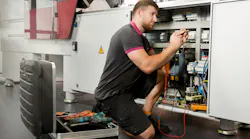
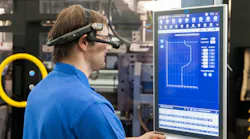 A Bekum technician uses Industry 4.0 tools to look over a machine. Increasingly, Christian Richard, corporate communications manager and sales administration manager for the OEM, said, “Maintenance in extrusion blow molding is no longer reactive — it is strategic.'
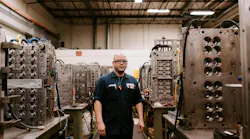
About the Author
Karen Hanna
Senior Staff Reporter
Senior Staff Reporter Karen Hanna covers injection molding, molds and tooling, processors, workforce and other topics, and writes features including In Other Words and Problem Solved for Plastics Machinery & Manufacturing, Plastics Recycling and The Journal of Blow Molding. She has more than 15 years of experience in daily and magazine journalism.