How will the Supreme Court's tariff ruling affect the plastics industry?
Key Highlights
- The Supreme Court struck down tariffs imposed without congressional approval, but President Trump announced new tariffs under different sections.
- Reactions are mixed, with some seeing potential relief, while others warn of continued uncertainty and supply chain challenges.
- Trade associations highlight the importance of stable, predictable trade policies to support manufacturing growth and supply chain resilience.
- Tariff impacts vary across industries, with some companies stockpiling inventory ahead of tariffs, while others report increased costs and delays.
- Experts suggest tariffs may have limited success in reshoring efforts and warn that ongoing trade policy volatility could hinder industry recovery.

More on tariffs
Will companies or consumers get refunds? It's complicated.
By Karen Hanna
Any predictions for stability and certainty following the U.S. Supreme Court's ruling striking down a raft of tariffs levied by President Donald Trump might have been premature.
Over the last few days, plastics industry insiders have expressed doubts the Feb. 20 decision will usher in stability that's been in short supply over the past year.
"It is difficult to plan for your business when costs are fluctuating so much month over month. It created uncertainty in the market," PCS Co. President Angela Elsey said. "There are certain products you just can’t purchase on U.S. soil. You are forced to find a foreign source. The process of moving product around the globe to accommodate the latest tariff news has taken a toll on procurement teams. At PCS, we constantly monitor the news and have worked hard to take costs of our business, so that we can absorb most of the tariff burden. Our goal has always been to be a good partner to our customers."

Tariffs eliminated and imposed
In his majority opinion nullifying tariffs levied without congressional approval under the International Emergency Economic Powers Act (IEEPA), Supreme Court Chief Justice John Roberts wrote, “The Framers did not vest any part of the taxing power in the Executive Branch.”
Within hours of the IEEPA tariffs' defeat at court, an outraged Trump announced Section 232 and 301 tariffs remain in place, and that he would impose additional tariffs under Section 122 — temporary duties that can be levied at a maximum rate of 15 percent for a maximum duration of 150 days.
“President Trump loves tariffs, and he will find a way to do what he needs to do,” said Laurie Harbour, a partner at Wipfli and longtime consultant to manufacturers. "I view this as a bit of a temporary hiccup that will be readjusted. There were a lot of people celebrating on Friday, and I just thought to myself, ‘I'm not sure I'd be celebrating right now, because all this does is create even more uncertainty.’ ”
As a Nissei official pointed out to Plastics Machinery & Manufacturing (PMM) a few days after the ruling, the Section 232 tariffs, on on steel and aluminum, have had the biggest influence on injection molding machine sales. With those duties still in effect, the spokesman had little expectation much would change.
While he signed an executive order on Feb. 20 imposing the 10 percent rate for the new Section 122 tariffs, as of Feb. 23, Trump had not signed off on the 15 percent rate for the new tariffs.
Industry reacts to tariff ruling
The news of the court’s ruling and the new tariffs drew mixed reactions, with some industry groups hailing the possibility of the end of tariffs that have underscored a year of volatility.
On the morning of Feb. 23, as Harbour spoke with PMM, the Dow Jones Industrial Average started the day with a slight climb before dropping more than 800 points. However, as of end of day Feb. 26, the stock market was almost a a level identical to Feb. 20.
The Nissei spokesman said his company has been busy advocating for American manufacturing, but tariffs aren't helping — "we continue to stress that tariffs are negatively impacting not only our operations but also American companies that support 'Made in USA' products," he said.
Harbour, who provides consulting services to both mold makers and plastics processing plants, noted it’s been a tough year overall for manufacturers.
“It’s more incredible uncertainty in a time when everybody is out trying to grow their business and gain their market shares back. And it's been slow across the board, and things are hopefully starting to turn a bit in ’26,” she said.
Jason Long, VP of sales for Wittmann USA, echoed Harbour in a statement released Feb. 24.
“Ongoing tariff discussions and shifting trade policies continue to create significant uncertainty within the industry. While the direct cost impact of tariffs can be calculated and managed, it remains meaningful and places real financial pressure on businesses. These added costs can slow investment decisions and delay growth initiatives as companies work to reassess budgets and capital plans,” he said.
However, in a statement released Feb. 23, LS Mtron President Paul Caprio seemed unfazed. Supporters of tariffs over the past year have lauded them as tools to blunt the cost advantages of foreign manufacturing in favor of domestic manufacturing, while opponents have decried higher costs on materials, components and equipment sourced from overseas.
LS Mtron — which has headquarters in Duluth, Ga., and sells injection molding machines made by its South Korean parent company, LG Corp. — is growing its footprint both in the U.S. and abroad.

Tariffs, Caprio said, “can create some delays in purchase orders if someone does not need to order a machine, but if someone needs to have a machine, they will order it. ... I see this year’s business being very stable and if anything increasing over 2025.”
He said the company is including the new 15 percent tariffs in quotes for customers.
Isolde Boettger, VP of Ontario, Canada-based LSR molder Silcotech, said in a statement that the company hoped the decision would normalize the trade relationship between the U.S. and Canada.
“We’re looking forward to a more stable business environment with our great American customers, suppliers and business associates,” she said.
A Feb. 20 statement from Kip Eideberg, senior VP of government and industry relations for the Association of Equipment Manufacturers (AEM), cheered the Supreme Court’s decision.
“Today’s Supreme Court ruling that the IEEPA tariffs are unlawful is welcome news for equipment manufacturers, which have spent the last year navigating higher input costs and mounting trade uncertainty.”
Meanwhile, MEMA, the Vehicle Suppliers Association, said on the day of the ruling it was awaiting more clarity. In a statement, it said, it “respects and welcomes the decision by the U.S. Supreme Court concerning the use of the International Emergency Economic Powers Act (IEEPA) to impose tariffs.”
Effect on plastics processors
Asked about tariffs in PMM’s annual survey, conducted last fall, and in an online poll last May, most processors that responded were sour on the policy. However, on Feb. 20, the Plastics Industry Association (PLASTICS) offered a measured response to the court ruling.
“Today’s Supreme Court decision underscores the importance of clear, durable trade policy that provides American manufacturers the certainty needed to invest, hire, and grow.
“While PLASTICS has raised concerns about tariffs imposed under the International Emergency Economic Powers Act (IEEPA), we support the Administration’s goals of bolstering U.S. manufacturing. A strong domestic manufacturing base depends on predictable trade policy that enhances competitiveness and strengthens supply-chain resilience,” PLASTICS said in its Feb. 20 statement.
In a Feb. 23 report titled “U.S. Economy Expanded in 2025 Amid Tariffs and Mixed Manufacturing Signals,” Perc Pineda, chief economist for PLASTICS, noted that growth over 2025 is estimated at 2.2 percent, but he said, “It is possible that weaker year-over-year growth this year reflects the impact of higher tariffs imposed by the United States. Trade data, however, suggest that the effect of tariffs on industrial equipment imports has been uneven. ...”
But only 7 percent of processors who responded to PMM’s survey said U.S. trade policy had a positive effect on business in 2025, while 44 percent said it had a negative effect. Twenty-two percent said they would likely spend less on equipment this year because of U.S. trade policy.
Machinery OEMs told PMM in late 2025 that tariffs had both positive and negative effects on their businesses, but their outlook for the year ahead was colored by uncertainty about what would happen next.
Companies including Wittmann and Absolute Haitian said they had stocked up on machinery inventory in the U.S. ahead of the implementation of tariffs, but that supply was mostly exhausted.
Pineda pointed to the Section 232 tariffs, levied on aluminum and steel, as playing a role in machinery sales.
“One might expect that 50 percent tariffs — specifically Section 232 tariffs on steel and aluminum, and on derivative products as defined by the Department of Commerce’s Bureau of Industry and Security — would reduce imports. Yet trade data show that industrial machinery imports actually rose 2.2 percent from 2024 to 2025.
“On aggregate, tariffs did not prevent imports from entering the U.S.,” he wrote.
Tariff volatility has also affected the mold making industry. While tariffs on molds and tooling from abroad were intended to help U.S.-based builders, for example, duties on raw materials cut into already-tight margins. And even with the additional cost of tariffs, molds made overseas are often still more cost-effective, Harbor told PMM late last year.
Elsey, of PCS, said there was optimism in the marketplace, but, "The real question is, 'How long will this stick?' I think we are all exhausted with the constant fluctuation. Stability is necessary."
Can tariffs help the industry?
One consistent proponent of tariffs has been Reshoring Initiative founder and President Harry Moser, who has been on a mission since 2010 to bring jobs back to the U.S. Though he champions devaluing the dollar to make American goods and labor more competitive, he has supported tariffs as a strategy to give the U.S. an edge.
How much that strategy has worked is a subject of some debate.
“It worked for the country back under Hamilton and Washington, and we're a big enough, strong enough market, that we definitely could have [gotten] away with ... having some little bit of price increase, like a one-time 1 percent price increase,” Moser said. “Unfortunately, [Trump is] fighting for survival on the affordability issue, and tariffs unquestionably do raise prices a little bit.”
He acknowledged that inflation, along with Trump’s mercurial approach to tariffs and his failure to work with Congress to implement them, had hurt the policy’s performance and public perceptions about it.
While the goal is to draw jobs to the U.S., Harbour said she hasn’t seen it happening.
“We are seeing some small pockets of parts moving here, but by no means has the spigot turned open and we're having this flood of reshoring. Plus, who's going to do the work?” she asked, as the industry continues to struggle to find skilled workers.
In the PLASTICS report released on Feb. 23, Pineda alluded to some of the challenges.
“While the goal is to strengthen U.S. domestic manufacturing, it would be unrealistic to expect rapid results — especially given the longstanding decline in domestic manufacturing over many years — and more so if higher tariffs are used as the primary tool,” he wrote.
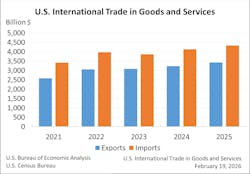
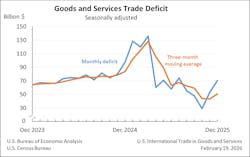
Over a year marked by tariff news, the gap between the value of goods imported into the U.S. and American products sold to other countries widened by 2.1 percent compared to 2024, hitting roughly $1.2 trillion, according to U.S. Census figures.
What’s ahead on the tariff front?
Whatever their reactions to tariffs, manufacturers had better get used to them. Harbour said she thinks they’re here to stay — at least for the foreseeable future.
With tariffs now a major economic reality across the supply chain, shops have to accept both the costs of the tariffs — as well as the costs of understanding them — as part of the price of doing business.
She said she believes the biggest burden is borne by smaller shops, which during prior presidential administrations had little reason to think about tariffs.
“The greater challenge lies in the unpredictability of changing regulations,” said Long, of Wittmann USA. “Frequent adjustments to policy, reporting requirements and enforcement timelines make long-term planning difficult, increase administrative burdens and disrupt normal operations. In many cases, this ongoing instability has a more profound and lasting effect on the industry than the tariff costs themselves, as companies attempt to plan for the future in an ever-changing environment.”
Fictiv, a global manufacturing and supply chain company, and Misumi Global, a leading global supplier of mechanical components and manufacturing services, noted in their “State of Manufacturing & Supply Chain Report,” a survey of over 300 senior supply chain and manufacturing leaders, that 77 percent of respondents said trade compliance requirements are too complex to manage without external expertise.
Small and mid-sized companies, especially, face challenges keeping up with changes, Harbour said, because they don't have the infrastructure and on-board expertise to stay current.
“All that uncertainty and trying to figure out is creating transactional waste, making me unproductive in my business. So, even if I'm a $30 million molder, I need somebody who is just spending their life understanding this and understanding what we're paying and doing the research and reading and so on and so on and so on,” Harbour said.
She advised that businesses continue to do their homework. While IEEPA is out, companies will have to prepare for what’s next — including the new Section 122 tariffs, set to go into effect Feb. 24.
Like other industry insiders, Wittmann's Long turned on one word repeatedly in his reaction to the latest news: Uncertainty.
It seems it's not going away
"In reality, the administrative burden of tracking and managing the data required to comply with tariffs adds significant operational costs. The constantly changing policies in 2025 made it challenging to stay ahead of requirements," he said. "While we were optimistic that 2026 would bring greater stability, this latest development has reintroduced uncertainty into the industry."
About the Author
Karen Hanna
Senior Staff Reporter
Senior Staff Reporter Karen Hanna covers injection molding, molds and tooling, processors, workforce and other topics, and writes features including In Other Words and Problem Solved for Plastics Machinery & Manufacturing, Plastics Recycling and The Journal of Blow Molding. She has more than 15 years of experience in daily and magazine journalism.