By Karen Hanna
The pressure of downtime, worker scarcity and a loss of institutional knowledge all can make planning maintenance — rather than simply reacting to crisis — seem impossible.
But experts say a better approach is within reach.
They offered some advice to begin turning around how you look at maintenance:
1. Identify problem areas in the plant
Jerry Fleming, service manager for Conair Group, said three common causes of problems are dusty internal air, low-quality water and moist air. Equipment exposed to those triggers might need extra attention.
For example, filters in dryers that process regrind might need to be swapped out every day, and vacuum pumps in dusty environments might require more-frequent maintenance. Plants with poor-quality water should focus on chillers and strainers, as well as the sensors on the equipment, which can become blocked by debris.
Moist air also can cause problems, including to damage valves on dust collectors, blender air cylinders and vacuum pump idle-mode valves.
“The most common cause of excess moisture is incorrect initial sizing of your compressed-air dryer, or the addition of new compressor capacity without added drying capacity,” Fleming said.
2. Look to your OEM
Many OEMs offer preventive maintenance (PM) checklists, spare parts lists and troubleshooting resources. They can also help train your workers, or guide you to smart features on your machines that can help offload some of the demands on your personnel.
“By engaging the OEM from the application specification stage through ongoing aftermarket support, customers can benefit from that broader experience base,” said Michael Duff, director of business development for aftermarket sales for auxiliary equipment maker ACS Group. “The OEM understands the design intent of the equipment, common wear patterns and best practices.”
Fleming said, “Many find that creating an annual PM schedule or service contract costs less, on an annual basis, than a single day of downtime.”
3. Do your part
Perform routine maintenance as recommended by the OEM.
“Consistent upkeep helps maximize reliability and lifespan,” said Jason Long, VP of sales for Wittmann USA.
He also advised giving special attention to aging equipment, over 15-20 years old. For such equipment, he said OEMs might offer retrofits or trade-in credits, if replacement or repair parts have become obsolete.
4. Establish a baseline
Observe and monitor: How is the equipment performing? Fleming recommended watching for fluctuations, such as higher conveying pump vacuum levels or rising pump temperatures, unsteady drying dewpoints, unusual chiller flow readings or reduced conveying throughputs.
“The key is observing and maintaining — pulling filters, cleaning sensors, identifying and repairing leaks, etc.,” he said.
Through a process of trial and error, establish a baseline for machines’ performance when equipment is running at full capacity. In a demanding environment, pursue maintenance on an aggressive schedule, and, Fleming said, “gradually transition towards a more relaxed one, finding a comfortable middle ground.”
“Vigilance is essential — observations, record keeping, data logging,” he said.
5. Use data to get ahead of problems
Fleming and Scott Mason, director for technical field support for Milacron, and other OEM representatives stressed the significance of data in getting a handle on how machinery is performing — and the factors that could indicate it’s starting to trend in a bad direction.
By adopting an automated monitoring system, companies can more effectively chart data regarding machine performance, setting them on a path toward shifting from reactive to predictive maintenance, Fleming said.
Ultimately, that should be the goal, Mason said.
He advised: “Prioritize a proactive maintenance strategy with regular machine assessments and data‑driven monitoring.”
More on maintenance

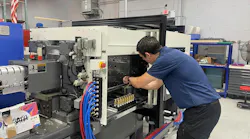
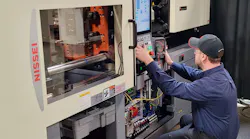
 A Bekum technician uses Industry 4.0 tools to look over a machine. Increasingly, Christian Richard, corporate communications manager and sales administration manager for the OEM, said, “Maintenance in extrusion blow molding is no longer reactive — it is strategic.'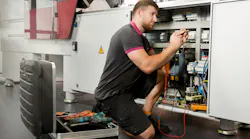
About the Author
Karen Hanna
Senior Staff Reporter
Senior Staff Reporter Karen Hanna covers injection molding, molds and tooling, processors, workforce and other topics, and writes features including In Other Words and Problem Solved for Plastics Machinery & Manufacturing, Plastics Recycling and The Journal of Blow Molding. She has more than 15 years of experience in daily and magazine journalism.