Arburg will demonstrate a range of technologies at Fakuma 2026
Key Highlights
- Arburg will showcase cost-conscious injection molding machines, automation and Gestica lite controls at Fakuma 2026.
- The Allrounder 475 V will demonstrate overmolding, recycled materials, in-mold decoration and automation.
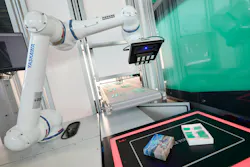
- A turnkey Allrounder More 2000 system will produce two-color dominoes using a specialized mold and automated packaging.
- Arburg will demonstrate in-mold Data Matrix marking for medical devices and precision micromolding of 0.002-gram microfilters.
Arburg plans to demonstrate a wide range of its injection molding technologies, from budget-friendly to bespoke, at Fakuma 2026.
Two models of the Allrounder Trend, the cost-effective injection molding machine (IMM) line that made its debut at K 2025, will be on display. The IMMs are designed for standard applications, short delivery times, automation integration, and easy operation and maintenance.
An Allrounder 1000 e Trend with a clamping force of 112 tons and a maximum injection speed of 500mm will produce automotive connector components on a 16-cavity mold from Rosenberger, with a cycle time of about 8 seconds. The parts, made of PA 12 filled with 30 percent glass fiber, will be removed by a Multilift Select 8 linear robot.
A fully automatic cell centered around an Allrounder 1800 e Trend with a clamping force of about 202 tons will pump out around 9,200 LSR closures per hour for needles and syringes. A Multilift Select 16 linear robot will set down the parts, separated by mold cavities, into a drawer system for quality assurance.
Both cells will feature the Gestica lite control system, which is designed for intuitive operation even for inexperienced employees. Fakuma attendees will also be able to try out the Gestica lite with simulators.
New features on the control system include simplified navigation and search, and the aXw Control FirstShotAssist, which enables quick production start-up using automatic calculations based on machine data.
Key fobs include in-mold labeling
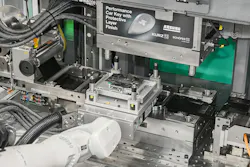
Another K introduction, the servo-hydraulic Allrounder 475 V vertical IMM, will display its overmolding specialty at Fakuma by making automotive key fobs. Other applications include electronics, cables and medical technology.
The machine, with a clamping force of 112 tons, is designed for space savings, flexibility and ease of use, and its servo-hydraulic system can reduce energy consumption by up to 60 percent. It also uses the Gestica lite control system.
The fobs will be molded from post-industrial recyclate based on PC/ABS. A high-quality surface is created using the new Protective Layer Finish (PLF) technology for in-mold decoration from partner Leonhard Kurz. A thin PET film that carries and protects the decoration is fed into the mold and applied to the plastic surface by in-mold lamination. The PET layer ensures high resistance to abrasion, impact and wear and tear.
The 475 V can be fitted with automation such as a six-axis robot or a linear Multilift. On the demonstration cell, a Kuka six-axis robot will remove the part from the mold and feed it to a laser station for coding, then transfer it to milling and cleaning stations.
R-Cycle data relating to recycling, such as the material composition, can be retrieved via a code on the component.
Turnkey system will produce domino sets
While Arburg’s recent introductions have focused on simplicity and cost-consciousness, its reputation was made in building precision, specialized machines, and those concepts will be on display at Fakuma as well.
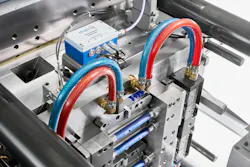
A sophisticated turnkey system for producing a set of two-colored dominoes will be centered around a 225-ton Allrounder More 2000, and a mold from Polarform and Hasco with interlaced hot runners made via additive manufacturing.
Unlike conventional two-component applications, the mold does not open and rotate to add the second component. Instead, the mold movement is generated using a two-stage core pull concept. The front side of the dominoes is created by injecting a light gray ABS via the vertical injection unit. With the mold closed, two hydraulic cylinders retract the cores and individual pins, creating space in the cavities for the second, green ABS component to be injected via the horizontal injection unit.
A Multilift V 30 robot removes the finished parts.
An upstream automation cell folds the boxes for the domino sets and feeds them into the process. A cobot, using a camera system in its gripper, detects the position of the box and lid, removes the dominoes from the conveyor belt, stacks them in the boxes and fits the lid.
Marking technology enhances traceability
Arburg is partnering with mold maker Kebo and marking technology manufacturer Matriq to demonstrate a marking process for medical devices for traceability.
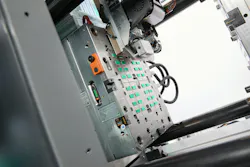
A cleanroom-equipped 225-ton electric Allrounder 570 A IMM with a four-cavity mold will produce auto-injector housings. A dynamic mold insert fitted with 144 heating elements, each measuring just 0.28mm by 0.28mm, will apply individual Data Matrix codes directly to the components during molding.
A central database system communicates with the Gestica machine controller and the Matriq system. The part ID and the production and measurement data from the IMM, as well as the individual Data Matrix codes, are linked in the database so the components can then be identified using a camera system. Machine data and process parameters — such as date, shot count, injection pressure and material cushion — can be retrieved at any time.
Matriq AG’s marking technology, DM-qode, does not rely on color contrast like laser marking does. A geometric structure is created during the molding process, making it suitable for a range of component colors and materials, including black or transparent parts and those with high filler content.
The process does not remove any material or thermally impact the surface of the part, and consumes around 20 times less energy than conventional laser systems and requires no additives or consumables such as RFID tags or in-mold labels.
Precision for the tiniest parts
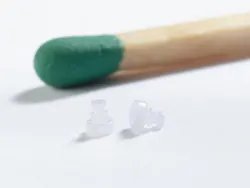
Micromolding, another demanding application, will be featured in a Fakuma production cell with an electric Allrounder 270 A making microfilters, each weighing 0.002 gram and featuring complex geometries.
The cell will be equipped with a four-cavity mold from Toolcraft, a hot runner system from Günther and a Multilift Select 4 linear robot, which will set the components on a conveyor belt, where they will be treated with ionized air and an ionizing bar to prevent static build-up.
The Euromap size 5 micro injection module delivers precision control of short travel strokes while maintaining high filling dynamics. It can process standard pellet sizes.
An 8mm injection screw is combined with a second 15mm or 18mm plasticizing screw for melting. This feeds the material forward continuously from the feed point to the tip of the injection screw. The injection screw features a non-return valve.
Fakuma 2026 runs Oct. 12-16 in Friedrichshafen, Germany.
About the Author
Lynne Sherwin
Managing Editor
Managing editor Lynne Sherwin handles day-to-day operations and coordinates production of Plastics Machinery & Manufacturing’s print magazine, website and social media presence, as well as Plastics Recycling and The Journal of Blow Molding. She also writes features, including the annual machinery buying survey. She has more than 30 years of experience in daily and magazine journalism.