Arburg touts smart factory, automation at Fakuma 2026
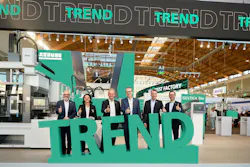
At its press conference Monday on the opening day of Fakuma 2026, Arburg reinforced its commitment to creating the “smartest factory,” touting its digital services and automation advancements for its injection molding machines (IMMs).
The company also gave an update on its financial state and outlook for 2027. “We remain realistic, yet we are also optimistic,” according to Tobias Baur, managing director, sales and after sales.
Baur said the year started off “subdued,” but orders picked up beginning in the second quarter.
“Despite a market environment that remains challenging overall, Arburg is on a moderate growth trajectory. ... We can already say today that our turnover in 2026 will exceed the previous year’s figure of 576 million euros,” he said.
But the environment remains challenging due to geopolitical tensions, economic uncertainty and a subdued industrial climate, he added, and the Americas and Asia are key drivers of growth as demand in Europe remains weak.
Baur sees positive momentum in electronics and medical end markets, continued uncertainty in automotive/mobility, and stability in packaging, which Arburg is poised to pursue more aggressively with its acquisition of Stork IMM.
CEO Volker Nilles said the company plans to expand the reach of Stork’s machines for thin-wall packaging beyond the European market.
In a Q&A session after the main presentation, Nilles said Arburg does not plan to build injection molding machines in the U.S. in the near future.
He said the strategic focus in the market is on automation, as the company sees demand and potential for growth among U.S. customers who are interested in automated IMMs and turnkey solutions.
Automation, digital advancements in the spotlight
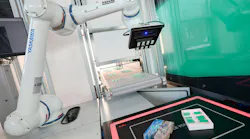
Arburg's emphasis on automation was highlighted by the introduction of standalone robots that can be used independently of IMMs. They utilize a new operating panel called rControl that is intuitive and easy to use, according to the company.
“This enables our customers to scale their automation flexibly, retrofit existing systems and achieve a sustainable increase in production productivity,” Baur said.
Several interlinked robots are on display in a cell at the show producing domino sets, demonstrating their potential for upstream and downstream automation tasks such as the preparation of feed parts, assembly and packaging.
Standalone variants are available for the Multilift Select linear robot systems with payloads of 8.8 to 35.3 pounds, as well as for partner Yaskawa SCARA and six-axis robots.
Digital and artificial intelligence (AI) solutions are also in the spotlight, including digital assistance functions and AI-supported analysis that automatically evaluates production metrics and identifies opportunities for optimization.
“The potential of modern plastics production has long since ceased to stem solely from high-performance machines. The key lies in making data usable and generating tangible added value for production from it,” Baur said.
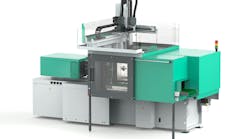
No new IMMs were introduced at Fakuma, as Arburg continues to promote the budget-friendly Trend line that launched at K 2025. Two Trend machines are on display at its stand.
“With this series, we are responding seriously to the growing global demand for cost-effective, readily available electric injection molding machines for standard applications. The machines combine a clearly defined scope of equipment with simple operation, attractive investment costs and high energy efficiency,” Baur said.
Further reading
About the Author
Lynne Sherwin
Managing Editor
Managing editor Lynne Sherwin handles day-to-day operations and coordinates production of Plastics Machinery & Manufacturing’s print magazine, website and social media presence, as well as Plastics Recycling and The Journal of Blow Molding. She also writes features, including the annual machinery buying survey. She has more than 30 years of experience in daily and magazine journalism.