10 new extrusion technologies reshaping plastics processing in 2026
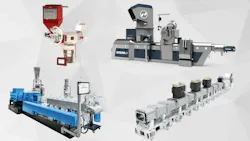
Extrusion equipment suppliers used K 2025 and the months since to roll out a wave of new technology, and the throughline is clear: bigger throughput, smarter controls and better ways to squeeze quality out of tougher feedstocks, including recycled and post-consumer material.
Here's a look at 10 recent extrusion innovations processors should have on their radar, with links to our full coverage of each.
BB Engineering debuts 360mm extruder
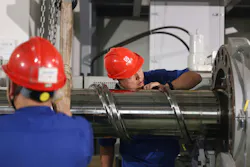
BB Engineering commissioned its largest-ever single-screw extruder — a pair of 360mm PET machines now running at a customer site in China, where they feed a Brückner flat film line producing high-performance PET film for optical applications.
The extruder, announced in February, tops 45 feet in length, weighs more than 46 tons and is driven by two 700-kilowatt motors, with maximum throughput topping 11,900 pounds per hour. The company says the larger screw diameter delivers better melt quality, energy efficiency and a longer service life with less maintenance.
KraussMaffei’s ZE-PC extruder serves petrochemicals market
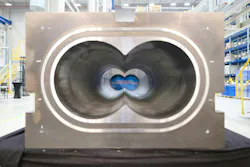
KraussMaffei used K 2025 to launch an entirely new product line, the co-rotating twin-screw ZE Petrochemical (ZE-PC) series, aimed at melt-to-pellet, powder-to-pellet and large-scale industrial recycling work. Screw diameters range from 260mm to 400mm, with throughputs from 27 to 143 tons per hour.
KraussMaffei Extrusion CEO Ralf Benack said the company's decades of experience with large single-screw extruders made this a natural entry point into raw polymer production; a Chinese petrochemical group has already ordered three ZE-PC 330 machines.
Alongside the new line, KraussMaffei redesigned its ZE BluePower compounding series — first introduced in 2013 — with improved energy efficiency and deeper digital integration through its Pioneer ProcessControl (ppC) system, which uses role-based dashboards to make production data easier to read across skill levels.
Read the full story: KraussMaffei debuts ZE-PC extruder for petrochemicals market
Battenfeld-Cincinnati extruders enhance efficiency and output
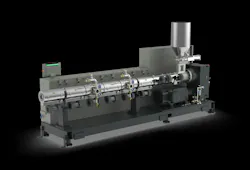
Battenfeld-Cincinnati showed off two new machines at K 2025: its first single-screw extruder with Dual Vent Technology (DVT), and the final addition to its solEX NG single-screw lineup.
Unlike conventional double-degassing setups, the DVT system — on display in the BC 120-40 DVT model — uses two independent degassing zones along the processing unit to pull more moisture and volatiles from the melt, which the company says can reduce or eliminate the need for pre-drying and allow processors to run untreated regrind without sacrificing quality.
Separately, the new solEX NG 105 fills a gap between the line's 90 and 120 models, offering throughput of 3,700 to 4,630 pounds per hour and a newly developed internal water-cooling supply that only needs to be filled once, reducing impurities and extending gearbox and motor life.
Battenfeld-Cincinnati says the solEX NG platform delivers roughly 25 percent higher output on HDPE and up to 40 percent higher output on PP compared with earlier designs.
Read the full story: Battenfeld-Cincinnati's latest extruders enhance efficiency and output
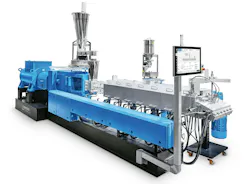
Coperion high-performance twin-screw extruders include smart features
Coperion added two new twin-screw models at K 2025 and previewed expanded digital tools. The ZSK 58 Mc18, with a 58mm screw diameter and throughput up to about 5,511 pounds per hour, targets engineered-plastics compounders with high torque (2,000 Nm per shaft) and a design aimed at fast ROI through low energy use and heavy automation.
The STS 35 Mc 11, built for masterbatch and regrind recycling applications, delivers up to 27 percent higher throughput than its predecessor along with optimized hoppers and a redesigned die head for quicker changeovers and cleaning.
Coperion also debuted its Lifecycle Manager, a predictive-maintenance feature within the C-Beyond digital platform that uses operating hours and performance data to forecast service needs and log maintenance history, plus a new condition-monitoring system on the ZSK 58 Mc18 that watches for vibration anomalies in the motor, gearbox and process section.
Read the full story: Coperion introduces high-performance twin-screw extruders with smart features
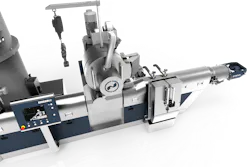
Erema degassing technique uses water to draw out impurities
Erema introduced Volex, which Managing Director Markus Huber-Lindinger says is the first effective application of water-stripping degassing on a single-screw extruder.
Built into the company's Intarema TVEplus machine, the process doses water precisely into the melt at the Plus-Zone, located just after the filter and ahead of degassing. As the water evaporates, it opens up the melt structure — multiplying exposed surface area roughly 1,000-fold and boosting surface renewal rate by up to 320 percent — which shortens the distance volatile organic compounds (VOCs) need to travel to escape. Erema says the result is up to 40 percent lower VOCs in finished recycled pellets, a 75 percent reduction versus the input material, and less fogging, without requiring extra melt lines or manifolds. The technology lets processors push higher percentages of recycled content into new products.
Erema also added two modules to its PredictOn predictive-maintenance suite: one using AI to assist data analysis, the other monitoring the plasticizing unit, both accessible through the company's BluPort control screen.
Read the full story: Erema degassing technique uses water to draw out impurities
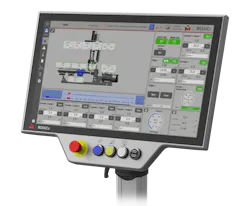
Milacron updates Mosaic extrusion control system
Milacron rolled out MosaicX, the newest version of its Mosaic control platform first introduced in 2007, at K 2025. The update brings faster processing for quicker data collection and reporting, a 21.5-inch HD screen, graphical monitoring across more than 50 parameters, and custom screens that let operators view several machine functions at once. It can run multiple extruders, downstream equipment and auxiliary systems simultaneously.
Security gets an upgrade too, with four access levels for up to 30 operators and optional RFID login, while improved self-diagnostics are meant to speed up fault-finding. MosaicX runs on Windows, supports English, Spanish and French, and can be retrofitted onto older Milacron extruders.
Read the full story: Milacron updates Mosaic extrusion control system
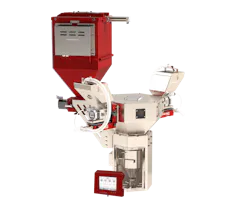
Movacolor blender makes quick adjustments
Movacolor's new MCS Continuous Loss-in-Weight Blender is built for extrusion applications sensitive to output swings, such as filament yarn production, where melt pump interruptions can throw off product quality.
A weighing hopper with a level sensor positioned beneath the dosing machines keeps constant track of hopper capacity and target material level, letting the system make rapid dosing corrections to hold a stable level — even at very low extruder capacities. Its high-temperature-ready design makes it suitable for PET processing.
Read the full story: Movacolor blender makes quick adjustments
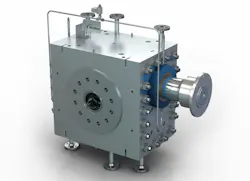
Nordson BKG's PolyNeo melt pump reduces shear
Nordson BKG's new PolyNeo melt pump handles throughputs from 15.4 to 22 tons per hour across all standard polymers, and the company says its advanced heating technology improves thermal control to cut material waste and defects while trimming energy use.
Ram Kumar Karnan, the company's global segment manager for polymerization, said the pump is engineered to reduce shear on the polymer for smoother flow and better material integrity. The design — available with water or air cooling and an optional gland packing system — allows lower melt temperatures through reduced shear and more efficient pressure buildup, and Nordson says heat dissipation improves by 10% over comparable models. Temperature capability runs up to 626 F.
Read the full story: Nordson BKG's PolyNeo melt pump reduces shear
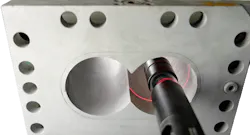
Citris scans for wear in extruder barrels
GL Control's new Citris system tackles a maintenance headache that's tough to quantify: barrel wear. An optical measuring head paired with a feed system scans the full internal geometry of an extruder barrel — circumference, roundness and diameter — generating a 3D image built from up to 50 million data points, exportable as a .csv or .stl file.
Companion software compares that scan against a reference state to flag wear or localized breakouts, with more than 3,600 measurement points captured per cut for high-accuracy, repeatable readings. The system can also be used on a dismantled barrel during scheduled maintenance. GL Control says the technology, now available to U.S. companies, gives plant teams a data-backed basis for repair decisions and replacement cycles, helping cut unplanned downtime.
Read the full story: Citris scans for wear in extruder barrels
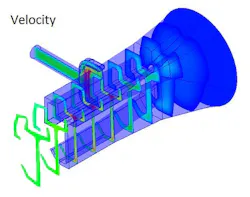
PolyXtrue simulates extrusion die performance
Plastic Flow's polyXtrue software, used by die makers to predict how a design will perform before it's built, picked up a round of upgrades. New features include batch processing so users can queue up multiple flow-simulation jobs, an improved algorithm for coextrusion simulation — including some flows that couldn't be modeled before — and interface improvements such as higher-resolution graphs, simplified material selection and the ability to specify up to five temperature zones on secondary die walls or die-plate faces.
The software estimates extrudate shape, layer structure, distortion, shrinkage and temperature, giving die designers a clearer read on multi-layer coextrusion performance before cutting steel.
Read the full story: PolyXtrue simulates extrusion die performance
The big picture: Taken together, these launches point to two parallel priorities among extrusion equipment builders — pushing the upper limits of throughput and scale (BB Engineering's 360mm screw, KraussMaffei's 400mm ZE-PC, Nordson BKG's 22-ton-per-hour melt pump) while also making it easier to process difficult, contaminated or recycled feedstocks cleanly (Erema's Volex, Battenfeld-Cincinnati's DVT, Coperion's masterbatch-focused STS). Add in the growing emphasis on digital monitoring and predictive maintenance — from Milacron's MosaicX to Coperion's Lifecycle Manager to GL Control's Citris — and it's clear processors will have more tools than ever to squeeze uptime and consistency out of their lines.
We'll keep tracking these technologies as they move from trade-show floors to production plants.