Mold-Masters' all-in-one Integra streamlines molding
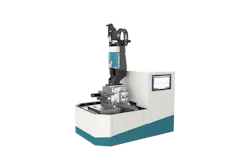
Visitors walking past a tiny machine churning out parts from a fully exposed, barely moving mold at a trade show had one common reaction:
“ ‘No way, there's no way that you're making parts with that,’ ” recalled Jordan Freise, a product marketing manager for Mold-Masters, one of the companies responsible for a new molding concept.
Welcome to the Integra. It’s not a traditional injection molding machine (IMM). It doesn’t have platens, cold runners or clamping force.
It’s one unit — ”a new production cell,” Freise said — that spits out parts faster than the conventional alternative.
Introduced last year at the K show, the plug-and-play, custom Integra is available from Mold-Masters, which supplies its E-Multi auxiliary injection unit, hot-runner and various process control systems, including a TempMaster TCU, and Primaform AG, Thun, Switzerland, which supplies the tooling. The partners worked about a year to develop the new platform, and can evaluate customers’ projects to ensure the Integra is a good fit.
Made for small parts, the compact Integra can handle all resins, and because it’s all-electric, it’s ideal for clean rooms.
The mold is integral to the machine, so each Integra so far is intended to handle only one application, with tooling custom-built for each user’s specific needs. Because of that, the machine is most appropriate for high-value, high-volume parts, such as those produced for the medical industry.
Modularity and bigger designs might come in the future, Freise said.
“It’s really set for someone who's making widgets non-stop,” said Freise, who cited needle shields as an example.
The setup uses an injection unit — configured either on top of the machine or off to the side — that spits resin into the mold, where individual valve gates squeeze off flow, producing high-quality parts with little scrap.
“The mold cavities simply lock closed, unlocks, open, unscrews and eject parts,” Freise said.
Cooling systems are below the mold, integrated into the machine.
The process, Freise said, “optimizes the production of small parts. So, normally, where you'd use cold runners or even side-gate hot-runner systems, you have the mold as usual, you'd put those into a conventional injection molding machine. Those have a lot of scrap associated with them, a lot of space, and obviously a lot of money, so this is really a new approach ... that really eliminates even the need for the conventional injection molding machines and semi-cold runner systems ... so not only are we eliminating that conventional traditional piece of equipment, we're also able, through this system and the technologies being used, to further optimize production quality and productivity.”
According to Freise, depending on the application, cycle times can be cut by 25 percent, and the Integra produces only one-quarter the amount of scrap as an IMM.
Compared with hydraulic units, the E-Multi injection unit uses only about one-third the energy.
“Pretty much,” Freise said, using the Integra represents “5x productivity.”
While presenting a video of the machine in action, Freise contrasted it with a traditional IMM.
“You've got to open up these huge molds, the actual movement, and then the clamping force, and then locking it down, that takes a lot of time,” he said, describing the clamping motion of an IMM. “Whereas this, really the only thing that moves is [a] little section here. It’s much quicker. You don't have to put it under pressure or anything.”
Freise said that because it lacks the complexity of an IMM, the Integra also is easy to operate and maintain. It has few moving parts, making the difference between the designs “night and day.”
“It's a very simple system, but it obviously works very well,” he said.
At the K show, where it debuted, Freise said, an Integra with a four-cavity mold produced syringe caps for the medical industry, to the amazement of passers-by.
Since then, he said, Mold-Masters has clocked a lot of interest from manufacturers looking into making parts with a variety of dimensions and applications.
“It’s funny because people would say, there’s no way that that works, and then we’re making parts right in front of their eyes,” Freise said.
“Sometimes you’ve just got to see it to believe it,” he said.
Contact:
Mold-Masters, Georgetown, Ont., 905-877-0185, www.moldmasters.com
Vital Statistics
|
Minimum size of an Integra cell |
About 41.1 square feet |
|
Maximum size of Integra-specific mold |
About 3.3 feet by 3.3 feet by 3.3 feet |
|
Number of cavities |
Four to 96 |
|
Part diameter range |
5mm to 22mm |
Related Content
About the Author
Karen Hanna
Senior Staff Reporter
Former Senior Staff Reporter Karen Hanna covered injection molding, molds and tooling, processors, workforce and other topics, and features including In Other Words and Problem Solved for Plastics Machinery & Manufacturing, Plastics Recycling and The Journal of Blow Molding.