How AI is redefining maintenance procedures for plastics processors
Key Highlights
- AI enables predictive maintenance by analyzing sensor data to identify issues early and reduce unplanned downtime.
- Generative AI automates diagnostics, creating detailed work orders and identifying root causes in minutes rather than days.
- Adoption remains limited, with only 20 percent of manufacturers prepared to deploy AI at scale despite strong interest.
- AI tools improve maintenance efficiency, cutting breakdowns, reducing costs and accelerating mean time to repair.
- Workforce shortages and data challenges drive demand for AI solutions that support less-experienced technicians and streamline operations.
By Karen Hanna
"The machines that power modern manufacturing are talking — and AI is finally listening."
So says Claude.AI, one of the artificial intelligence (AI) chatbots ushering in a new era of communications and machine-human interaction.
Maintenance represents one of the first places where shop floor managers can begin using — and benefiting from — AI, according to an IBM IT expert. And OEMs are touting the opportunities, with new capabilities that allow machine users to make better, more efficient choices around maintenance. With the technologies, users can build a maintenance program that doesn’t revolve around crises or calendars, but reflects their own needs and limits downtime.
One OEM representative impressed by the potential is Randy Wendling, director of aftermarket operations for Absolute Haitian, where he’s worked about 15 years. He said, “Probably one of the bigger things that we're going to see in our lifetime is AI troubleshooting, maintenance programs, things like that.”
Vrunda Gadesha, an AI advocate and technical content author at IBM, warned companies that wait too long to begin experimenting with the technologies will be left behind in just a few years. For those just getting started, one goal is the establishment of what she calls “self-healing infrastructure.”
“Let's say I have four machines in the pipeline. Four machines are working together. One of them is not working now, so I have to repair it. Now, here’s two losses: one loss that I'm paying a repairing cost directly; that is the first upfront loss. And apart from that, I'm having downtime in my plant. So, instead of that, if I have a system which can priority-identify that within a week, this machine is behaving not properly and it needs a repair, I can plan my repair, and I will face less downtime,” she said. “That is what I mean when we talk about self-healing infrastructure.”
AI generates advantages for processors
In an earlier time, or at a plant that’s not using AI, a manager could expect to receive a report along these lines from a fellow human: “The conveyor motor on Line 3 is making a grinding noise and running hot."
But that observation only kicks off what might be a laborious process toward remediation, from diagnosing what’s causing the problem to identifying what’s needed to fix it.
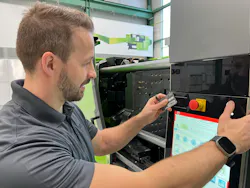
AI can help manufacturers transition from reactive maintenance — waiting until equipment fails to fix it — to recognizing that something’s wrong before it breaks.
With generative AI (GenAI) — which bases brand-new content, including text and images, on patterns established from existing data — manufacturers can get the full picture right away. In a case study, Oxmaint AI, which provides industry-specific AI maintenance solutions, illustrates how maintenance is evolving. It provides the example of the Line 3 problem, but with AI, the report goes so much further than the observation of noise and heat: “GenAI converts that into a structured work order — asset identified, fault category tagged, priority set, relevant historical failures surfaced, spare parts flagged — in under 10 seconds.”
Sensors on components can pick up key performance indicators that signal problems ahead, Gadesha said. Vibration analysis, for example, can identify misalignments or imbalances in rotating parts; thermal imaging can detect overheating in electrical circuits or friction in bearings; acoustic sensors can detect sounds that indicate early-stage malfunctions; and sensors can monitor fluid levels or gas leaks.
AI also can provide prompts to operators to help them troubleshoot problems or interact with the manufacturer of their equipment.
In one case, Oxmaint AI says, “After a failure event, GenAI processes thousands of log entries, sensor readings and work order notes to identify the root cause — in minutes rather than days. One manufacturer used this approach to discover that a recurring hydraulic failure traced back to contaminated oil sourced from a single supplier lot, a connection that required analysis of 18 months of data. GenAI surfaced it in a single query.”
In another case, GenAI spotted early-stage wear patterns on a pump, and based on the failure of a bearing the previous year, recommended inspection within 72 hours, warning, “estimated cost $3,200 if unaddressed."
With real-time data, along with the systems to assess it, companies can make more informed maintenance decisions, said Michael Duff, director of business development and aftermarket sales for auxiliary equipment maker ACS Group.
Predictability, faster repairs, fewer breakdowns, lower costs, support for an overstretched or less-experienced workforce and higher quality are among the biggest benefits of AI, according to experts on the technology, along with machine manufacturers.
“As AI technologies continue to evolve, we see meaningful opportunity to enhance our value-added service offerings, from more intuitive troubleshooting guidance to faster access to parts availability and service resources,” Duff said. “Our goal is practical application of these tools to simplify maintenance and improve responsiveness, not technology for its own sake.”
The Oxmaint AI post provides statistics that bear out the benefits: a 70 percent reduction in machine breakdowns, according to professional services firm Deloitte; a 25 percent reduction in maintenance costs; and an ROI of three to six months for AI maintenance deployments. It also claims plants that use AI to diagnose machine faults report a 40–50 percent faster mean time to repair.
Saying that molders are increasingly integrating Industrial Internet of Things (IIoT) systems, software and AI-powered diagnostics, Scott Mason, director for technical field support for Milacron. affirmed that the approach “speeds response times, improves insight quality and enhances ROI.”
“For injection molding operations especially, IoT‑driven predictive maintenance can significantly reduce production interruptions,” Mason said.
Deciding to get smart on maintenance
But according to the Oxmaint AI post, not many manufacturers are cashing in on AI — yet. Citing Deloitte research, it says 92 percent of manufacturers believe smart manufacturing will be the primary driver of competitiveness over the next three years, but only 20 percent say they are fully prepared to deploy AI at scale.
Gadesha said maintenance isn’t the only aspect of operations that could benefit from AI, but it is an ideal place to start. She urged businesses to consider storming that beachhead before their competitors do.
“I think maintenance is the good place to start for the plants to infuse AI because they know their own digital baseline. They understand it because they are doing it,” she said.
In her blog post, she described “ ‘X-ray vision’ that only artificial intelligence can provide, detecting hidden internal wear that is invisible to the human eye.”
As their maintenance approaches evolve, shops can move from recognizing when components are starting to fail, based on how variables like temperatures and pressures are trending, to actually predicting when failure will occur. The first step is condition-based monitoring (CBM), according to Oxmaint AI; the latter, predictive maintenance, which provides a window of a few weeks to optimize scheduling for a repair.
“In practice,” a second Oxmaint AI post says, “most manufacturing operations benefit from CBM as the initial implementation — it is simpler to configure and delivers 70–80 percent of the ROI of full predictive modeling.”
Setting off on a journey beyond reactive maintenance requires what Gadesha calls a “left shift.” Generalized from the IT field, the phrase means supporting an improvement mindset by incorporating critical development practices in earlier stages.
AI is key to steering through that turn.
“If they want us to start with the AI, I think they should have this ... left-shift mindset, where maintenance should not be considered as a repairing task. It should be considered as a healthy tracker, where I can track which machine is behaving in a proper way, or which machine is behaving a little awkwardly,” she said in an interview with Plastics Machinery & Manufacturing.
Gadesha said manufacturers’ embrace of AI could be hampered by the steep cost of full edge computing capabilities and a lack of skilled workers to manage the sophisticated systems. But that shouldn’t stop them from trying out what’s available.
According to Oxmaint AI, manufacturers can reduce their maintenance spending by 20-25 percent in one year just by fully using the data that existing sensors already deliver.
That’s without buying a single additional sensor.
To see what AI can do for them, Gadesha suggested manufacturers look at just a small aspect of their operations first.
“If one function of the production, I know that it is working completely fine, I can do the experiment with that one particular vertical, rather than thinking [about] the entire horizontal span. ... They can have a small ... investment, try it, test it out, [see] how effective it is. ... So, instead of thinking of the entire horizontal of your business, if you pick up one particular small vertical, I think they can adopt it more easily,” she said.
Over time, as they see results, manufacturers can begin taking on more, said Gadesha, who identified one main future hurdle to climb: bad data.
“Data is very important when you want to make this transition. Most of the plants have their data, but they store the data in silos, because from the past 30 years, 40 years, they don't know how this data [could] be adapted by the AI,” she said. “So, now they do have the data, but this data is not helpful to the AI systems in which we can feed this data. So, the core problem is data quality.”
Adding to the toolbox
OEM representatives say their companies are increasingly offering solutions that use AI. And customers are asking for it.
Manufacturers aim to leverage the technology in a way that makes it seamless and practical to use, said Duff, of ACS, and Christian Richard, corporate communications manager and sales administration manager for blow molding machine maker Bekum Maschinenfabriken GmbH, Berlin.

“Our goal is practical application of these tools to simplify maintenance and improve responsiveness, not technology for its own sake,” Duff said.
ACS is planning for the future with its MiVue, a cloud-based data storage and analytics platform that connects directly to processing equipment, and captures, stores and analyzes key machine performance data. Eventually, it will act as the data gateway to feed AI engines and use machine learning for predictive alerts.
The software helps with diagnosis and troubleshooting, along with providing access to remote help from ACS professionals.
AI can help shops navigate the skills gap, while providing information that brings novice workers up to speed.
“The labor shortage is one of the most pressing challenges in manufacturing, and technology plays a critical role in closing that gap,” said Mason, of Milacron, which offers real-time data regarding pressure, temperature and cycle machine performance through its M-Powered digital platform. Features include AI‑assisted diagnostics, predictive maintenance algorithms and automated alerts.
“These innovations not only reduce the need for deep troubleshooting expertise but also help newer team members ramp up faster,” Mason said.
Kyle Kluttz, VP of the customer service division and operations for Engel North America, said tools like the Engel Virtual Assistant (EVA) bridge skill gaps.
The injection molding machine maker’s portfolio of AI tools includes: iQ weight control, which optimizes the injection volume during the ongoing injection molding process; iQ process observer, which continuously monitors all five phases of the injection molding process: plasticizing, injection, cooling, demolding and production; and iQ melt control, which determines the optimal plasticizing time for each application.
Solutions such as iQ process observer analyze production data in real time to detect deviations and provide proactive recommendations.
Other digital assistants include the Ask Arburg app, which presents easily accessible, comprehensive injection molding knowledge; and Aim4Help, a customer-service support portal under development by Wittmann that draws on information from manuals, service reports and technical documentation to provide troubleshooting help, according to Jason Long, VP of sales of Wittmann USA.
One of the biggest benefits of AI is its potential for supplementing the skills and institutional knowledge of the existing workforce, said Wendling, of Absolute Haitian, which like other OEMs offers AI-assisted troubleshooting with its machines.
“Rather than replacing technicians, AI acts as a force multiplier, helping smaller teams work more efficiently and effectively. So I think we're just on the cutting edge. I think AI is going to continue to progress,” he said.
The company’s HT-Xtend functions compensate for product weight variations, monitor and manage energy use, optimize charging and cut velocity as needed, adjust oil based on cycle times and pressure, compensate in real time for injection process faults, and support multi-stage pressure molding. Wendling said many of the features are automatically engaged.
Other Haitian tools include HT Lubricate, which takes into account factors such as a lubrication control, cycle times, mold opening stroke and mold clamping pressure to optimize lubrication intervals, and HT Diagnose, which provides alerts when it detects problems with machine components.
“We're measuring algorithms to generate a precise lubrication model based on original operation habits. We're using HT Diagnose for troubleshooting, which is making it faster and easier,” Wendling said.
What does the future of maintenance look like?
From simply alerting operators when a machine component is acting abnormally, to predicting when a component might actually fail, AI and its capabilities are trending up.
Oxmaint AI provides one example of what the future holds: AI features, known as agentic AI, that work autonomously based on existing data to spot problems. Agentic AI will be able to request parts, schedule repairs and generate work orders — all by itself.
If that’s not a compelling case for using AI for maintenance, Claude.AI provides another: “AI-powered predictive maintenance helps manufacturing shops reduce costly unplanned downtime by detecting equipment failures before they happen, saving thousands in emergency repairs and lost production time.”
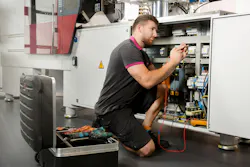
With AI, manufacturers can flip their maintenance mindset, from a reactive to predictive approach, according to Gadesha and others.
“Many tech teams still struggle to execute preventive tasks consistently," Milacron’s Mason said. "But AI‑enabled scheduling and automation are helping close that gap."
He and other OEM representatives expect AI’s role to grow, giving users an edge and making maintenance a more-seamless function of operations, rather than a disruption.
In the coming years, AI will “become a powerful tool,” Wittmann’s Long predicted.
If your plant isn’t there yet, there’s time — but Gadesha urged companies to use that runway to get up to speed.
She compared the current uptake of AI to the early days of cell phones, when many brands were bringing out new models. That was the time to make a big impression in that arena, but companies now aren’t jostling to gain attention with new platforms — it's already a mature industry, with known players.
Just as it did for cell phones, the window to experiment and master a new technology eventually closes.
For AI, Gadesha gives it another few years. By then, companies will have separated into two camps: those that are finding a way to fully exploit the possibilities, and those that fell by the wayside.
That makes now the ideal time to shift left.
“After five years, these kind of technology infusions [will] not be luxury anymore. ... I think after five years, it is more like a competitive market, because your competitors are doing better because they have already adopted these technologies. ... To grow your business faster and get a better ROI, get better, accurate results, I think these things need to be there,” she said.
More on maintenance
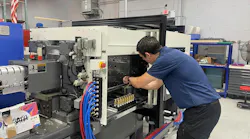

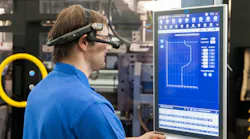 A Bekum technician uses Industry 4.0 tools to look over a machine. Increasingly, Christian Richard, corporate communications manager and sales administration manager for the OEM, said, “Maintenance in extrusion blow molding is no longer reactive — it is strategic.'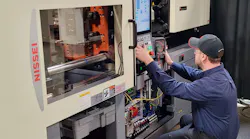
About the Author
Karen Hanna
Senior Staff Reporter
Senior Staff Reporter Karen Hanna covers injection molding, molds and tooling, processors, workforce and other topics, and writes features including In Other Words and Problem Solved for Plastics Machinery & Manufacturing, Plastics Recycling and The Journal of Blow Molding. She has more than 15 years of experience in daily and magazine journalism.