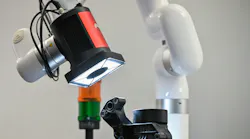
Krevera's AI vision system enables autonomous injection molding quality control
Key Highlights
- Krevera’s AI vision system inspects every injection-molded shot, identifies defects and autonomously adjusts processing parameters to improve part quality.
-
The technology evaluates subsequent shots to verify corrective actions and detects defects including flash, short shots, sink marks, burns, splay and weld lines.
-
Krevera says its modular vision hardware installs in about 30 minutes and adapts to top-entry and side-entry automation cells.
-
The company has deployed about 86 systems, reports saving clients 1.27 million pounds of plastic and targets broader adoption across manufacturing.
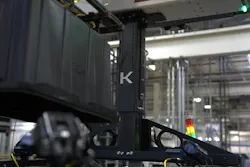
Krevera’s AI vision system is capable of autonomously controlling injection molding machines, according to company officials.
Sebastian Schneeweiss and his brother, Edward, founded Krevera in Massachusetts on Oct. 23, 2023, and designed vision technology specifically for injection molding, emphasizing autonomous quality control and molding.
Krevera officials identified several major problems facing injection molders that its technology could address: reducing scrap, maintaining quality control amid a skilled labor shortage, increasing machine uptime, and creating a fully autonomous work cell. Krevera owner Nickolas Reinhart said he has a goal of reindustrializing America through autonomous factories. Reinhart acquired the company on May 31, and Sebastian and Edward Schneeweiss retained equity and remained with the company.
The United States is facing a shortage of new skilled labor in the manufacturing industry. Krevera, by allowing autonomous molding with its vision systems and AI technology, provides manufacturers using injection molding machines (IMMs) with a solution, Sebastian Schneeweiss said during an interview.
The company is small, employing about 18 people, Schneeweiss said. He added that the Krevera system so far has saved its clients 1.27 million pounds of plastic. It has deployed about 86 systems.
The goal is to deploy over 100,000 systems in the next 120 months, Reinhart said in a written comment to PMM supplied by his public relations team.
Krevera so far has been deploying systems within Reinhart’s companies but is under contract to supply systems to three other large injection molders in 2027 and 2028, according to a statement supplied to PMM.
Vision in action
New plant will employ Krevera technology. Read more.
The system inspects parts as a takeout robot removes them, classifies them as good, bad or needing work, and can autonomously adjust injection molding parameters before the next shot, Schneeweiss said. It can determine whether its corrective action worked by inspecting the subsequent molded part.
“It's a self-validating AI, which I think is beautiful because you have this outcome like a short shot, for example, and it adjusts the parameter, and if it's successful, it will know it's successful because the next shot that comes out is validated by the vision system,” Schneeweiss said.
The system uses proprietary technology to achieve accuracy in identifying part defects, he said.
System observes and adapts
The Krevera AI system self-learns from observing a client’s process and constantly adapting as the environment, mold, process and machine operation change, according to the company’s website. It offers real-time inspection of parts, inspecting every shot in real time and identifying flash, short shots, sink marks, burns, splay and weld line defects before parts leave the press.
The system feeds quality data back into the process, so molders catch drift early instead of sorting bad parts after the fact. The system requires “zero recalibration,” according to the company website.
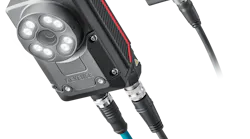
In addition to supplying patented AI technology for recognizing defective parts and determining what molding parameters to adjust to eliminate them, Krevera supplies modular hardware that can be installed in about 30 minutes and adapted to top-entry and side-entry automation cells.
“We have pre-built vision systems and rigs that are able to be adjusted to fit most manufacturing cells,” Schneeweiss said. “It's a really simple plug-and-play, like a 30-minute install time, rather than the client getting a bunch of aluminum extrusion and custom fitting everything. The Krevera system just comes in; you slide it around and then bolt it in place. It's really cool.”
Schneeweiss said Krevera’s technology is extremely accurate at identifying defects in injection molded parts. He published what he called an open letter on his website outlining why he believes Krevera’s technology is superior to vision systems that rely on comparing photos of a good part to live images of parts being manufactured on a customer’s IMM.
If enough pixels are different, those systems conclude a part is defective, but he said the problem is that changing conditions, such as lighting, a product color change or dust on a camera lens can affect accuracy. Other AI vision systems that are trained to recognize bad parts can be better, but since the appearance of defects can vary from part to part, those systems have their own limitations. Most vision inspection systems struggle to achieve a high accuracy level when working in high-production environments, Schneeweiss said.
He believes Krevera’s system, due to its advanced AI technology and vision system hardware, overcomes those shortcomings.
Krevera’s system consists of “an array of cameras, based on the product, to capture as much surface area as needed for proper inspection,” according to a statement supplied by a public relations representative for Reinhart. “This connects to our compute unit and does edge inference. Data is stored in secure Krevera cloud.”
The system also includes multiple connection ports to all auxiliary and other equipment. The entry costs vary depending on the application.
The system is brand-agnostic, Reinhart said.
Krevera is currently focused on injection molding, the largest potential market for the technology, but maintains waitlists from those interested in adapting the technology for extrusion, blow molding and rotational molding applications.
Reinhart said he has established relationships with several OEMs.
“We've got a really strong partnership with Engel,” Reinhart said. “Engel's been a very good partner in terms of the injection molding machine. We've also got a good partnership with Wittmann. Wittmann's been a great partner for of mine for many years. I bought a lot of Wittmann robots. The AI in the vision is Krevera, and then we have a Fanuc cobot that packages the parts.”
Wittmann, Krevera and Kreate – a design, engineering, and plastic injection-molding company – are developing a demonstration that they plan to show at NPE2027 in Orlando.
The two founders of Krevera, Sebastian and Edward Schneeweiss, have complementary technical backgrounds. Sebastian Schneeweiss said his background is in data science and health care.
“I taught myself to program,” he said. “I created a neural network, which is a form of AI, that predicted FDA decision-making when I was a data analyst in the health care space. I then moved that into Krevera as a data analyst.”
Edward Schneeweiss, the company's CTO, has bachelor's degrees in mathematics and programming and a master's degree in computer science. Before co-founding Krevera, he worked in computer vision for food processing.
‘The brains of the molding work cell’
Reinhart, in addition to owning Krevera, is the founder of Kreate, a product development company headquartered in Findlay, Ohio. The company helps design and manufacture private label products, including HDX storage containers sold at retailer Home Depot.
Reinhart is also the founder of Sequent, which he describes as a technology-focused platform that's focused specifically on the plastics industry. Its goal is to connect manufacturing, regional distribution and innovation through physical AI, automation and integrated systems, according to the Sequent website.
Reinhart grew up in a family-owned injection molding business and today owns 14 manufacturing sites and eight distribution sites. The manufacturing sites employ the Krevera AI vision system on their injection molding machine cells and use the Sequent platform, he said. His manufacturing operations have adopted a strategy of combining automation of injection molding, robotics, inspection, packaging and material handling into integrated production systems.
“It’s kind of everything working together through Krevera,” Reinhart said. “We built some internal AI tools that create one source of truth or one data lake that pulls it all together. But Krevera is what I would call the brains of the molding work cell.”
The AI tools allow for completely autonomous cells, he said.
“When you talk about technology, the most important thing is getting all the different pieces of the technology to work together, and that was probably the hardest thing for us to solve was taking every piece of technology that we have today, making it all work together, and creating that fully autonomous work cell, and that's what we've done,” Reinhart said.
Contact:
Kreate, Findlay, Ohio, https://kreate.com/
Krevera, Boston, https://krevera.com/
About the Author
Bruce Geiselman
Lead Reporter
Senior Reporter Bruce Geiselman covers plastics processing technologies and end markets including automotive and packaging. He also writes features, including In Other Words and Problem Solved, for Plastics Machinery & Manufacturing and The Journal of Blow Molding. He has decades of experience in daily and magazine journalism, including eight years at PMM, and is the recipient of a Jesse H. Neal Award, among other recognitions.