Keyence vision systems handle inspection, traceability
Key Highlights
-
Keyence vision systems support plastics quality control from mold protection to final inspection, identifying defects and preventing tooling damage.
-
AI-enhanced cameras recognize varied defects, accelerate setup and enable inspection programs to be replicated across production lines.
-
Keyence systems provide defect images and inspection data but leave corrective decisions and injection molding parameter adjustments to processors.
-
Vision systems support parts traceability by storing inspection images and lot numbers, while accommodating inspections throughout production and within robotic cells.
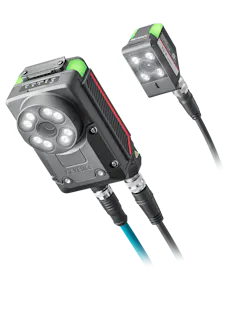
Keyence offers cameras and laser systems with integrated software for inspecting plastic parts — ranging from small injection-molded components to large items such as outdoor patio furniture — and monitoring key stages of plastics manufacturing.
Its vision systems are also commonly used to inspect blow-molded bottles and preforms, according to Audrey Mannion and Jackson Herrmann, strategic marketing analysts in the Keyence vision systems sector.
Inspections can begin with mold protection and continue through final quality control. Injection molders often use Keyence vision systems to verify that a mold is empty before it closes after each cycle. Material left undetected in a mold can damage expensive tooling and halt production.
Inspections of finished parts can identify defects and defect types. Keyence’s technology ranges from simple presence/absence checks to detailed dimensional inspections.
Systems for plastics processors
Keyence vision systems commonly employed by plastics processors include:
- The IV4 Series vision sensors, designed for relatively simple go/no-go (or pass/fail) applications such as whether a cavity is full or empty and whether a bottle cap is properly situated.
- The VS Series vision system provides more sophisticated 2D analysis, including identifying flash, short shots, contamination and discoloration.
- The LJ Series 3D laser profiler is used for dimensional measurements and identifying 3D defects such as warpage, incorrect hole position and flash height.
Keyence incorporates both rules-based inspection and advanced artificial intelligence (AI) features into its cameras and vision systems. While the inspection software runs on the cameras, a user’s PC helps train the software before transferring the program onto the inspection device. The systems can learn from examples of good parts, examples of defects, or from a combination of both.
The addition of AI features allows for faster setup and deployment.
“Typically, where maybe we were doing an application that needed to find both flash and short shot, it might take a little bit longer to set up in a rules-based scenario, and might need multiple tools to be able to achieve that, where with AI being able to train it with examples of each one, we're able to deploy a camera system a lot faster and able to find a lot more variety of defects in just one tool,” Mannion said.
AI can duplicate an inspection process across multiple production lines even when mold layouts differ.
“Maybe we go on site, and the customer’s just looking for mold protection,” Mannion said. “We're able to solve that with the IV4. With the IV4, we're able to duplicate that program across lines, regardless if maybe the layout of the mold is different. The AI is going to ignore the background and just find an example of where a cavity is full. Rather than having to redeploy the camera five, six times for however many lines there are, the AI is able to pretty much copy and paste itself and make that deployment a lot faster and easier to understand for the engineer that is setting it up.”
Processors remain in control
Vision systems can help processors identify recurring problems, such as burns or contamination, and retain images that engineers can examine to investigate defects.
“The vision system is going to say this is good and this is bad, but also why is it bad, and where is it bad?” Mannion said.
That information helps engineers investigate defects. However, the system identifies problems rather than recommending specific corrective action, Mannion said.
Keyence vision systems do not directly adjust injection molding machine parameters. Instead, they send inspection data to a computer, programmable logic controller or other device, giving users information they can use to adjust processing parameters.
“A lot of people don’t want a black box, and our systems are not that,” Herrmann said. “Even though there are AI tools in there, you know what they’re doing, and you have control over what is happening to them.”
Processors determine what happens when a defect is found.
“The cameras have built-in status lights on them, so the camera itself has a bright LED wrapped around it that can flash red, for example, if it sees a bad part,” Herrmann said. “You could also send a signal to a dedicated stack light of green, yellow, red that's flashing if it sees multiple bad parts in a row. The customer can do with that whatever they want. If they want to have it just displayed somewhere, if they want to stop the line, if they want to use compressed air to blast the bad part off, they can do that … It’s totally up to the customer how they want to handle that.”
Traceability of manufactured parts is increasingly important to plastics processors, and Keyence systems can help, according to the company.
“Nowadays, every customer wants to save, store and track images of their parts and lot numbers throughout a system and keep all those images for six months to a year,” Mannion said. “That is something that we are really driving in our systems, to be able to save and store them internally on the camera without having to take up space on an FTP [file transfer protocol] site or on the server of a production line.”
Keyence systems are flexible to meet customers’ various needs, Herrmann said.
“There's not really a limitation of where the camera can go,” he said. “It can be end of line. It can be early in the process. It can be part of a robot cell for guiding the robot or mounted to the robot for inspections.”
It’s up to the customer where vision systems go, he said.
Keyence Corp. of America, Itasca, Ill., 201-930-0100, www.keyence.com
About the Author
Bruce Geiselman
Lead Reporter
Senior Reporter Bruce Geiselman covers plastics processing technologies and end markets including automotive and packaging. He also writes features, including In Other Words and Problem Solved, for Plastics Machinery & Manufacturing and The Journal of Blow Molding. He has decades of experience in daily and magazine journalism, including eight years at PMM, and is the recipient of a Jesse H. Neal Award, among other recognitions.