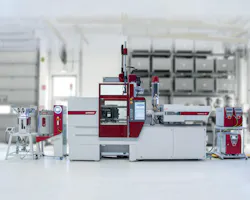
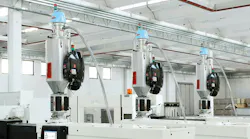
Wittmann has long been committed to smart factory technology and connectivity across processing equipment.
“We’ve been innovating that technology for a long time,” said Jason Long, vice president of sales for Wittmann USA. “I always say that smart technology is not new to the Wittmann Group, but as most of us know, the injection molding industry is definitely slow at adopting new technology, so it’s still very new to the industry.”
However, Long said customers are learning about the benefits of the technology and increasingly seeking it.
“We get a lot of requests for smart factory technology, like the Wittmann 4.0 technology that we’ve had for quite a while,” Long said. “More customers are seeing the benefits of that connectivity and asking for that connectivity.”
Long said the reshoring of manufacturing to the United States is increasing the need for connected injection molding machines (IMMs) and automation to help manufacturers remain competitive.
Wittmann Group, the Austria-based manufacturer of IMMs, automation and auxiliary equipment, believes artificial intelligence (AI) will play a larger role as companies adopt smart technologies, and the company is developing new offerings in that area.
“I can’t really talk about everything we’re working on, partnering with a lot of schools and companies that are looking to help us research how AI can factor into that,” Long said.
One project Wittmann is undertaking is a partnership with a company that manufactures AI vision systems. The companies are developing a demonstration that they plan to show at NPE2027 in Orlando.
“They already have good technology, but how can we work together to make their technology work with our injection molding machines to improve what we can get?” Long said. “One thing that we have learned about AI is that it is about data, but what do we do with all that data? I see a lot more companies working together to pioneer what the next AI developments will be for injection molding.”
Wittmann began the project with AI vision system manufacturer Krevera after learning one of Wittmann’s customers had worked with the company to develop an inspection system that communicates with a Wittmann IMM.
A robot picks up a molded part, and a vision system inspects it. The system then communicates data back to the IMM, which can autonomously adjust operating parameters to correct for a defect, Long said.
“We’re seeing customers use smart factory technology for more autonomous molding such as that, especially in the medical field,” Long said.
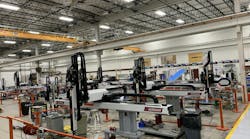
Wittmann also is seeing increased demand for smart automation in large operations where customers use autonomous mobile robots to transport parts after manufacturing and count and store them in warehouses.
To automate the process, customers use the Wittmann MES system to communicate not only with molding machines but also with AMRs and other robots and equipment.
Wittmann 4.0 technology enables all of the company's equipment to connect with one another. Equipment within a single work cell can connect through Wittmann 4.0 software installed on a company’s injection molding machine, or equipment can connect plantwide and possibly across multiple locations through Wittmann’s manufacturing execution system, or MES, software called TEMI+.
Imago is Wittmann’s energy monitoring module for TEMI+ that offers a detailed analysis of a customer’s energy consumption and where improvements could make their operations more green. The company says the system is ideal for customers who need to investigate specific energy usage or gain visibility into overall consumption. It monitors energy consumption in real time across production floors.
Wittmann also is developing an AI tool called Aim4Help that would help customers troubleshoot problems with their equipment, Long said.
“It’s basically a knowledge base,” Long said. “We’re taking our technical data, our documentation, service reports and other material, and putting them into this AI module. Our customers will be able to scan a QR code when they have an issue with a machine or a robot or another piece of equipment. It will show them the alarms and have suggestions on how to fix them.”
While still in development, Wittmann has demonstrated the technology at several shows, and the company’s service workers are using it extensively, Long said. A few customers have access to the software through a beta program.
Contact:
Wittmann USA Inc., Torrington, Conn., 860-496-9603, www.wittmann-group.com