Uniloy highlights AI, machine vision and predictive maintenance for blow molding
Key Highlights
- Uniloy says AI, machine vision and advanced process monitoring will play an increasingly important role in future blow molding operations.
- The Uniloy Eye camera system integrates with machine PLCs to monitor critical process areas and identify potential production issues.
- Company executives plan to offer the Uniloy Eye platform as a retrofit for existing machines as software integration progresses.
- Uniloy is developing AI-driven preventive maintenance tools that analyze machine data and recommend corrective actions before problems occur.
Part of a series examining smart factory and artificial intelligence technologies available to plastics processors.
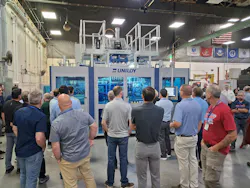
“Data, data, data, data — that’s the main word, I think, of the day,” said Uniloy Shuttle Product Line Manager Daniel Horecica-Csiki during a recent open house at Uniloy’s headquarters in Tecumseh, Mich.
Horecica-Csiki told attendees that the future of blow molding lies in process monitoring and artificial intelligence.
“Control systems, obviously, now have become very advanced,” he said. “All control systems now have closed-loop control. We also have feedback from the components that they are controlling. All kinds of sensors around the machines, precise adjustments, accelerations, decelerations so that you can control your movements with high precision.”
All processing machinery parameters are available for export due to Industry 4.0 control systems, which have become standard, he said.
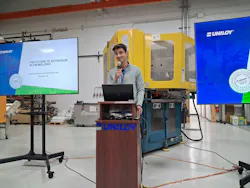
HMI displays today are larger, and control systems are more sophisticated than they were only a few years ago.
“What’s the difference?” Horecica-Csiki asked. “They’re smart, right? They have AI software. They have data, data, data.
“Data is the future. That’s what’s changing … We have a rich availability of parameters that can be easily monitored nowadays. You have feedback from valves. You have feedback from motors. You have feedback from heater bands … We have weight measuring systems, feed testing systems that can give feedback to the machine. The weight measuring system can create a loop to have a self-adjustment within the machine.”
With Industry 4.0 technology standard on new control systems, AI is becoming increasingly reliable, he said.
Horecica-Csiki said Uniloy is planning to work with an outside company “which is going to help us basically manage the data that we’re getting from machines and use that data to control processes. Also to guide the operator, the process engineer, on where he should be looking when he has issues.”
Cameras help spot problems, improve processes
Cameras, coupled with AI technology, will increasingly help machine operators optimize their blowing cycles, Horecica-Csiki said.
“This more goes into the future, but it’s not that far in the future ... camera systems monitoring the diameter and the shape of the parison as it comes down,” Horecica-Csiki said. “It can see the temperature, so we can have a thermal camera and see the temperature of the plastic coming down and how you’re cutting, and if your cutting is consistent. These are all small things, if you want to call them that, but they make a big difference when you have a system telling you there’s something wrong here. This can be extended to the blowing pin descending correctly into your parison. Are you optimizing your blowing cycle?”
Double shots are the most common cause of damage to molds, he said. Having a camera that can see inside a clamp to detect whether there is a stuck bottle, coupled with AI, could help processors save their molds.
“These systems can actually warn you before you get an alarm,” Horecica-Csiki said. “Why do I say that this future is not that far out? Because we have already developed a camera system that we call Uniloy Eye. It has been presented at the plastics show in Milan.”
The system that Uniloy presented had seven cameras that were integrated with the blowing machine PLC, he said.
He outlined seven possible camera installation areas:
- Mold area
- Parison/extrusion area
- Blow pin/nozzles
- Take-out area
- Generic accessories (including leak tester and trimmer)
- Scrap area
- Critical areas indicated by the customer
“This technology was presented at Plast Milan as a first in the industry,” explained Chuck Flammer, Uniloy VP of machine sales. “It is available on new machines from Italy (shuttle, injection blow, and industrial machines), and it’s also going to roll out for machines built in the U.S.”
Uniloy is looking to allow customers to install the Uniloy Eye system as retrofit technology on existing equipment.
“We are currently looking at how we can integrate it into the PLC software on each platform,” Flammer said.
Moving ahead on preventive maintenance
Uniloy will be offering preventive maintenance options in the very near future.
“It’s something that we are developing, but it’s not out years from now,” Horecica-Csiki said. “It’s out months from now. As I mentioned, we have already partnered with an industrial AI software company ... that will work with us over the next few months to process the data that we already have. This is going to be quite fast.”
Uniloy and the AI software company are developing preventive maintenance models to trigger machine intervention or operator actions to correct processes that are drifting from optimal, Flammer said.
“Since it is an AI package, the programming is minimal, but to determine which variations need to be corrected is what we are looking into,” Flammer said. “How to automate the correction is our next step, so this is a continuous process.”
Contact:
Uniloy Inc., Tecumseh, Mich., 517-424-8900, www.uniloy.com
Further reading
About the Author
Bruce Geiselman
Lead Reporter
Senior Reporter Bruce Geiselman covers plastics processing technologies and end markets including automotive and packaging. He also writes features, including In Other Words and Problem Solved, for Plastics Machinery & Manufacturing and The Journal of Blow Molding. He has decades of experience in daily and magazine journalism, including eight years at PMM, and is the recipient of a Jesse H. Neal Award, among other recognitions.