Plan ahead to ensure a circular future for plastic packaging
Key Highlights
- Extended Producer Responsibility laws are accelerating demand for recyclable packaging designs and greater accountability for end-of-life material management.
- Mono-material PE packaging, including MDO film structures, is expanding recycling opportunities while maintaining performance and aesthetics.
- Digital modeling and simulation tools help processors optimize recyclable film structures, reducing development time and trial-and-error costs.
- Expanding collection programs, consumer education and commercial film recovery is critical to increasing high-quality PCR feedstock supply.
- Strong end-market demand for PCR remains essential to scaling recycling systems and advancing plastics circularity initiatives.
By Sarah Marshall
Interim SVP, PE sales and marketing, Nova Chemicals
Increasing recycling rates for plastic packaging is a multifaceted challenge. With corporate commitments to combat plastic waste and emerging Extended Producer Responsibility (EPR) legislation, brand owners and packaging producers are searching for ways to recapture plastic materials and reuse them in high-value applications. The wide variability in recycling access and infrastructure, however, is making this process difficult.
Building strong end markets for post-consumer recycled (PCR) materials is a foundational requirement for building a circular economy for plastics. Without consistent demand for PCR, collection and recycling systems will not be able to scale. In this developmental phase of building new models for plastic use and production, the industry needs proactive organizations that are committed to advancing PCR innovation.

Progress will require a willingness from the value chain to share risk and cost. Keeping plastics in circulation and out of the environment demands investment, experimentation and long-term commitments from industry stakeholders. Organizations that are early adopters of PCR will define themselves as leaders in the transition to more sustainable packaging solutions.
The time to get started on designing for recyclability and incorporating PCR is right now. Every successful project helps establish a roadmap for other organizations to adopt more circular practices. For organizations that are wondering what to do about PCR, a transparent evaluation of the recycling industry and how new technologies are shaping the capabilities of recycled plastics is a good place to start.
Designing for recycling
EPR policies are fundamentally reshaping how packaging is designed and managed at end of life. With multiple programs already starting implementation, these policies are placing greater accountability on packaging producers and accelerating the need to rethink material choices and system design.
For example, California’s Plastic Pollution Prevention and Packaging Producer Responsibility Act (SB 54) requires that by 2032, 100 percent of all single-use packaging food service ware is recyclable or compostable; that 65 percent of all single-use plastic packaging is recycled; and that the amount of single-use plastic packaging and food ware produced is 25 percent less than 2023 levels. These targets will require a radical transformation in recycling systems and practices. The latest Covered Material Category list from CalRecycle found that about 20 percent of HDPE containers are recycled, representing one of the highest recycling rates for plastics, while only about 5 percent of flexible plastics are recycled.
Other states have different approaches to PCR mandates and eco-modulation frameworks. This year, Oregon will require the top 25 packaging producers in the state to conduct life cycle evaluations on the top 1 percent of their covered products. With the differences in program designs and measurement tools, it can be difficult for brand owners to know what projects to start with and where to prioritize investment.
Innovations in resin technology
The consistency and performance characteristics of PCR materials remain a roadblock for some commercial-scale applications. New collection streams can help improve feedstock quality, but redesigning other types of packaging for compatibility with existing recycling systems is equally important.
Mono-material packaging structures overcome one of the problems with multi-layered flexible packaging. By simplifying material composition, these designs improve the recycling options for flexible films. Material innovations in PE resins are supporting this transition.
While machine-direction-oriented (MDO) PE films are not new, their use has recently increased in mono-material packaging design. Combined with all-PE sealant webs, MDO films enable pouches and bags that meet the same performance demands as biaxially oriented PP (BOPP) and biaxially oriented PET (BOPET) laminate films but are suitable for mechanical recycling processes.
Specially designed MDO resins are engineered to maintain print registration, deliver low haze and produce high-quality finishes that meet functional and aesthetic requirements. Advances in formulation also have improved thermal stability and reduced defects, ensuring consistent performance during processing.
High-barrier PE resins are helping replace ethylene vinyl alcohol (EVOH), which cannot be separated from PE and degrades performance when it is melted with other materials. Advanced PE resins are enabling thin coatings that deliver essential barrier performance in a structure designed for recyclability.
Streamlined development with digital tools
To meet the various processing and performance requirements of mono-material films, digital tools are helping streamline development. Modeling and simulation software, built to analyze various resin characteristics and processing parameters, enables producers to evaluate and optimize film structures before moving to physical trials. This approach reduces development time and facilitates more efficient collaboration across the value chain.
Logistical challenges
Designing for recycling will not help reduce plastic waste if the collection infrastructure does not exist and consumers and businesses do not participate. Capturing post-use packaging to ensure its highest value in recycled form will require behavioral and logistical changes.
First, there is a need for increased consumer education and awareness about the effectiveness of plastic recycling and how products can be recycled. Many consumers are unsure about which plastics are recyclable and which collection mechanisms exist for particular plastics.
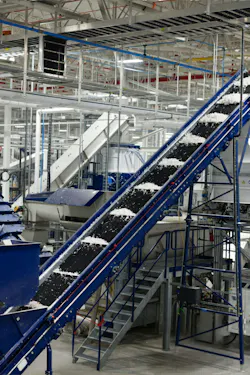
For flexible packaging in particular, store drop-off programs are often the primary collection pathway, but participation depends on a clear understanding of what is acceptable at each location. Educational campaigns and on-package messages are two options that can help bolster consumer understanding of recycling options.
There is also untapped potential in commercial and industrial settings. Back-of-house films, including pallet and shrink wrap, represent a valuable source of clean, high-quality material. These programs require a reframing of how organizations view plastic waste, and building the networks to transport the materials to recycling facilities takes time and effort.
Borouge International, owner of Nova Chemicals, opened its first PE film mechanical recycling facility in Connersville, Ind., last year. Borouge works with brands and retailers to create film recycling programs. By expanding collection efforts in retailer and distribution center environments, the industry can increase the supply of feedstock needed to produce high-quality PCR.
Solving these challenges will require coordination across stakeholders, but the situation also represents a clear opportunity. With improved collection systems in place, significant volumes of material that currently end up in landfills can be recycled and reused.
How to incorporate PCR
A practical approach for PCR incorporation is to begin with smaller-scale projects and expand over time. Flexible packaging offers many entry points. Applications like secondary packaging for paper towels and tissue, as well as stretch film, are accessible places to start adding PCR. These projects provide valuable learning experiences and help strengthen the supply chain without the performance demands of some other applications.
This incremental approach is both realistic and effective. While the long-term goal is to incorporate PCR into high-performance applications such as food packaging, achieving this at scale will take time. Food-contact applications have additional testing and regulatory requirements from the U.S. Food and Drug Administration (FDA), and supplies of food-grade PCR resins are still ramping up.
End-market development
Designing for recyclability is one critical part of the plastics puzzle, but the most influential factor for driving change is the development of responsible end markets for PCR material. The U.S. Plastic Pact’s Journey to Film & Flex Circularity framework identifies end-market demand for PCR materials made from plastic films as the most decisive lever for creating a circular economy.
For a circular system to function, there must be consistent and intentional demand for recycled materials. This is where company leaders and brand owners come into play. By specifying PCR content in packaging, even in the face of uncertain market conditions or moderate cost increases, these stake holders can directly influence long-term market dynamics and prevent mismanaged plastic waste.
With the right combination of collaboration and commitment, the packaging industry has the tools to create the next era of plastic innovation. The transition to the plastics circular economy is already in motion, driven by the organizations that are willing to champion the use of PCR. By working together and taking action today, stakeholders across the value chain can participate in building comprehensive systems that not only reduce waste, but also unlock new value from post-use plastics.
About the Author
Sarah Marshall
Sarah Marshall is interim SVP of polyethylene (PE) sales and marketing for Nova Chemicals’ PE business, responsible for leading Nova’s PE marketing, sales, technical services, customer experience and business optimization teams. She serves as a board member of the Flexible Packaging Association and earned her Bachelor of Engineering degree at McGill University, Montreal.