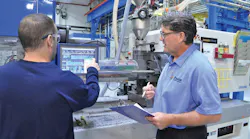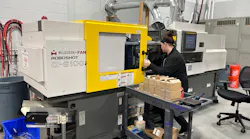
Many company executives say employees are their No. 1 asset and that training is a good investment.
But no plastics manufacturing company has ever launched a training program like the International Automotive Components' North American Cockpit and Overhead Group, which aims to give job-related training to more than 12,000 employees at plants in the U.S. and Mexico.
READ ON THE FACTORY FLOOR MAIN FEATURE HERE
IAC's three-year plan to become an excellent molding company started with training employees. "People needed to be first," said Joel Scott, IAC's senior director of manufacturing operations.
To accomplish the three-year improvement program, IAC evaluated several training programs and selected Paulson Training Programs Inc., Chester, Conn.
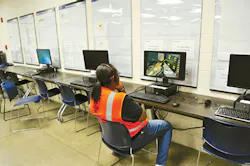
"We investigated a lot of systems before picking Paulson," Scott said. "We did not want to be confined to a classroom and the Paulson model is self-managed. The content is pertinent, and it has a good curriculum."
Scott said all employees can take advantage of additional technical training opportunities with the Paulson model. "We have untapped talent, and this is a way to recognize that talent," Scott said.
IAC rolled out the training program at the group's 14 plants in July-September 2015. Progress is tracked at each plant and, as of November, a total of 23,543 hours of training has taken place. Scott estimates that number will be well over 50,000 hours by the time training is completed.
Training focuses on injection molding machines and controls; material behavior under processing conditions; and plastic behavior inside a mold.
IAC divides personnel into two categories:
• Nonaffected, the people who do not work directly with the injection molding machines. These include managers at all levels of the organization, assembly, materials-handling and quality-control personnel.
• Affected, the people who directly set up, monitor, maintain or improve the injection molding process. These include molding and machine technicians, process technicians, process engineers and engineering managers.
Everyone starts with the basic injection molding course. "It is our core competency, and everyone needs a basic understanding," Scott said. For more advanced training for affected employees, each plant built part of its own curriculum based on Paulson's programs.
Is the training paying off? Scott thinks it is. Through improved production efficiencies, the company says the 14 plants are now saving 4,288 labor-hours per week and 3,024 press hours a week. Cycle times have improved.
Scott Paulson, director of business and product development for Paulson Training, said that "by tracking and measuring ROI via man and machine hours saved, IAC has demonstrated that technical training, without a doubt, pays off in clear, significant financial returns."
"It has been a raging success," Scott said. "We can see a lot of hours saved with more tools at the best-in-class and world-class cycle times. It is staggering."
Ron Shinn, editor
About the Author
Ron Shinn
Editor
Editor Ron Shinn is a co-founder of Plastics Machinery & Manufacturing and has been covering the plastics industry for more than 35 years. He leads the editorial team, directs coverage and sets the editorial calendar. He also writes features, including the Talking Points column and On the Factory Floor, and covers recycling and sustainability for PMM and Plastics Recycling.