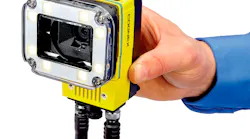
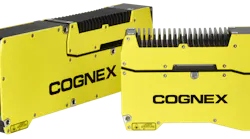
Cognex vision systems range from simple to complex
Key Highlights
-
Cognex vision systems inspect every molded part for defects, offering customized configurations of cameras, sensors, lenses and lighting.
-
New In-Sight 3900 and 6900 systems combine embedded software and AI features for high-speed inspection and flexible applications.
-
Cognex’s OneVision cloud platform trains AI models for complex inspections, then deploys them to cameras for local processing.
-
Cognex maintains human oversight of process adjustments, allowing engineers to evaluate inspection results and approve or reject recommended changes.
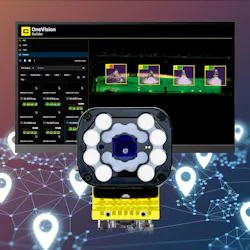
Cognex's vision systems can be tailored to meet the user’s needs, allowing plastics processors to deploy them for inspecting molded parts and molds, as well as other production areas.
A major benefit of vision inspection systems is the ability to inspect every molded part for possible defects instead of relying on workers to inspect samples, said Brian Benoit, director of advanced vision products at Cognex.
While inspection software is critical to accurate vision inspection, the quality of captured images is just as important, Benoit said. Cognex offers various combinations of cameras, sensors, lenses and lighting to accommodate different applications and production speeds.
Some Cognex vision systems have embedded lighting and lenses, while others allow processors to select external lenses and lighting that can accommodate different fields of view and resolutions. Cognex supports everything from simple plug-and-play applications to sophisticated systems requiring specialized optics and lighting, Benoit said.
The processing of data generally occurs directly in Cognex’s smart cameras, eliminating the need for an external computer for many applications.
Common applications for plastics processors include:
- Detecting flash before sending molded parts downstream.
- Checking molded parts for deformation, dimensional tolerance issues, and color accuracy.
- Inspecting preforms for defects before bottles are blow molded.
- Inspecting finished products for label misalignment.
New vision systems for plastics processors
Cognex earlier this year introduced two new vision systems, the In-Sight 3900 and the In-Sight 6900.
The 3900 is an integrated system incorporating a camera, lens, lighting and software, including AI features, into a single unit. It can handle high-speed, high-throughput applications, inspecting up to 5,000 parts per minute, according to the company’s website.
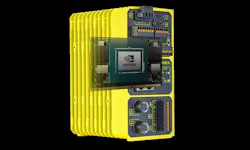
The 6900 is a controller that accommodates different cameras, lenses and lighting configurations and can produce “ultra-high resolution” images of up to 65 megapixels. Its embedded software includes AI features.
The 6900, with its ability to change configurations, offers greater flexibility, while the 3900 emphasizes ease of installation, Benoit said.
The In-Sight Vision Suite, software incorporated into the vision systems, handles most functions necessary for inspections, such as image formation, exposure and gain settings, integration with PLCs and robots, and the ability to display results on a PLC, computer monitor, or other screen, Benoit said.
Most plastics applications are handled with 2D vision, although Cognex also has systems that can analyze 3D images. Three-dimensional systems use lasers and are aimed at more sophisticated applications often requiring depth, height or volume measurements, or inspecting parts with complex geometries.
New cloud-based software offers more power
The software incorporated into Cognex vision systems is capable of handling most visual inspections required by processors, but there are exceptions, which a new platform can help address.
“There are some limitations,” Benoit said. “If you are doing some really complicated model formation using advanced AI, there’s not enough processing power on the camera itself to do the training. We have a new product that we launched earlier this year called OneVision, which is a cloud training platform.”
A user collects images from the factory floor on a Cognex vision system and either saves the images onto a PC or streams them directly to a local drive. Processors can provide examples of good parts and bad parts, including examples of specific defects such as dents, scratches or flash, while training their AI model. The user connects to the internet and OneVision, which has the processing power to train a user’s AI model to handle complex manufacturing inspections.

“Once you're in the cloud, you have access to very powerful GPUs (graphics processing units),” Benoit said. “That model that you create there is now your model that's specifically geared toward solving your application. That model can now be redeployed to these cameras and then run indefinitely. Once those models are created and validated, you can run them for years on the line without touching them, as long as nothing is changing.”
By running the inspection software directly on the cameras, rather than communicating constantly with cloud-based software, inspections are possible on high-speed production lines.
“Especially in the plastics world, there are 10 to 15 inspections per second in some cases, so streaming images to the cloud is an impossibility in those cases,” Benoit said. “Everything has to happen locally on the edge, on the smart camera devices.”
If something on the production line changes, the user can retrain their model in the cloud and then send the retrained model back down to the camera, he said.
Keeping humans in the loop
Cognex vision systems identify questionable product images and bring them to the attention of an automation engineer or other human who can determine whether parts are drifting out of specification or the AI model needs retraining. Benoit said he does not envision the AI independently adjusting or controlling the molding process. Instead, a human remains responsible for making any changes.
“While we have systems that could recommend changes, there’s always going to be a human in that loop that’s going to ultimately accept or reject whether or not they want to make that change,” Benoit said. “That’s very important.”
Benoit said that Cognex customers are conservative and want a human in charge because an incorrect process change could be extremely expensive.
Cognex Corp., Natick, Mass., 508-650-3000, www.cognex.com
About the Author
Bruce Geiselman
Lead Reporter
Senior Reporter Bruce Geiselman covers plastics processing technologies and end markets including automotive and packaging. He also writes features, including In Other Words and Problem Solved, for Plastics Machinery & Manufacturing and The Journal of Blow Molding. He has decades of experience in daily and magazine journalism, including eight years at PMM, and is the recipient of a Jesse H. Neal Award, among other recognitions.