Reading the signals: What Q2 equipment data tells us about the plastics industry
Key Highlights
- Plastics machinery shipments fell in the second quarter, while new orders tracked above trend and market confidence improved.
- North America is expected to drive plastics equipment market growth, despite weakness in residential and commercial construction.
- Tariffs, trade policy, capacity utilization and end-market demand remain key factors influencing plastics machinery investment decisions.
- CES data helps plastics manufacturers distinguish temporary market volatility from broader trends affecting sales, investment, hiring and production.
The plastics machinery market entered the second half of 2026 with a mixed set of signals: softer shipments, stronger new orders and growing optimism about the year ahead.
The Plastics Industry Association’s (PLASTICS) latest Committee on Equipment Statistics (CES) report found that primary plastics machinery shipments totaled an estimated $235.8 million in the second quarter, down 14.8 percent from Q1 and 7.2 percent year over year. At the same time, new orders increased, broader U.S. equipment investment grew and CES participants reported greater confidence in market conditions over the next 12 months.
To put those numbers into context, we sat down with PLASTICS Chief Economist Perc Pineda to discuss what the latest data says about the equipment market — and what manufacturers should be watching next.
Q: What does recent CES data signal about the outlook for the plastics equipment market?
Pineda: I would describe the outlook as cautiously optimistic. When we look beyond one quarter, new orders have consistently been tracking above trend, which can be an early signal of stronger business activity.

The report also underscores that much of the expected growth will come from North America. The United States, Canada and Mexico remain an extremely important market for plastics equipment, so expectations for stronger activity closer to home are encouraging.
That said, equipment demand rarely moves in a straight line. Recent data also show that important end markets for plastics, including residential and commercial construction, remain relatively weak. So, I would say, for business owners, there are positive signals worth watching.
Q: What factors are shaping that outlook?
Pineda: As usual, trade remains an important factor. Equipment suppliers and manufacturers continue to operate in an environment shaped by tariffs, global trade policy and highly competitive markets.
We are also watching capacity utilization in plastics products manufacturing and demand from major end-use sectors. Stronger activity in those areas would provide additional support for machinery and equipment investment.
When market conditions are competitive, suppliers also tend to become more protective of their existing market share, which can make it more difficult for companies trying to enter new markets. That is why understanding both the broader economy and industry-specific trends is very important.
Q: How can companies use this kind of data when making business decisions?
Pineda: Information is key. Companies need both a short-term and long-term view of the market because decisions around sales, investment, hiring and production are influenced by both.
CES gives equipment suppliers and manufacturers access to specialized industry data that they cannot necessarily get from broader economic statistics alone. The more information a company has access to, the better positioned it is to distinguish temporary volatility from a more meaningful shift in market conditions and adjust its strategy accordingly.
Q: PLASTICS also recently released its 2026 Size and Impact Report, examining data from across the entire supply chain. How does the CES data fit into that broader picture?
Pineda: Any analysis of the U.S. plastics industry would be incomplete without looking at plastics machinery. Equipment is an essential part of the industry’s value chain and the lifeline of plastics manufacturing.
Our latest Size and Impact analysis estimates that plastics machinery generated approximately $1.7 billion in value added in 2025, representing a meaningful contribution to U.S. GDP.
The two reports provide different but complementary views. The Size and Impact Report shows the scale and economic importance of the industry. This year’s findings underscore the industry’s resilience amid a challenging economic environment shaped by higher tariffs, the risk of more tariffs — thus trade uncertainty plus broader geopolitical pressures. The CES report complements this by providing business owners and investors more of a real-time outlook at how the equipment sector is performing and where it may be headed.
For companies that want to know what may be coming around the corner, that kind of timely, industry-specific information is invaluable — and the more companies that participate in CES, the more robust and well-rounded that picture becomes. To learn more about participation in CES, visit the CES webpage or email [email protected].
Further reading
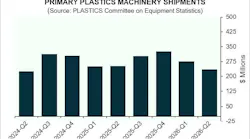 Plastics Industry Association (PLASTICS) bar chart showing a 14.8% decrease in shipments of plastics machinery in Q2 2026 from Q1.

 Perc Pineda is chief economist of the Plastics Industry Association (PLASTICS).
About the Author
Plastics Industry Association (PLASTICS)
The Plastics Industry Association (PLASTICS) is a purpose-driven organization that supports the entire plastics supply chain. Learn more at plasticsindustry.org/about-plastics/