Equipment buying remains cautious as plastics processors balance growth with uncertainty
Key Highlights
- PMM's midyear survey found half of respondents expect business to improve, though equipment investment decisions remain cautious amid uncertainty.
- Resin price increases, tariffs and supply chain concerns continue influencing machinery purchasing decisions across plastics processing operations.
- OEMs report improving quoting activity, but many processors continue delaying major capital investments while monitoring economic conditions.
- Open production capacity and uncertain trade, energy and interest-rate conditions remain significant factors shaping equipment investment strategies.
By Lynne Sherwin, Bruce Geiselman and Ron Shinn
Halfway through 2026, plastics processors are still wrestling with equipment purchasing decisions in light of tariff whiplash, labor shortages and interest rates, with the added complication of resin price hikes due to the war in Iran.
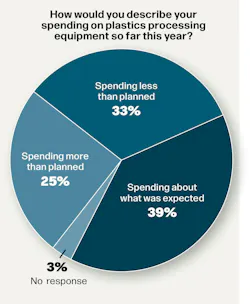
A poll conducted on Plastics Machinery & Manufacturing’s website in June indicated that 39 percent of respondents were spending about what they had expected on equipment so far this year, while 33 percent are spending less and 25 percent are spending more (3 percent had no response).
Tariffs and supply chain issues, among the top concerns processors expressed in PMM’s most recent Machinery Investment Survey in late 2025, were each causing more than one-third of respondents in the June poll to spend more on equipment this year, while resin costs drove increased spending for 55 percent of respondents.
The survey “reflects some cautionary behavior,” said Perc Pineda, chief economist for the Plastics Industry Association (PLASTICS).
“There is a significant share of companies who are still a little bit cautious of how they're going to invest in equipment. And I think this is consistent with the broader macro data. If you look at the economy's investment on industrial equipment, it has stayed somewhat flat or just modestly upward-sloping ... This is consistent with the overall picture of what's happening in the economy,” he said.
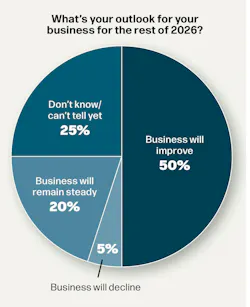
But despite the multiple factors complicating the plastics business, respondents’ outlook was surprisingly positive, with 50 percent expecting conditions to improve over the next six months, and only 5 percent believing they will be worse. Twenty percent expect things to remain steady, while one-quarter say they don’t know or can’t tell yet.
In PMM’s survey last fall, 17 percent were expecting business to be worse in 2026, while 56 percent expected it to be better.
“There is clearly some positive sentiment out there with 50 percent expecting improvement,” Pineda said.
He said he expected the share of “don’t know/can’t tell yet” responses to be around 15 to 20 percent, “and so when I saw 25 percent, I said, wow, that's still a meaningful share. A quarter of them are thinking that they still aren't able to feel where the direction of the business is going to be, and we're halfway into 2026. So that concerns me a little bit.”
The outcome of the war in Iran remains murky, and although some companies are benefiting from tariffs, Pineda believes the “guessing game of the tariff and trade policy” is a major factor for those expressing uncertainty.
The view from the plastics shop floor
Greg Meins, general manager of custom blow molder Plastics Packaging Concepts, is one of those feeling the optimism. He’s having a record year.

“We have a few new customers, and we have seen a tremendous amount of growth from some of our existing customers,” Meins said in a recent interview. “We have one customer for a 16-ounce bottle for concentrated tea that is sold at Trader Joe’s supermarkets. They are going from 1.5 million bottles to more than 3 million per year.”
Meins said Plastics Packaging Concepts currently operates nine extrusion blow molding machines, and he would like to increase that to 15 machines. The company has 35 employees.
The current facility in Garden City, Mo., does not have enough space for expansion, so the company is looking to build a new plant on its current campus that may include PET production from preforms.
Meins said he started 2026 with a conservative business estimate but now expects strong growth to continue for the second half of the year and into 2027.
“We have two more fairly large customers that we just brought on late last year, and we are kind of getting things figured out with them now,” he said.
Sales may reach $5 million this year, up from $3.8 million last year and just $2.8 million a couple years ago, Meins said.
Representatives of two Pennsylvania dairy operations recently visited the Michigan headquarters of Uniloy because they are considering buying blow molding equipment to begin manufacturing their own milk jugs and other dairy containers.
Chuck Flammer, VP of machine sales for Uniloy, said of these types of prospective customers, “Some are seeing advantages in making their own as they control the supply chain better. Some have complained about the service of some converters as many have merged over the last years.”
Clover Farms on its website says it is the largest privately operated dairy in the state. It currently buys milk jugs to fill at its site, but it is looking at moving that job in-house.
“We buy at least 42 million jugs per year, and that's a lot,” said Marcos La Fuente, director of operations. “We’ve got to control the supply chain so we can save some costs and invest in new equipment so we can have more employees in our facility. We’ll also try to encourage our people to run this new equipment. Then we can supply our plant more efficiently and control all the supply chain and costs.”
Clover Farms is still in the planning stages, but La Fuente said the company might be looking at equipment purchases early next year. The dairy operation is currently trying to determine how much money it would invest in purchasing the necessary equipment.
“We’re working on that to see how much money we would have to invest and then also work with the state to see how we can handle this situation because it’s really a big investment,” La Fuente said.
Chuck Turner, president of Turner Dairy Farms, based in Pittsburgh, said his dairy also has been buying pre-made jugs and bottles but is exploring other options.
“We’ve had a growth in sales and it’s at least time to look at self-manufacturing,” he said.
Open capacity, interest rates remain concerns
A representative for a major plastics packaging company said prospects for the rest of 2026 are hard to predict, citing “the continued challenges we see this current calendar year due to the crisis in the Middle East. Challenges with increasing costs, passing costs to customers in the way of price increases, cost cutting to meet financial goals, utilization of available assets and capacity, and careful management of limited capital.”
He said his company’s spending on equipment so far this year has been slow, “due to the above cautiousness in spending and reserving capital for key growth customers and markets,” and that open capacity and capital constraints have affected purchasing decisions, along with considerations of upgrades or rebuilds on existing machinery.
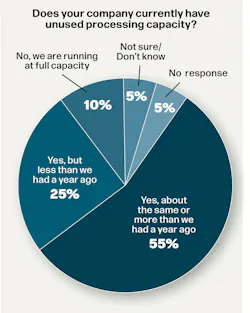
Open capacity, which has been cited as holding back equipment purchases since COVID-era spending sprees, remains an issue. Fifty-five percent of respondents said they have about the same unused capacity or more than at this point last year, while 25 percent have less open capacity than last year. Only 10 percent are running at full capacity.
A year ago, in August 2025, another PMM poll showed 67 percent of respondents had open capacity.
Pineda said that response is consistent with the data PLASTICS has been analyzing.
“Demand remains stable and it's missing that robust growth. And so 55 percent indicating the same or more capacity than a year ago, I think it's consistent with what we are seeing in the market,” he said.
“If you look at government data on capacity utilization, it has actually stayed below 80 percent ... Growth in our industry, specifically in the processing sector, is concentrated on quite a small portion of the industry.”
Interest rates and inflation, which were reported as a negatively influencing business in PMM’s 2025 Machinery Investment Survey, also remain a complicating factor.
Leadership at the Federal Reserve seems focused on holding down inflation, Pineda said, which may mean interest rates won’t fall in the near future. They may even rise, which could push buyers to act soon.
The Fed voted July 29 to hold interest rates steady; the next meeting is in September.
“It's hard to read the tea leaves of where that might end up,” he said.
OEMs still see caution among potential buyers
Late last year, some plastics machinery OEMs told PMM they were seeing cautious optimism from customers, while others said processors seemed to be holding back in the face of so much geopolitical and economic uncertainty.
That hasn’t changed much.
Volker Nilles, CEO of injection molding machine maker Arburg GmbH, put it bluntly in an interview with PolyformNext, a German publication: “Investments are only being made when they are unavoidable. Many customers are postponing decisions further and further into the future in the hope that forecasts will become more stable. Personally, I tend to believe that we will have to live with these uncertainties in the future.”
Nilles said high energy prices in Europe are pushing more plastics production to the Americas and Asia, and Martin Baumann, president and CEO of Arburg Inc., the company’s North American operation, is seeing good signs.
“We had a positive first half of 2026 and at this point expect that principal trend to continue,” he said, noting interest in the lower-cost, all-electric Trend injection molding line introduced at K 2025, along with automation and digital solutions.
“Customers in North America are saying that business is OK, but it is still not great. Many shops are running under capacity. What we are also hearing from customers is that there isn’t a reshoring wave,” he said.
Interest is high, but the purchase orders are not always following, Baumann said.
He expects the rest of the year to be “generally positive for the USA, with Canada and Mexico being challenged by the on and off tariff rounds. Stability would be helpful to have.”
Jason Long, VP of sales for Wittmann USA, said the company has seen modest improvement so far in 2026 and expects that trend to continue, despite the challenging environment.
“We have seen increased positivity in the market, with several customer projects that had been delayed now moving forward and reaching the order placement stage,” he said. “This growing momentum gives us some confidence that business activity will continue to improve through the rest of the year.”
Like Baumann, Long said demand for cost-effective equipment is increasing as customers face pressure on their capital expenditures. Wittmann’s technologies include injection molding, auxiliaries and automation.
“While premium equipment continues to have a place in the market, many customers are prioritizing solutions that deliver strong performance and reliability at a more economical price point,” Long said.
KraussMaffei Corp. has seen “encouraging momentum” in the U.S. market in 2026, with increased activity in new projects and capital investment, according to John Fini, who took over as president in June. The company manufactures equipment for multiple processes, includinginjection molding, extrusion, automation and additive manufacturing.
Although “customers remain disciplined in their investment decisions,” he said the company is optimistic about the remainder of the year. “Our project pipeline remains healthy, customer engagement continues to increase, and we're seeing solid demand across several key markets,” including automotive, medical and recycling.
“Manufacturers are continuing to invest in automation, sustainability and advanced processing technologies to remain competitive,” Fini said, and the company focuses on helping customers balance technological innovation with cost-effectiveness.
A mixed bag so far for some OEMs
Rick Buschini, VP of Entek Material Handling Equipment, said business for his division has outperformed that of Entek’s larger processing systems.
“We see material handling remaining strong through the rest of this year and into next year,” Buschini said. “Extruders have been slower, but we're seeing indications that business could begin to pick up.”
He believes that rather than committing to large capital expenditures, many manufacturers are prioritizing upgrades that improve productivity and operating efficiency, such as automation systems.

“Customers are investing in automation that helps reduce costs associated with labor and scrap,” he said. “Those projects continue to move forward.”
Despite mixed performance across equipment categories, Buschini said he is optimistic about overall business conditions.
"The first third of the year was a little slow, the middle third was fantastic, and we're expecting the final third to be very good," he said.
Joe Platek, sales director for auxiliary equipment manufacturer ACS Group, said the year so far has been inconsistent: “We've had some very strong months mixed in with more average months. Larger project wins have helped offset what has generally been a slower market.”
He expressed optimism about the second half of the year, with several projects in the pipeline, though some have taken longer than usual to move to the order stage.
“Quoting activity has been strong throughout the year, and there continues to be interest in new equipment. Many customers are moving forward cautiously due to ongoing uncertainty, which has pushed some project decisions further out. Day-to-day business has remained steady, while larger expansion projects have been slower to move,” he said.
Uniloy had a solid first quarter with some slowdown in the second, Flammer said. The company is working to fill back orders by the end of the year.
But like many other executives, he said many factors remain beyond a company’s control.
“With the economy having levels of uncertainty with regards to inflation, tariffs, energy costs, etc., it has been a challenge for organizations to set long-term goals, slowing some decision milestones,” he said. “Many know that they need capital equipment, but cannot figure out when is the best time to pull the trigger.”
Further reading
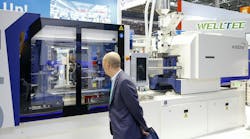 A visitor checks out an injection molding machine at K 2025.
Annual survey is coming
PMM will conduct its eighth annual Machinery Investment Survey in October. Watch your email inbox and plasticsmachinerymanufacturing.com for your invitation to participate.
About the Author
Lynne Sherwin
Managing Editor
Managing editor Lynne Sherwin handles day-to-day operations and coordinates production of Plastics Machinery & Manufacturing’s print magazine, website and social media presence, as well as Plastics Recycling and The Journal of Blow Molding. She also writes features, including the annual machinery buying survey. She has more than 30 years of experience in daily and magazine journalism.
Ron Shinn
Editor
Editor Ron Shinn is a co-founder of Plastics Machinery & Manufacturing and has been covering the plastics industry for more than 35 years. He leads the editorial team, directs coverage and sets the editorial calendar. He also writes features, including the Talking Points column and On the Factory Floor, and covers recycling and sustainability for PMM and Plastics Recycling.
Bruce Geiselman
Lead Reporter
Senior Reporter Bruce Geiselman covers plastics processing technologies and end markets including automotive and packaging. He also writes features, including In Other Words and Problem Solved, for Plastics Machinery & Manufacturing and The Journal of Blow Molding. He has decades of experience in daily and magazine journalism, including eight years at PMM, and is the recipient of a Jesse H. Neal Award, among other recognitions.