Arburg executive sees expanding role for AI in injection molding
Key Highlights
- Arburg says skilled labor shortages are increasing demand for simpler, AI-enabled injection molding technologies that improve machine usability.
- The company plans to highlight Smart Factory solutions, digital services and AI-supported production tools during Fakuma 2026 in Germany.
- Arburg's ALS production management system helps manufacturers monitor performance, analyze machine data and improve overall equipment effectiveness.
- AI applications, including Ask Arburg, aim to deliver faster troubleshooting and make complex manufacturing knowledge more accessible.
Part of a series examining smart factory and artificial intelligence technologies available to plastics processors.
A skilled labor shortage is accelerating demand for easier-to-use smart technologies, according to Arburg.
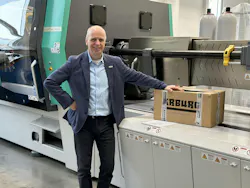
“I’m sure you hear the same as I hear from a lot of molders in the USA — one of the biggest issues that keeps them up at night is a skills shortage,” said Martin Baumann, president Americas and CEO of Arburg Inc. “This is a challenge as well as an opportunity for machinery makers like Arburg.”
The challenge is that with less skilled labor, many injection molding operations might not be able to fully take advantage of the capabilities built into the machinery they purchase, Baumann said.
“The opportunity for us is to make the utilization and accessibility for day-to-day operations as easy as possible,” Baumann said. “By making the machinery and associated auxiliary equipment easier to integrate, exchange data, and operate, we can address that issue.”
Arburg's machinery has long collected extensive process data but making that information accessible and easy for operators to act upon has been challenging.
“That is dramatically changing with AI [artificial intelligence],” Baumann said in emailed responses to questions from Plastics Machinery & Manufacturing. “AI will allow us and our customers to turn data into useful information that can be interpreted.”
Baumann said ease of use will determine whether smart technologies gain widespread adoption: “Smart cannot mean more complexity, otherwise it won’t be used, and that’s what we’re working on.”
Arburg plans to highlight its smart offerings during Fakuma 2026, which will be held Oct. 12-16 in Friedrichshafen, Germany.
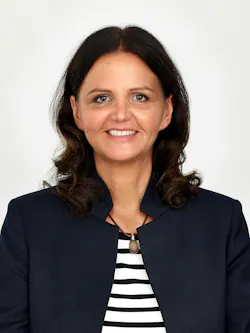
“With our ‘Smartest Factory’ focus, we are making it clear how we position ourselves within the industry,” said Juliane Hehl, managing partner of global marketing at Arburg, in a press release. “We aim to ensure that our customers continue to receive the most innovative, intelligent and therefore best solutions in the future.”
Arburg plans to release additional details in late September about its exhibit at Fakuma. The display will feature digital products spanning the production value chain, including smart assistants, AI-supported features for injection molding and digital interconnection of the production process.
Arburg’s demonstrations will include its in-house-developed host computer system, ALS, which will be available as a cloud-based model in the future, according to the company.
ALS assists with the efficient and safe setup of tools and machines by, for example, centrally storing the data records of all machines. A major advantage of ALS is that the data can be recorded and analyzed in real time. Key performance indicators, metrics and production reports help processors adapt quickly in response to changing conditions, according to the company.
ALS creates transparency in production, increases overall equipment effectiveness (OEE) and can be interlinked with arburgXworld, the company’s digital customer portal, according to a company statement. The customer portal offers numerous apps — including AI-supported ones — that boost productivity in day-to-day operations.
“Ask Arburg” is an AI chatbot that searches Arburg’s knowledge database to produce answers that match or nearly match a user’s specific question about the operation of its equipment, saving time in troubleshooting problems.
Contact:
Arburg Inc., Rocky Hill, Conn., 860-667-6500, www.arburg.com/en/us
Further reading
About the Author
Bruce Geiselman
Lead Reporter
Senior Reporter Bruce Geiselman covers plastics processing technologies and end markets including automotive and packaging. He also writes features, including In Other Words and Problem Solved, for Plastics Machinery & Manufacturing and The Journal of Blow Molding. He has decades of experience in daily and magazine journalism, including eight years at PMM, and is the recipient of a Jesse H. Neal Award, among other recognitions.