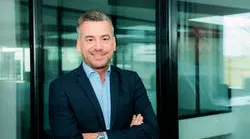
Martin Baumann brings experience from across the plastics industry to Arburg
Key Highlights
-
Martin Baumann, CEO of Arburg Inc. and president for the Americas, draws on three decades across plastics, spanning materials, recycling, compounding, extrusion and injection molding.
-
He sees service, refurbishment and automation as opportunities as processors keep machinery longer amid weaker equipment demand.
-
Baumann says smarter machinery, including Arburg’s AI-supported Ask Arburg, can help address skilled processing labor shortages.
-
He encourages young people to consider manufacturing and plastics careers, citing Arburg’s efforts to engage local students.
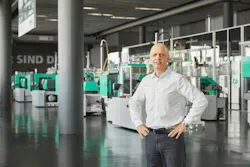
Martin Baumann has worked for more than three decades in the plastics industry on two continents.
A native of Germany, Baumann moved to Canada in 1993 to work as a project engineer for Husky Technologies, then known as Husky Injection Molding Systems. That began a career in North America that took him through positions with Husky, Erema and Maag before he joined Arburg in 2023.
Today, he serves as President Americas and CEO of Arburg Inc., overseeing the company’s operations in the United States and its subsidiaries in Mexico and Brazil.
Baumann’s career has given him an unusually broad perspective on the plastics industry, having worked in areas including hot runners, recycling equipment, compounding and extrusion equipment and injection molding machinery.
As an equipment manufacturing executive, Baumann has navigated a difficult market in recent years marked by reduced demand for new equipment, tariffs, and the lingering effects of the capacity expansion that followed the COVID-19 pandemic.
At the same time, he sees opportunities in service, refurbishment, automation, and increasingly intelligent machinery.
Baumann talked with Plastics Machinery & Manufacturing Senior Reporter Bruce Geiselman about Arburg’s efforts in these areas, his experiences as a leader, his desire to attract young people to the plastics industry, and his interest in photography.
Where did you grow up, and how did you get into the plastics industry?
Baumann: I was born close to Stuttgart, Germany. The town was Kirchheim unter Teck. I was brought up there.
In 1993, I got the opportunity to move with my wife, who was not yet my wife at the time, to start as a project engineer for hot runners at Husky Injection Molding in Canada, which started my North American adventure.
In 1998, Robert Schad [Husky’s founder] decided to build a factory in the United States in Vermont. I was one of about 30 Canadians, so to speak, who moved to Vermont to build the Husky hot runner plant in Milton, Vt.
My home is actually still in Vermont, even as I work and have worked in different places in the United States. That’s where my family is. I have four kids — one was born in Canada, so I have a Canadian in the family, and the other three kids were born in the United States, so they are American Germans. I am a citizen now. I got naturalized about four years ago, so I am a German American.
Do you plan to stay in the United States?
Baumann: It’s been over 30 years now, so I have lived in North America longer than I have lived in Germany.
When I ask my kids where they want to live, because technically they have choices, it’s the U.S. because that’s where their friends are. That’s where they grew up, and we want to be where the kids are. There’s a saying among German immigrants who have come here: if you stay longer than three years, you usually get hooked, and you don’t turn back.
You buy a house, you have kids, and you settle down. But at the same time, it has helped me in my career. I am fluent in German. I am reasonably fluent in English. I have worked all my career for companies that have strong roots in Germany. Even Husky, it’s a Canadian company, but they had a huge campus and still have a huge campus in Luxembourg, originally in Wiesbaden. Then I worked for an Austrian company, Erema, on the recycling side, and then I worked for Maag, which is a Swiss company. Now I work for Arburg, which is one of the quintessential family-owned German machinery companies.
I always felt I was building a little bit of a bridge culturally. From a business perspective, I’m very much an American because I spent my career, for the most part, in North America. Culturally, I’m still quite German because that is where I grew up. I think it has helped me throughout my career to bridge these two worlds together and has probably helped me to where I am today.
What got you interested in the plastics industry as a career?
Baumann: I did an apprenticeship at Mercedes-Benz, back then called Daimler, as an industrial mechanic. It had nothing to do with plastics, but I was always interested in studying engineering after that.
It may sound kind of funny, but all my friends studied traditional mechanical engineering, and I wanted to do something different than everybody else, and I thought plastics in the ’90s was growing. It was an interesting field, and it was different than mechanical engineering. This might not be the best rationale, but it’s why I chose plastics. I don’t regret the choice at all.
What I find so interesting about our field, selling and servicing machinery, is that we deal with so many different segments of industry. It’s not just automotive parts. We deal with medical, we deal with packaging, and you always have to make an attempt to develop an understanding of these end markets and what’s going on. I think plastics has really allowed me to do this because plastics are used in so many different fields. I really enjoyed this.
I have worked on the entire plastics value chain, which is kind of unique. I don’t think many people have that. I made pellets and had customers like ExxonMobil. I was on the virgin side of making materials. Then, of course, I was on the processing side with Husky hot runners. Now, I’m with Arburg injection molding machines. Maag also made extrusion equipment, pelletizing [equipment], filtration [equipment]. Then I also worked on the back end, what happens in the afterlife, with Erema, which is in the business of recycling extruders.
So, I worked right from how to make pellets, to how to process pellets, to what you do afterwards. I covered the entire spectrum, and I find our industry even today very fascinating. Plastic is such an adaptable material. It truly affects society in every aspect, from your clothing to your glasses to your medical care to the automobile that you drive. It’s a very exciting industry to be participating in.
What made you decide to join Arburg?
Baumann: Arburg has an excellent brand image, of course, and I was very happy to be selected to join as part of a retirement. My predecessor retired, and they had been looking for new candidates. I was very happy to join Arburg as a market leader in 2023.
Your tenure has been during a very tough time for machinery makers. What has been the toughest challenge, and how do you stay so positive?
Baumann: First of all, I’m positive by nature. I think that is important. It is also important from a leadership perspective. We all have challenges all around us. But as a leader, you have to put these challenges in perspective.
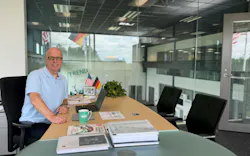
Are our customers happy? Yes, they’re still happy. Are we working on keeping them happy? Yes, we’re working on that. Do we have fundamentally good technology? Yes, we have fundamentally good technology. Are our customers happy with the technology? For the most part, yes.
Does stuff happen? Yes, absolutely. But what’s important is how you address it. I think you have to go into this business, generally speaking, with a positive outlook.
I think like an engineer. First, get the facts. Get the data. Then we work on the problem. That’s how we have approached things like the tariff situation. Sure, we can all complain about it, but that doesn’t help. How do we deal with that? Is there a possibility to minimize the impact for our customers? The fact is that the tariffs are not going away. Then there is the question of how you approach the subject.
During COVID, and this is not just true for Arburg, of course, machinery makers, especially injection machinery, really enjoyed a boost, and that created, when you think about it, overcapacity.
So, you have less new machine sales. Can we provide more services for our customers? Customers want to actually run the machines longer. Well, we have a great service network. We have spare parts in the United States; let’s work on that. Our services business is actually doing quite well. That’s how you try to balance things.
The key is you have to stay creative. From my perspective, you actually will always find ways. The key thing, as I mentioned before, is that customer focus. That generates business opportunities at the end of the day. But, yeah, it’s been challenging.
First, there was a dip in how many machines we need in the United States. Then, of course, the tariff situation. I think it’s about 90 percent of all injection molding machines are imported into the United States. Let’s be honest, we created kind of a tax on machinery for our molders because there is not, per se, a huge American build source of that kind of machinery. Customers decided to really think twice about whether they want a new machine. That opened the door for service — we’re happy to refurbish your machine if you don’t want to buy a new one.
Staying flexible is one of the key things.
Another key we see in the United States is the need for automation. A lot of our customers are saying, “I can’t find the personnel. Arburg, can you help me with my automation needs?”
We have invested in infrastructure and people in the U.S. to put automation systems together locally. So, the machine comes from Germany, and with the help of local suppliers, I do the value-added for the automation right here in Rock Hill. That’s one example.
Another interesting opportunity arises when a lot of my customers are telling me that it’s really hard to find skilled people, especially in processing. The opportunity for us as machinery makers is: how can we make it easier for them, especially with respect to the operating system on the machine. We can provide assistance, what we call pilots, where the machine can go all the way to the point where it self-corrects. It supports the operator or the processing engineer right on the HMI (human-machine interface). I look at this as an opportunity. We’re making the machines smarter and more supportive.
For example, we have our own Arburg AI agent directly on the machine. Instead of going to ChatGPT or something generic, we have an interface on the machine called Ask Arburg. It’s AI supported, but with Arburg information on the machine, it’s more specific. You can ask operator maintenance questions or processing questions and get answers.
Any challenge also has an opportunity, and that’s how I think about it.
What are your job responsibilities?
Baumann: I have sort of a double duty. I have my responsibilities as the managing director and CEO for Arburg Inc., which is Arburg USA, and I have additional responsibilities for Arburg Americas, which is the entire region.
We have two subsidiaries outside of the United States. That would be Mexico and Brazil. In each one, there’s a local managing director, and that managing director reports to me in addition to my responsibilities for the United States.
As you can imagine, the United States is the biggest of the three subsidiaries in the Americas. That’s why it makes sense that our headquarters is in the U.S. It’s our largest market.
We are not a manufacturing organization. When it comes to building machines, those are purchased and imported from Germany. But we provide value-added within the region. For example, we do refurbishment of machines. We provide service. We have preventive maintenance contracts with customers, and we do that in all three regions, especially in the United States. We also do complete automation, what we call turnkey systems. We have engineers, and we have local suppliers that help with that. We put them together here in Rocky Hill.
Customers then come for FAT [factory acceptance testing] and sign off on these systems. That’s done locally so they don’t have to travel to Germany.
What is your greatest career accomplishment?
Baumann: I think it is managing through COVID and keeping everyone healthy. That was a very challenging time for a lot of managers — keeping employees healthy and having all the controversies.
I had a strong responsibility for the employees when I worked for Maag at the time, and being able to do that under difficult circumstances at times. I think this is one of my biggest accomplishments: being able to manage that successfully, not having to shut down, and not having to let a lot of people go, etc. [Baumann was VP/GM of Maag Group Americas in Eagle Rock, Va., from June 2019 to June 2023].
What do you do with your time off?
Baumann: I like photography. I'm a trail runner, and I enjoy hiking. I live in Vermont, after all. So, I really enjoy the outdoors. That involves running and hiking. In the winter, I ski because I live where I easily can do that.
I enjoy what I call winter hiking. Lately, I hike more than ski in the winter, which, from my perspective, is a great experience because everything calms down. It's quieter. You’ve got snow. There are no leaves. I really enjoy that, and I do that often alone. My wife is not so much into winter hiking, but those are my hobbies.
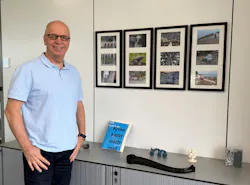
I understand you have some of your photographs in your office; could you describe those?
Baumann: There’s a little story behind those photos. There’s an aspect of art in photography, like colors, etc. I love to photograph animals of all kinds, from insects to lions.
Then, we humans create beautiful structures.
Then there is nature and what we humans do.
The last point in this series of photographs is that I really don’t appreciate it when there’s plastic waste washing up on beaches. I have a little photography series with a little Lego figurine that is cleaning up the beach because I think we have a responsibility, as the plastics industry, to do a better job on the recycling side, and we need do a better job on waste reduction in the environment. We’re still not where we need to be. That’s actually in these photographs.
What would you like to be your legacy?
Baumann: It would be nice to be remembered as a manager who drove a successful company but also cared about the people under his leadership. As long as that is recognized, I think I will be happy. And if I was able to make a contribution during that time, that’s good.
Is there anything you would like to add?
Baumann: I would really encourage young people to consider careers in manufacturing and plastics.
We have our open house in September, and the day after, we have kids in. We invite all the local schools, and usually 100 kids show up. We’re making an effort, and it’s very local, of course, to get kids interested in our field and in manufacturing in general.
Just the facts
Who is he: Martin Baumann, President of Arburg Americas & CEO of Arburg Inc. (USA)
Age: 60
Education: Bachelor’s degree in Engineering (plastics technology) from Aalen University, Aalen, Germany, 1991. MBA in international marketing from Export Academy in Reutlingen, 1993.
Company headquarters: Rocky Hill, Conn.
Number of employees: 100+
About the Author
Bruce Geiselman
Lead Reporter
Senior Reporter Bruce Geiselman covers plastics processing technologies and end markets including automotive and packaging. He also writes features, including In Other Words and Problem Solved, for Plastics Machinery & Manufacturing and The Journal of Blow Molding. He has decades of experience in daily and magazine journalism, including eight years at PMM, and is the recipient of a Jesse H. Neal Award, among other recognitions.