Haitian builds AI controls into fifth-generation injection molding machines
Key Highlights
- Haitian’s HT-Xtend AI software is standard on its fifth-generation injection molding machines, with hydraulic and electric machine-specific features.
- AI-driven controls automatically adjust molding processes to improve stability, accommodate material changes and reduce operator intervention.
- Haitian’s AI features vary by machine type but address clamp force, energy use, diagnostics, pressure, and speed control.
- Go Factory MES provides real-time machine monitoring, alerts, production data, downtime tracking and mobile access across molding operations.
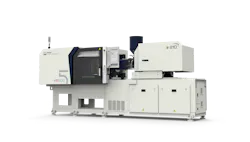
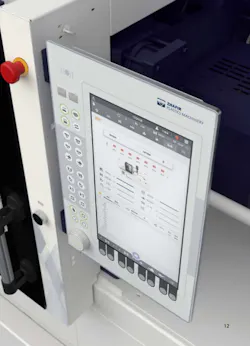
Haitian, with the introduction of its fifth-generation injection molding machines, has made a suite of artificial intelligence (AI) software a standard feature.
As employers struggle to find skilled operators, demand for AI technology is growing, according to the company.
“It does a litany of things to help molders keep the process stable without any human interaction,” said Ben Hartigan, Absolute Haitian marketing manager. “It prevents having a processing guy run to the machine every time something goes a little out of deviation.
“It also helps with energy savings and just kind of overall helps the adaptability of the machine with different materials, and if there’s a change in the actual resin quality, it can make slight adjustments to kind of maintain injection stability.”
The AI software, called HT-Xtend, was introduced in late 2024 on Haitian’s fifth-generation injection molding machines (IMMs).
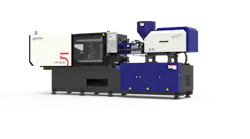
HT-Xtend includes a suite of AI software. Some features apply to Haitian’s servo-hydraulic MA 5 and JU 5 IMMs, while others are specific to the electric Zhafir ZE 5 and VE 5 IMMs. The goals of the software, whether for hydraulic or electric machines, are the same: improving process quality and minimizing human interaction.
“Essentially, they’re about the same suite of software, just tweaked to work with electric machines or hydraulic machines,” Hartigan said.
Haitian outlines six AI features included in the HT-Xtend portfolio for servo-hydraulic IMMs:
- HT Clamp: An optimized self-correction algorithm for stable, fast mold movement and accurate positioning that adapts to changing conditions.
- HT Energy: A power meter with a dashboard detailing electrical usage.
- HT Inject: Adaptive control of fill-and-hold measurements with automatic adjustments.
- HT Lubricate: Tracks lubrication intervals based on production history and dynamic factors of the molding machine’s process.
- HT Diagnose: Uses a graphical interface to locate and identify machine faults and shorten troubleshooting.
- HT Charge: Makes self-adapting adjustments to screw rotation speed to reduce the potential for shot-to-shot material degradation.
Seven AI features are available for its electric IMMs:
- HT Optiforce: Reduces clamp energy usage by lowering clamp force to a minimally acceptable value.
- HT Energy: Similar to the feature on hydraulic machines.
- HT Inject: Similar to the feature on hydraulic machines.
- HT Protect: Instantly detects load deviations in the servo motor throughout the mold-close stroke.
- HT Pressure: Uses sensor monitoring to help ensure accurate pressure and calibration.
- HT Hold Control: Provides multistage pressure control for part quality and reduced scrap.
- HT Speed Control: Intelligent multistage injection-speed control designed to reduce the risk of pressure peaks and component defects.
Demand for increased AI-driven control is rising because operations are having difficulty finding workers capable of making manual adjustments needed to maintain quality part production, especially in newer shops with less-experienced employees, Hartigan said.
“The management side is asking for this sort of technology because a lot of these guys just don’t know. They don’t have 20 processing guys running around their plant for babysitting each of these machines,” he said.
While the new AI technology is standard, plastics processors have the option of disabling it.
“If you have some old school guys who don’t want to do all this and they just want to set their exact parameters themselves, that is totally fine,” Hartigan said.
For processors who use the software, there is no recurring cost and setup is easy, Hartigan said.
“It is out of the box, built into the control,” he said. “You don’t even need to hook it up to the internet or anything to make it work. It just works as is, fully bundled, good to go.”
For processors wanting to monitor their entire operation, Haitian offers its own manufacturing execution system, or MES, for medium-sized companies.
Go Factory MES integrates IMMs across a company’s operations, offering real-time monitoring, automatic alerts, centralized process data storage and TV dashboards.
“It’s pretty much a mobile app or a computer program, and it fully monitors your machine, your process,” Hartigan said. “It tracks all your molds, everything you’d want. You can get alerts on your phone. You can see when the machines are running, when they’re not running. You can track downtime, uptime, part counts, everything you could think you’d want to track in your factory.”
Haitian has additional AI offerings “in the pipeline,” Hartigan said.
One example he cited is AI software that may be released by the end of the year to help plastics processors initially set up a new mold. The goal is to simplify the initial setting of processing parameters.
Contact:
Absolute Haitian, Parma, Ohio, 216-452-1000, www.absolutehaitian.com
Further reading
About the Author
Bruce Geiselman
Lead Reporter
Senior Reporter Bruce Geiselman covers plastics processing technologies and end markets including automotive and packaging. He also writes features, including In Other Words and Problem Solved, for Plastics Machinery & Manufacturing and The Journal of Blow Molding. He has decades of experience in daily and magazine journalism, including eight years at PMM, and is the recipient of a Jesse H. Neal Award, among other recognitions.