Glenn Frohring keeps an ear on the plastics industry
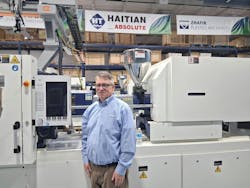
Glenn Frohring has spent much of his life listening to famed rockers like Roger Daltrey, Freddie Mercury and Robin Zander. Lately, he’s turned his attention to another sound — bird song.
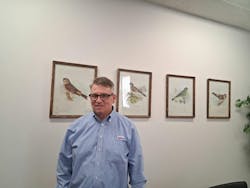
Living in Northeast Ohio’s snowbelt, Frohring, one of three owners of Absolute Haitian Corp., has become a bird guy, but his love isn’t unconditional, as he explained while showing off some artwork at the 20,000-square-foot Parma, Ohio, Absolute Haitian facility where he’s based.
“These are drab birds,” he said. “This looks like a dumb Eurasian finch or something. I guess I’m a bird snob.”
While birds and music are among Frohring’s passions, plastics is in his blood. His father owned Newbury Industries, a since-shuttered mechanical press maker. Occasionally, he still sees them running in plants, after 50 years or so; one still bearing plastics splatter sits in the lobby. Like chasing warblers, stumbling upon the old machines in the wild provides its own thrill for Frohring, who discussed his career with Karen Hanna, senior staff reporter for Plastics Machinery & Manufacturing.
How’s business? How did the K show go?
Frohring: I felt the pain of the European suppliers and manufacturers. We spent a lot of time facilitating projects that are getting shored to us that used to be in Europe. We were sort of the hot thing because of our president.
Their market was down, and ours was improving. 2026 is starting off pretty strong.
We were fortunate with the tariff swing. It was crazy, but, because Haitian had bought Niigata, they were able to switch production quickly [from China] to Japan, and they had built a plant in Guadalajara, Mexico. We ship a lot of our machines from Mexico, so we were able to withstand that roller-coaster ride during the middle of last year.
We had a lot of inventory. ... The fact that we can bring machines in from Japan or Mexico helps.
After the coffers get filled and maybe the U.S. pays off some debt, maybe it’ll stabilize a little. There’s smart people watching it. The guys [President] Trump has —we’re anti-tariff, of course — but they’re going to make decisions pretty quick. They’re not going to let things languish to the point we’re in a recession or something.
You’re seeing reshoring?
Frohring: We see it mostly because there’s a tariff on goods from Europe, and a lot of our customers are European-based, and they have factories here and factories there.
They’re helping us get business over here. They’re like, “OK, now there’s a tariff on all these parts. We’ve got a factory in the U.S. Let’s just throw these tools over and make it here.”
What led you to plastics?
Frohring: I grew up in Newbury, Ohio. My father owned Newbury Industries ... which manufactured injection molding machines (IMMs), primarily up to 200 tons. The building is still there. It’s owned by Kinetico. The machines were both vertical clamp [and] horizontal clamp. After a certain time, they focused strictly on vertical clamp.
My first W2 [tax form], I would have been about 15 years old. I worked for my stepfather in an electrical supply store.Because I was making more money doing that than I did at my father’s job, I didn’t work for him until I got out of college.
I didn’t have a lot of exposure to the business. When I was just maybe 9 or 10, [my father] took me down to a company in Berlin, Ohio, in Amish country. He showed me his machines in the factory. The Amish women were taking pill [vials] out of the machine every cycle. That was sort of cool for me.
When I got out of college — when you go to OU, you spend most of the time drinking and screwing around — he was gracious and said, “OK, you got your college degree, come and learn the business.”
He sold the company in 1993. At that point, I was an independent sales rep. The private equity company that he sold to, I just had a contract. I sold conveyors for Dynacon, [from] ’93 to ’96, and then the private equity company sold Newbury to Van Dorn. ... I worked for Van Dorn from 1996 to 2006, when we started the Haitian business.
How did Haitian come about?
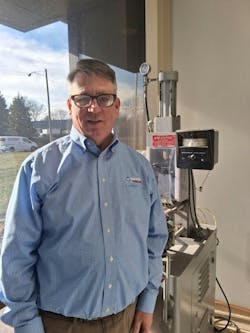
Frohring: When I started at Van Dorn, they had about 715 employees. When I quit in 2006, they were down to about 120. In 2004, they let go [of] Helmar Franz, who was the CEO of Mannesmann Demag (which was at that time part of the private equity company’s holdings). I think they didn’t want him in that position, because he was trying to grow the company, and they just wanted to flip the company. ... He was a visionary.
I’m like, “What does that say for the company I work for?” ... I did well there, but it was attrition; I was making more money, getting promotions, but everybody else was leaving, being shown the door.
It was a good experience to watch my father sell his business to private equity. It was also a good experience to work 10 years at Van Dorn and just see the ups and downs of working for a big company. I learned so much. But the one thing that Helmar Franz did, he went and developed two partnerships in Asia. One was with a company in India and the other was establishing the joint venture with Haitian in China. ... That was the first company in mainland China to have a joint venture. ... He became chief strategic officer.
I started Absolute Haitian with two of my business partners, Nate Smith and Mike Ortolano. They had been Van Dorn reps. They worked for me.
In 2006, we understood because Haitian had a small presence in the U.S. and Canada, they were looking to do some changes with distribution. We were friends with Helmar, and we knew he was over there, and it was basically my off-ramp to get out of Demag.
We started the company when we had the opportunity to start the distributorship for Haitian. Everybody thought we were a little crazy.
This is our 20th year, starting in April.
How has the company grown?
Frohring: I think we’ve built up a pretty good reputation. Customers have a problem, we can solve it fast.
Early on, it was just Nate, Mike and myself. Mike is a former nuclear engineer, so he’s like our chief. We all own the companies, but he’s like the CTO. Nate, he’s a guy that can move a mountain, because he just can get things done. He’s got the energy. He’s a licensed appraiser.
When we started Absolute Haitian, they had a rep group in New England in the company, Absolute Machinery, which is one of our companies. Their motto was, “Your success is our passion.”
These are the primary companies: Absolute Haitian, ARI [Absolute Robot Inc.], Absolute Machinery, Williston Asset Management, which is where we buy companies, but it’s more tied to Absolute Machinery and the used business. We get involved with buying factories, take machines on trade to facilitate new sales.
I [focus] mainly on the new machine sales, and we’ve built a rep network. We have independent sales people. We also have direct sales people. We have a strong team. ...
Our market was very small, but our whole thing was customers that wanted a good value and wanted to replace older Milacron or Van Dorn machines. We had the personal connection with some of these customers, and we built up a sales network. ...
Haitian developed servo technology on their machines, a directly coupled servo motor to a gear pump ... so they could build bigger motors, bigger pump systems and all that energy savings. Then, we started selling a ton of presses. ...
Franz, who was the chief strategic officer, he also developed the planetary branding, so now we have Jupiter, Mars, Venus, Zeres. Everybody’s got different cultures. What permeates all these cultures is the planets. That was a pretty good strategy. ... We started shipping big numbers. ...
Haitian, one of the things [that] is an advantage is their R&D is like a freight train. They can develop new models, new machines, quicker than anybody. This is their selling point. Everybody says, “What’s your elevator pitch?” It’s the lower cost of labor, the economies of scale, because Haitian builds 50,000 machines a year. We can take advantage of the big markets with that economy at scale, even for the U.S. Haitian’s philosophy is, “We sell machines. You want to buy parts for your machines, you can go to us, we’ll sell it to you. Or you can go to directly to the manufacturers: Vickers, Rexroth. ...” When Haitian did that, they kept their manufacturing costs low. “We want the best price for all these switches and pumps because you’re going to have access to our customers.” The philosophy with these other companies is they try to manipulate part numbers to force customers to go back to the OEM; Haitian does not do that. That keeps the price of the machine down. It keeps the cost to operate year over year, down.
If our customers are successful, we’ll be successful.
Your businesses represent a broad portfolio. How is that advantageous?
Frohring: We’re a one-stop shop for machines and robots, and sometimes even auxiliary equipment, like chillers and loaders and dryers. A lot of our sales reps have their own products they sell. We respect customers’ tendencies.
Besides the tariffs, what other challenges are you seeing?
Frohring: One thing is the training aspect. There’s still a high demand for [filling] jobs. Customers are keeping people, and they’re all tired of temp agencies providing people that just come and go. We support institutions like Ferris [State University], Penn State Behrend, Pittsburg State [University]. ... We have full-time training courses.
Last year, we probably had one of our biggest years for robot sales. Finally, people are biting the bullet, where, instead of just dropping parts in a box, they’ve got to automate. We’re Fanuc integrators, so it’s not just our robots we sell.
How is Haitian addressing sustainability concerns?
Frohring: For an equipment manufacturer like us, sustainability is a little bit different. It’s more what our customers do with our equipment. It’s more the material; it’s all the efficiency things.
What about energy-efficiency?
Frohring: That’s one of our strong points. When Haitian developed the machines with servo technology, we were able to go to our customers and make a business case to replace older machines. That’s a big thing for us.
Is there a way to balance the trend toward landing new jobs in the U.S., with the ongoing challenges manufacturers have finding workers?
Frohring: One reality is the newer projects are starting off fully automated. I think there’s always going to be a labor shortage. You see the turnover of older companies, consolidations, mergers and acquisitions. Those companies that have high overhead or are too labor-intensive, they’re getting pushed aside. Then, that labor becomes available for companies that are more in tune or in step with the efficiencies of today.
There’s a lot of younger people that are getting into the business.
Did your college path anticipate you’d be going into plastics?
Frohring: OU was known for journalism. I tried to go down there like everybody else, and be in the Scripps Howard School of Journalism. Then, I realized that everybody there was from New York City, and their fathers and mothers worked on Madison Avenue and in advertising. And I’m like, “OK, I’m not in this clique.”
You wanted to be a journalist?
Frohring: I grew up in the ’80s and the late ’70s. I went to a ton of concerts, probably upwards of 200. I liked the rock ’n’ roll thing, and it was more like that movie, “Almost Famous,” with Cameron Crowe. What a nice second career [that] would have been: music publishing. These guys make the money, write the songs or write the music. I’m interested in that. I read all those rock ’n’ roll books. I read everybody’s biography, everybody’s autobiography. I’ve got a collection of that stuff.
I saw some pretty good shows over the years. … I've seen Queen three times. I saw them in ’78, ‘80 and, like, ’82. Then, after that, they stopped touring the U.S., and then Freddie [Mercury] was gone. I remember going to see The Who and bands like Rush every single year, AC/DC. ... I went to tons of concerts. … My first concert was 48 years ago. I went to see Kiss at the [Richfield, Ohio] Coliseum. I’m not a huge Kiss fan, but, when you’re 13 years old, that was huge. The stage show was something else. I was amazed. And, then, six months after that, I saw Cheap Trick. I’ve seen Cheap Trick now about 25 times. I started to realize it’s not all about the fireworks and all the stuff that Kiss was doing, but Queen was a little bit of both. I’ve seen Aerosmith and all these bands back when they were doing a lot of drugs.
I was in the Belkin [Productions concert-ticket] club. If you belonged to the club and paid a fee, you would get first opportunity to buy tickets. It was luck of the draw. The luckiest I got was in 1982, when The Who [had] supposedly their last concert ever. They came to the [Richfield] Coliseum, and I had front row for that. I took my younger brother, who was only 10 years old, because he loved The Who. Roger Daltrey, after [playing] “Baba O'Riley,” tossed his harmonica down, and I got his harmonica at home. He was trying to give it to my brother, but [my brother] wasn’t looking.
I read all the books. Most of the time, these bands were screwed out of their [money]. You hear where they all made mistakes, and then you hear where there were success stories. Like, Dave Clark Five, their music ... you could forget about it. They’re Beatles-wannabes. They owned all their music ... all their publishing. I’m sure Dave Clark got a fortune. Then, bands like Queen did the right thing, their bass player retired, but he built them a fortune. Then, you hear the sad stories about these other bands, like Badfinger — their manager stole all their royalty rights.
Tell me about your other hobby — birds.
Frohring: I always liked birding, but there was a guy that was blind, he was a carver, a painter, and he was a local guy. Because he couldn't see, he could hear the birds, just sitting in the backyard. It sort of got me interested. I wasn't really like intense into birding until probably a couple years ago. We have a really good park district. They have bird walks in the spring, so, I started going with my daughter on those bird walks. I just want to see warblers. I don’t care about those other birds I see all the time. Some people love every bird. I could do without the crows and the Canadian geese and stuff like that. We caught one glimpse of that Blackburnian warbler, which is a tough one to see. I just like going out and maybe seeing a new one here and there. The cerulean one I saw up in the trees, one year. I like the red-breasted nuthatches. They’ll come into my hand [for birdseed]. I’ve still got plenty [of birds] to go. Then, I’ll probably not do it as much.
I still believe that the ivory-billed woodpeckers are still around. I would love for somebody to finally get photos of that. I hope it's not extinct.
You’re also active with the Plastics Industry Association (PLASTICS). What’s fulfilling about that?
Frohring: I was the chair of the equipment statistics [committee], also chair of the Equipment Council. I’m on the board of directors as an officer, and we work closely with [PLASTICS CEO] Matt Seaholm and his team. I enjoy doing that. I learn a lot, and it gives me an opportunity to work with colleagues from outside my organization. It’s a different perspective. Some of these people I’ve known for years; some people have worked for me. Other people, I’ve worked for them.
I feel good about where PLASTICS is at right at the moment ... Because they’re starting to turn the tide with public sentiment. My biggest thing is you can’t store food and people will starve if you don’t have plastic; you’re not going to deliver drugs and people aren’t going to live if you don’t have medical devices. Who cares about the turtle [photographed with a straw in its nostril]? Don’t throw garbage into the sea.
How do you feel about PLASTICS and SPE’s decision to join forces?
Frohring: That’s going to be a huge benefit, because it brings the technical aspect of those individual memberships into a trade organization. ... There was some apprehension, and everybody was nervous that SPE would lose their autonomy. But that’s not the case. We want to make sure they operate autonomously and maintain their identity within PLASTICS.
Any advice to people starting out in the industry?
Frohring: They’ve got to put their time in. But I see a lot of young talent. I learned a lot from sales, but the more technical you are, the better. I’m not an engineer, but I know enough to be dangerous. I think the newer people coming into the business are pretty talented, because they’re integrating all the AI and the social media aspects of it.
How much longer do you think you’ll be doing this?
Frohring: I always say, “When I'm 67, I'll probably retire,” which is five more years, maybe two more NPEs. That’s probably the right time. We have a lot of sales reps.
Forty-some years goes by quick.
We have a place in Portugal. Spend more time over there, and at our place in Georgia and Tybee Island. I won’t have any shortage of hobbies: Music, books, there’s a gazillion things I feel like I should be doing. It’s like that Blue Oyster Cult song, “Burnin’ for You,” when he says, “Time to play B sides.” I’ll listen to B sides.
What would you like your legacy to be?
Frohring: I just want to be remembered by my customers. And maybe there’s people out there that remember I was able to help them be successful. That’s the big thing, the people I work with, the relationships.
Just the facts
WHO IS HE: Glenn Frohring, one of the three owners of the Absolute Group of Companies, based in Worcester, Mass. It distributes injection molding machines made by Haitian International and other equipment originating from plants in Mexico, Japan, China and the U.S.
NUMBER OF EMPLOYEES: 90-95, including about 20 in Parma, Ohio
AGE: 61
EDUCATION: Bachelor of Science, organizational communications, 1986, Ohio University in Athens, Ohio
About the Author
Karen Hanna
Senior Staff Reporter
Former Senior Staff Reporter Karen Hanna covered injection molding, molds and tooling, processors, workforce and other topics, and features including In Other Words and Problem Solved for Plastics Machinery & Manufacturing, Plastics Recycling and The Journal of Blow Molding.