Mold maker diversifies with KraussMaffei in-mold coating process
Key Highlights
- Omega Tool is expanding beyond moldmaking to offer low-volume production capabilities that address evolving automotive customer needs.
- The company’s 4,500-ton KraussMaffei ColorForm injection molding machine adds in-mold PUR coating capabilities while eliminating conventional painting requirements.
- Successful PUR coating requires specialized tooling, precise sealing and process expertise that Omega developed through extensive in-house testing.
- Omega views vertical integration and value-added services as strategic tools for remaining relevant amid automotive and trade-market uncertainty.
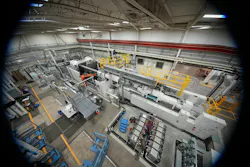
Problem: A mold maker looking to stay relevant within the tumultuous automotive industry sought ways to expand its portfolio of services, particularly in downstream applications such as painting and sealing.
Solution: KraussMaffei’s ColorForm technology extends the company’s capabilities to include polyurethane-coated parts, while providing the opportunity to offer small-volume molding.
Tariffs, trade wars and competition from lower-cost regions have created turmoil throughout the supply chain. For manufacturers that work within the automotive industry, the tumult is especially pronounced, as demand for vehicles has ping-ponged dramatically, from internal-combustion-engine (ICE) designs to electric vehicles and back.
What’s a mold maker or plastics processor to do?
For Dave Cecchin, president of Omega Tool Corp. in Oldcastle, Ont., which makes tooling for a large number of automotive OEMs and Tier 1 suppliers, the answer is simple: Be useful, stay relevant.
“We decided we don't want to leave our fate in the hands of our local politicians that are trying to eliminate or reduce tariffs and trade wars between Canada and U.S. So, instead of doing that, why don't we just become more relevant to our U.S. clients? Because, let's face it, everything we do is probably for the U.S. automotive market,” Cecchin said.
Central to that mission is a question the company and Cecchin himself ask: “How do we maintain our usefulness?”
Omega showcased answers to that question for around 350 industry participants at a tech week open house in mid-June. Highlighting the tour was Omega’s latest investment — a KraussMaffei ColorForm machine, installed in April, that provides the ability for in-mold color via the injection of a polyurethane (PUR) coating to the surface of the part within the mold.
In an interview prior to the open house, Cecchin was expecting visitors to be impressed by all they saw.
“I call our mold shops the casino. You walk through our mold shops, and your jaw drops,” he said, explaining that the comparison reflects the cleanliness, flow, organization and efficiency of Omega’s layout.
New capabilities to meet customer demand
Founded in 1980 by Cecchin’s father, Omega has established its reputation in the automotive industry, where it does about 85 percent of its business. It has expanded to two plants in Mexico, along with three plants in Canada, and employs about 350 people.
It’s doing well and lately, according to Cecchin, is emerging from a five-month downturn, precipitated in part by the industry’s aborted transition from ICE to electric and hybrid vehicles.
But Omega’s success doesn’t mean it’s standing pat.
“We're very good at what we do when it comes to building molds, and that's all fine and good, but we asked ourselves, we sat with our management and said, ‘Now what?’ ” Cecchin recalled.
Starting around 2012, in response to customer demand for testing and validation capabilities, Omega invested in a couple of large-tonnage injection molding machines from KraussMaffei, installing one in Mexico and three in Canada.
After that, customers started asking for other services, especially related to the priming and painting of large exterior body panels.
“We found there was a niche, or a sweet spot in a low-volume environment, where quite possibly there's business that our Tier 1 clients aren't interested in; they don't want to break into their mass-production lines,” Cecchin said.
To help these customers, Omega began offering automated painting/coating services for low-volume production contracts.
But it hasn’t stopped there.
Two years ago, a customer asked Omega about a new technology — KraussMaffei's ColorForm, an alternative to paint.
For a company that’s committed to finding additional ways to remain useful, the next steps represented a “natural progression,” Cecchin said.
He recounted: “We immediately went to KM.” Meetings between Omega and KraussMaffei, and several trips to Europe, resulted in a big purchase and what Cecchin characterizes as a “one huge learning curve,” as his company’s mold makers experimented with the ColorForm machine.
“It’s not a small investment, and there's a lot of risk associated with it. ... We're very in tune to what our customers like, what they don't like. ... We have very good relationships with all of our Tier 1 and OEM customers, and we listen to what issues they have. As you gather all this information, all this data, it helps us to decide where we're going to spend our CapEx,” he said.
Sealing the deal on PUR coating
KraussMaffei’s ColorForm technology involves coating plastic components with PUR directly in the injection mold in a single, integrated process, eliminating the need for painting.
“The technology delivers premium Class-A surface quality, excellent scratch and UV resistance, and exceptional design flexibility while reducing overall manufacturing complexity. In addition, ColorForm eliminates paint overspray and significantly reduces VOC emissions, helping manufacturers meet both sustainability and environmental objectives,” said John Fini, president of KraussMaffei Corp.
The company says the layer is tough enough to withstand damage from rocks, chemicals and ultraviolet (UV) light, and even provides a self-healing effect for fine scratches.
PUR layers can range from around 0.3mm to 0.6mm for interior panels to 0.8mm to 1.2mm for bumpers, Cecchin said.
But achieving that extra layer on plastic parts is tricky, as he explained.
"A PUR injection mold typically requires two of everything — two cores and two cavities, because what you're doing, in one operation, you're injecting the substrate or the plastic part, and then the next operation is you're injecting the polyurethane on top of the Class A surface of the substrate part,” he said.
Heated PUR flows like water, so sealing it off properly and preventing it from pooling are important skills Omega Tool’s workers have been practicing through in-house research and development since the company acquired the machine.
“Organizations considering ColorForm should also recognize that achieving optimal results requires expertise in tooling design, polyurethane processing, automation integration, and process control. However, when these elements are addressed early in program development, manufacturers can realize substantial benefits in quality, efficiency, sustainability and long-term cost performance,” Fini said.
When it first got the machine, Omega Tool had no molds to enable it to test this new PUR capability. Over a period of about three months leading up to the company’s open house, Omega designed and manufactured its own proprietary development tooling to showcase the machine’s capabilities, and to demonstrate various tooling conditions conducive to injecting PUR successfully onto a plastic substrate surface.
Help in learning a new technology
Cecchin said in addition to supplying the machine, KraussMaffei has been generous in doling out assistance.
From the beginning, he said, he communicated to the company, “ ‘You need to hold our hands while we're doing this,’ and you know, they have been here holding our hands. They've been educating us,” he said.
Fini said KraussMaffei is committed to supporting customers “throughout the entire journey, from concept development and feasibility studies to commissioning, production ramp-up and ongoing optimization.”
He said engineering teams work with the various stakeholders right from the start, including mold builders, material suppliers and automation partners, helping them optimize part and tooling designs and manufacturing processes to meet the program’s requirements.
“We provide training, process development support, commissioning assistance, production startup expertise and aftermarket service. ... Perhaps most importantly, we remain engaged long after installation,” to help meet changing needs and new opportunities, and to help the customer get the most out of their equipment investment, Fini said.
To learn about the machine, Omega Tool mold makers first had to make tooling for it. And, while TPO — the material commonly used for bumpers — presents challenges in combination with PUR, workers didn’t shy from it.
They had to learn under the conditions and specifications Omega Tool’s own customers will impose on jobs, Cecchin said.
The process for a PUR injected part requires two molds, one for the substrate and one for injection of PUR onto the substrate part’s surface. The substrate mold is designed to mold a part capable of accepting a PUR surface coating. The PUR mold holds the substrate part in place with adequate seal off needed to allow for the injection of the polyurethane coating.
“When you inject polyurethane onto the Class A surface, you're basically building a mold that will close with the plastic substrate part inside of it,” Cecchin said.
Injecting polyurethane on the surface of the substrate part requires a water-tight seal-off capable of handling extreme injection pressure, such that the polyurethane will not flash or leak out of any open areas.
The PUR creates new dimensions of variability that molders of uncoated bumpers don’t encounter.
Cecchin continued: “You have to hold that plastic part in a perfectly still position. ... If the part moves, the polyurethane will tend to create islands around the high spots.”
A constant process of refining
Since installing the 4,500-ton ColorForm machine, Omega’s workers have been continuing to make tweaks.
They’ve probably taken that same tooling off five times, as they have learned more about PUR coating through “obviously a lot of trial and error,” Cecchin said.
Taking on new technology and promoting new capabilities isn’t a slam dunk; it’s always a gamble.
“It is a journey, and we're not at the end of the journey yet. We're still learning, and absolutely, it's high risk,” Cecchin said.
“The reason why the PUR technology exists on our campus is because we were making an educated bet or wager that our OEM and Tier 1 customers, over the next little while, are going to start wanting more body panels molded and colored,” he said.
For Omega Tool, the ability to churn out parts with a specialty process at lower volumes is another way to stay relevant, as it tries to serve global customers more concerned about running and painting parts at mammoth volumes.
“Low volume is not where you're going to make your money when you're investing into $80- to $100 million paint systems,” Cecchin said.
At a time when Mexico and Canada are grappling with changes in the U.S. government’s approach to trade, such as the United States-Mexico-Canada Agreement (USMCA), Cecchin lavished praise on his company’s partners for offering stability and support.
In addition to KraussMaffei’s presence at the open house, he was anticipating showing off how Omega Tool has been using its Stratasys F3300 3D printer.
Over the last couple years, Omega Tool has used 3D printing to perform a variety of applications, including making machine repairs, end-of-arm tooling and paint masks. 3D printing has become a “go-to-fix" type tool, Cecchin said.
As it expands beyond simply making tooling, Omega Tool is still looking out for its customers, with a vertical integration plan that has “allowed us to do to be more and do more for our Tier 1 and OEM clients,” he said.
That’s kept it focused on the big payoff — staying useful.
“How do we maintain our usefulness in the eyes of our client? And if we are useful to them, and if we are relevant to them, and if we provide all this value-added services to them ... that may tilt the scales more in our favor, even though we're in a hostile social-economic government setting now between all three countries that make up the USMCA,” Cecchin said.
Contact
KraussMaffei USA, Florence, Ky., 859-283-0200, www.kraussmaffei.com
About the Author
Karen Hanna
Senior Staff Reporter
Senior Staff Reporter Karen Hanna covers injection molding, molds and tooling, processors, workforce and other topics, and writes features including In Other Words and Problem Solved for Plastics Machinery & Manufacturing, Plastics Recycling and The Journal of Blow Molding. She has more than 15 years of experience in daily and magazine journalism.