Press suppliers tout advanced manufacturing processes
At NPE2018, injection molding machinery suppliers operated sophisticated manufacturing cells showcasing technologies and processes that facilitate color changes, improve in-mold decorating and advance multi-material molding.
SUMITOMO SPEEDS COLOR CHANGES
Sumitomo introduced a fully automatic color-change system that reduces the time and labor required to change the color of a molded part, while minimizing the amount of colorant used.
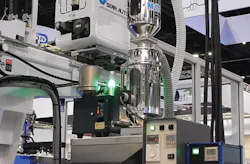
The system is available as an option on Sumitomo's SEEV-A line of all-electric injection molding machines.
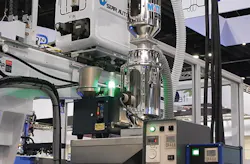
A Pigmic-brand pigment mixer from CAM Co. Ltd., Tochigi, Japan, is connected to the hopper on the injection molding machine. It precisely weighs and meters powdered pigment into the feed throat of the injection unit.
The quick-color-change system also incorporates a high-definition color camera with an image sensor to identify and reject parts that are the wrong color.
The programmable Pigmic mixer receives feedback from the camera when a color adjustment is required. The mixer precisely adjusts the amount of pigment used to achieve the desired tone. The quality-control capabilities of the SEEV-A machine, coupled with the Pigmic mixer, image sensor and camera, prevent bad parts from leaving the factory, Sumitomo regional manager Tony Marchelletta said.
The ability to precisely adjust the pigment level provides a cost savings to the molder versus using masterbatch. Approximately 17 percent less colorant is required when the closed-loop system is used. Also, the Pigmic mixer prevents powder from collecting inside of the material hopper.
At the show, an SE50EV-A press molded 1.9-gram vacuum-cleaner fan blades from PP in a three-cavity mold every 14 seconds. The part color was changed from blue to white.
ENGEL ADVANCES IN-MOLD DECORATION
For the first time in North America, Engel demonstrated its DecoJect in-mold decorating process in a fully automated, integrated production cell producing premium automotive interior components.
The DecoJect process combines injection molding with Engel's in-mold graining process. DecoJect is distinct from conventional in-mold decorating processes in that it doesn't transfer paint from a film to the molded part in the mold. Instead, the painted film is molded into the outer surface of the part.
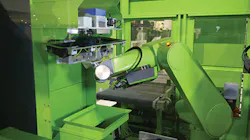
The DecoJect process gives parts high-quality colors, patterns, surface structures and haptics and significantly increases scratch resistance, said Larry Alvey, manager of Engel's North American automotive business unit. What's more, part surfaces and decoration can be varied just by changing the film.
At NPE2018, Engel used one film roll to impart a refined leather-grain texture, including seams, to automotive interior parts. It switched to another film roll to give the parts a modern, carbon-fiber look, Alvey said.
An Engel duo 5160/1000 servo-hydraulic two-platen injection press and its CC300 machine control formed the core of the machinery cell.
The DecoJect process shown at NPE2018 started with a thin TPO film that was drawn from a roll between the halves of an open mold. An infrared radiator oven mounted on an Engel Viper robot heated the film, and a vacuum pulled the film into the mold cavity. The mold closed, and the film was back injection molded; the mold also punched out the film from the web. An Engel easix articulated robot transferred the decorated part to an integrated laser station for precision cutting and then placed it onto a conveyor.
Engel also used the triennial trade show to demonstrate its know-how in processing liquid silicone rubber (LSR). For the first time, Engel presented a production cell making LSR lenses for LED automotive headlights, said Joachim Kragl, director of advanced molding systems and processing for Engel North America.
Engel produced a complex LED headlight lens from LSR in a two-cavity mold using an e-victory tie-bar-less all-electric machine with 120 tons of clamping force. "Complex lens geometries can be efficiently and consistently produced with injection molding," Kragl said.
Engel said LSR is rapidly gaining importance in a wide range of technical parts, including automotive and construction parts, as well as street lighting, due to its special characteristics. LSR has a lower rate of yellowing than standard thermoplastics used for lenses. It also is UV-resistant and stable across a broad temperature range.
ARBURG TAKES TURNKEY MULTI-COMPONENT SYSTEMS FURTHER
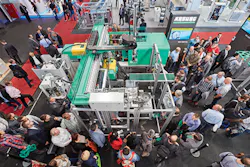
Arburg presented turnkey manufacturing cells showcasing sophisticated multi-component LSR molding and LSR micro injection molding.
In a U.S. debut, an Arburg Allrounder 570 A molded a wristwatch strap from two LSR materials with different hardnesses and colors. The electric machine was configured with two injection units. The primary injection unit produced a 1.13-ounce shot while the second injection unit delivered a 0.05-ounce shot, said Friedrich Kanz, managing director of Arburg Inc. The press used a 2+2-cavity mold and had a cycle time of 75 seconds.
Arburg incorporated a new technology into the cell, a CPP Reader, which automatically verifies whether both LSR materials are formulated correctly. The reader worked with two LSR mixing, metering and dispensing systems that fed an injection unit that produced one component in the two-component strap. The reader and the two systems were provided by 2KM North America Inc., Parry Sound, Ontario.
An Arburg Multilift V 15 linear robot removed the strap from the mold, set it down in a cooling station and then moved it to an assembly station where a timepiece and clasp were added, Kanz said.
Arburg demonstrated multi-component LSR molding in a second machinery cell that produced a micro-molded diaphragm used in valves for the medical and automotive industries.
An Arburg Allrounder 270 A injection molding machine with a micro injection unit produced the first component, a 0.05-gram part with a hardness of 30 Shore A. A second add-on servo-injection unit produced the second LSR component, a 0.005-gram 70 Shore A part. The add-on injection unit was supplied by Kipe Molds Inc., Placentia, Calif., and was fully integrated into the Arburg machine and controlled by Arburg's Selogica machine controller.
The multi-component LSR part was made in a 1+1 cavity mold in a cycle time of 15 seconds, Kanz said. An Arburg Multilift H 3 linear robotic system removed the LSR/LSR diaphragm from the mold, presenting it to a camera inspection station for quality assurance before transporting it to a container.
KRAUSSMAFFEI COMBINES PROCESS TECHNOLOGIES
KraussMaffei demonstrated new capabilities for its FiberForm technology in a manufacturing cell making a lightweight, multi-material automotive part.
KraussMaffei's FiberForm process marries the thermoforming of continuous-fiber-reinforced composite sheet with injection molding. KraussMaffei now has incorporated its SpinForm technology for molding parts from multiple materials. At NPE2018, the combined technologies produced a center armrest for an automotive interior.
"This combination can be used to create completely new visual and haptic component features for thermoplastic composites in a single process," said Paul Caprio, president of Krauss-Maffei Corp.
The automotive part was molded on KraussMaffei's GXW 450-2000/1400 machine configured with the SpinForm swivel plate for multi-shot, multi-component molding. The MC6 machine control ran KraussMaffei's Adaptive Process Control (APC) program, which optimizes injection by monitoring melt viscosity in real time. Proper Group International, Warren, Mich., is the mold maker.
First, an industrial robot transferred a 1mm-thick, continuous-fiber-reinforced sheet to an infrared heating station located directly above the mold parting line. The robot then transferred the heated sheet to the mold, where a vacuum system pulled the sheet into the contours of the mold.
Two parts were molded on one side of the mold: The top part was created by encapsulating the sheet with PP and the bottom part was primarily molded from PP. In a second step, the SpinForm swivel plate rotated so that a second injection unit could apply TPE to both parts. The TPE was flow-coated on to the visible and functional surfaces of the top part and applied to specific regions of the bottom part, Caprio said. A second robot handled demolding. Combining the two processes results in a lightweight, rigid part featuring a surface that is soft to the touch.
KraussMaffei said its SpinForm swivel-plate technology offers advantages over a rotary table, index plate or sliding table. The swivel plate rotates between the stationary and moving platens. At NPE2018, two mold parting lines were used, which allows a molder to use twice the number of cavities without switching to a larger machine. The SpinForm device is compact, even for large molds, making the technology useful for producing large parts or multiple components.
Mikell Knights, senior staff reporter
Contact:
Arburg Inc., Rocky Hill, Conn., 860-667-6500, www.arburg.com
Engel Machinery Inc.,
York, Pa., 717-764-6818,www.engelglobal.com
Krauss-Maffei Corp.,
Florence, Ky., 859-283-0200,www.kraussmaffeigroup.us
Sumitomo (SHI) Demag Plastics Machinery North America Inc., Strongsville, Ohio, 440-876-8960, www.sumitomo-shi-demag.us