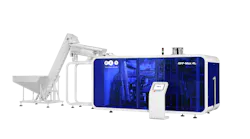
Minimize bottle bursting in high-output PET stretch blow molding
Key Highlights
-
High-speed PET stretch blow molding requires precise pressure, timing and motion control to prevent deformation, bursting and excessive scrap.
-
Dome regulators provide responsive pressure control across pre-blow, intermediate and final blow stages while adapting to format changes.
-
Proportional valves dynamically stabilize pressure within milliseconds, supporting compact blowing stations and consistent performance at high production speeds.
-
Real-time flow and air quality monitoring, combined with pre-engineered blowing blocks, improves process stability and reduces bottle defects.

The next generation of bottling operations targets 80,000 to 90,000 bottles per hour (BPH). This production rate compresses the full blowing sequence into a process window as narrow as 0.8 seconds. At the process speed required to achieve this rate, conventional blowing technologies struggle to switch valves quickly enough or hold pressure tightly enough to perform reliably, destabilizing processes and resulting in burst bottles.
In the first year of operation, unstable PET blowing processes can result in initial scrap rates of 10 to 15 percent, wasting production, energy and material and increasing costs. Bottle bursting adds to financial loss through delayed commissioning and unplanned downtime, while deformation leads to failed performance tests that put customer confidence at risk.
Although the root causes of process instability are rarely obvious, stretch blow molding OEMs can still address them. During the blow sequence, pre-blow, intermediate and final blow stages shape heated preforms into finished bottles. Precise control of pressure, timing and motion determines the success of each stage. Small inconsistencies in air pressure, valve timing or stretch rod motion can cause variation in wall thickness, deformation and bursting.
However, when pressure, timing and motion are fully synchronized across all three stages, material distributes evenly, walls form to specification and bottles hold their shape under load and carbonation pressure.
By stabilizing these critical factors, OEMs can eliminate the root cause of bottle bursting and design blowing stations that run faster, waste less and deliver consistent output. Fit-for-purpose pressure regulators, proportional valves and complete, pre-engineered blowing block solutions can provide this level of stability and dynamic control.
Here are four ways to integrate these components in machine designs to precisely control the blowing profile across pre-blow, intermediate and final blowing stages, improving processability and minimizing bottle bursting.
1. Optimize blow sequence pressure delivery using dome regulators
To achieve greater first-pass yield and fewer burst bottles on high-speed bottling lines, every part of the blow sequence — the pre-blow, intermediate and final blow stages — requires precise, consistent pressure delivery within very tight process windows. While standard switching valves can be used, these components lack the responsiveness to adjust pressure fast enough on high-speed lines. The addition of pressure tanks helps, but it prevents the level of flexibility needed for modern production.
In comparison, there are now dome regulators that can deliver precise, consistent pressure within tight process windows during each stage of the blowing sequence with the process flexibility today’s bottling lines require. The design of these sophisticated devices includes a proportional valve pilot that controls chamber pressure and a specialized membrane that compensates for pressure fluctuations.
The combination is far more responsive than standard switching valves and provides tighter pressure control across all three stages of the blow sequence. It also has the ability to adapt to format changes without recommissioning risk. And, in the event of a bottle burst, dome regulators can hold pressure throughout it, protecting bottles that follow.
2. Maintain dynamic flow and pressure control using proportional technology
For blowing stations to work effectively and efficiently during each part of the blow sequence, complex control loops must support multiple media volumes and pressure levels. Each stage requires a different pressure level: The pre-blow stage is usually set around 16 bar, the intermediate stage around 26 bar and final blow around 38-40 bar. To meet high-speed blowing cycles, pressure levels must be precisely adjusted within milliseconds.
Blowing stations can achieve this balance of speed and accuracy with electronically controlled proportional valves. These components can provide the precise, responsive control needed to adjust pressure across each stage of the blowing sequence while protecting the system from sudden pressure changes due to a burst event or malfunction.
The proportional valves use integrated controllers to dynamically stabilize pressure levels. If the pressure level deviates from the required setting during a given stage of the blowing sequence, the controller immediately adjusts the valve opening to maintain stable pressure.
In addition to dynamically controlling pressure, proportional valves with an integrated controller have another advantage. With a much smaller footprint than alternate solutions such as a compressed air tank, electronically controlled proportional valves make it possible for OEMs to build more compact blowing stations.
3. Improve air supply stability by addressing flow and quality
As the margin for error shrinks at high line speeds, every element of the stretch blow molding process matters. This includes air quality and flow at the air supply. Maintaining high-quality air distribution from the source help protect process integrity, as excess moisture, leaks and contamination can cause irregularities that travel downstream. Pneumatic irregularities often introduce pressure variations during the blow sequence, affecting bottle quality and leading to deformation and bursting.
PET stretch blow molding lines that include flow and air quality measurement solutions such as ultrasonic flow sensors and dew point sensors enable operators to monitor supply conditions in real time and quickly address issues that threaten processes.
Ultrasonic flow sensors attach externally to the supply line, continuously measuring flow volume without contacting the media. This noninvasive installation approach prevents operational disruptions as well as interference with aseptic processes. Using real-time flow data, operators can quickly identify leaks, calculate cost savings related to compressed air recycling and improve overall process efficiency.
The addition of dew point sensors at the air supply allows operators to continuously monitor humidity, dew point and quality of compressed air. Too much humidity in the pneumatic line can impact valve switching times or cause forming bottles to cool too quickly, resulting in inconsistent quality. Continuous air quality data helps operators optimize process conditions and maintain reliable pressure during the entire blow sequence.
Combined, these real-time pneumatic measurements give operators greater visibility to maintain precise process control and minimize defects.
4. Tighten process control with pre-engineered blowing blocks
Designing a highly precise stretch and blowing unit from scratch takes substantial time, resources and pneumatic expertise. With the ongoing skilled labor shortage, talented OEM engineering teams may already be extended across projects. Blowing blocks that are pre-engineered and tested can reliably manage the full sequence of pressure changes across the entire process with millisecond accuracy while shortening product development and assembly time.
Within these integrated solutions, pre-blow, intermediate and final blow pilot valves operate in sync, achieving rapid switching cycles that hold timing within the tightest process windows and stabilizing pressure control across all blow stages. By integrating pre-engineered blowing blocks into their designs, OEMs can build high-density blowing stations that attain repeatable precision and superior process stability at accelerated production speeds.
Leading component suppliers offer engineering services to co-engineer these blowing blocks. For instance, Emerson pneumatic experts use the company’s proven pneumatic technologies to build compact blowing blocks that are customized and tested to OEM application requirements.
Design options can include air recycling capabilities that recover compressed air across the blowing sequence, aseptic designs for hygienic and food-contact applications and PFAS-free innovations to meet evolving material and compliance requirements.
Designing high-speed PET blowing stations that stop bottle bursting at the source
In PET stretch blow molding processes, even minute deviations in air pressure, valve timing or stretch rod motion can cause deformation and bottle bursting, increasing scrap rates and rework. As throughput targets reach 80,000 to 90,000 BPH and line speeds increase, blowing stations must maintain stability within extremely tight process windows.
By incorporating fit-for-purpose pressure regulators, proportional valves and pre-engineered blowing block solutions into equipment designs, OEMs can stabilize the blowing process at the source and engineer machines that are ready to effectively and precisely control pressure at every step.
This article appears in the fall 2026 issue of The Journal of Blow Molding.
© 2026, Society of Plastics Engineers Blow Molding Division
About the Author
Manuel Görbert
Manuel Görbert is Segment Marketing Manager, Factory Automation, Fluid & Motion Control, at Emerson. Drawing on his extensive experience with pneumatic and motion control applications for the packaging industry, he works alongside the Emerson development team and in collaboration with OEMs and end users to develop precise control architectures that improve throughput, reliability, and sustainability in high-speed production environments. Manuel supports the AVENTICS™ portfolio of pneumatic solutions for packaging applications.