Patent Report: Flow-control system cools preforms


A new technology from Athena Automation, Vaughan, Ontario, is designed to provide more uniform cooling of PET preforms. The invention replaces pressure-control cooling circuits with flow control.
"Flow control combines series and parallel flow through each take-off tube, significantly reducing the amount of flow required in order to maintain turbulence and ensure even distribution across an assembled plate," said Rob Sicilia, PET business manager. "Pressure-control plates use parallel
circuits to supply individual take-off tubes, which require significantly more flow to ensure proper turbulence at each take-off tube."
Even with less than half the flow, flow control can provide a comparable or better cooling effect than pressure control, Sicilia said.

Flow-control testing by Athena Automation has shown that the new process results in a temperature variation of less than 9 degrees across a 72-cavity plate versus 32.4 degrees Fahrenheit with the previous technology. The approach is currently used by the company in test setups with 32- and 72-cavity molds.
PET preforms can require significant cooling time, sometimes more than double the time it takes to form the part in the mold. The cooling plates referred to in the patent are located outside the mold. Other benefits of the technology include reduced construction costs, particularly if booster pumps can be eliminated due to reduced water flow. Sicilia and Robert Schad, the founder of Athena Automation, are the inventors.
Patent Application 20160271850; published Sept. 22
In other patent news:
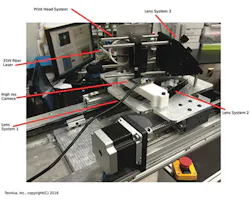
3-D printing. A new type of print head significantly speeds up the selective laser sintering (SLS) process, according to a patent awarded to Charles Bibas, founder and CEO of Technica Inc., Great Neck, N.Y. A "beam director" in the inventionis capable of enabling print speeds that far exceed those of older systems, which often have a maximum speed of about 20 feet per second, according to Bibas.
Next month, Technica will release two new printers using the technology — the Casa and the Casa Pro. The Casa will have a print resolution of less than 0.2mm and cost $9,200, while the Casa Pro will have a resolution of less than 0.1mm and cost $14,995. Both models will have build volumes of 3.6 inches by 3.6 inches by 5.9 inches.
In addition, the company plans to release a metal-printing model, called the Optima, next August. Capable of printing tool inserts, the Optima can handle a variety of build materials, including stainless steel, aluminum and titanium. Its build volume will be 31.5 inches by 23.6 inches by 59 inches, and it will cost $99,905.
The Casa models use a 25-watt fiber laser for sintering, while the Optima has the option of either a 100-watt or 250-watt laser.
Patent 9,435,998; issued Sept. 6
Closure unit. A new technology from Engel Austria, Schwertberg, seeks to reduce the costs of systems used to close injection molding machines. The new approach employs a vertical restraint device to hold and lock the movable mold-mounting plate to at least one frame bar.
Patent 9,452,559; issued Sept. 27
Contact:
Patents and patent applications can be viewed at www.uspto.gov
Have you applied for or received a patent? Contact [email protected]