Wickert press is tailored for aircraft parts
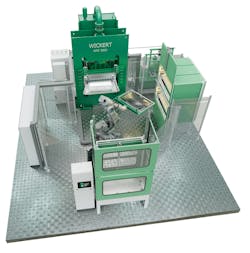
Thermoforming press for aircraft structural components Appropriate for numerous composite materials used to make structural aircraft components from composite materials, including carbon fiber-reinforced thermoplastics such as polyphenylene sulfide (PPS) and polyetheretherketone (PEEK), this new semi-automated press from Wickert, Landau, Germany, encompasses all stages of the thermoforming process — from raw part loading and preheating to the actual pressing process and unloading. It works in conjunction with an industrial robot as part of a customizable handling system. The industrial robot picks up a blank fixed to a clamping frame, and transports it into a double-decker infrared oven, where the part is heated to the required temperature. Then, the robot removes the clamping frame with the preheated component from the oven and immediately transports it to the press, where it is precisely positioned and formed. After pressing, the robot transfers the part back to the input/output station, so it can be prepared for the next stage. In the U.S., Desma represents Wickert.
What’s new? The thermoforming press, which Wickert planned to show in March at JEC Paris. In addition to the press, Wickert developed the frame components and the grippers of the accompanying industrial robot.
Benefits Safety, efficiency and higher outputs, thanks to the automation, which significantly reduces the need for operator intervention, especially around hot parts. The new press allows for flexible processing of components of different sizes, and it maximizes precision, quality and efficiency. In addition to its robot handling system, the press features a customizable control system that allows recipe changes to be carried out quickly and effortlessly, and its double-decker oven allows two clamping frames with components to be tempered at once.
Desma USA Inc., Hebron, Ky., 859-372-3347, https://www.wickert-presstech.de/en
Vital Statistics
|
Maximum processing temperature |
842 degrees Fahrenheit |
|
Maximum length of possible components |
About 3.6 feet |
|
Heating time |
Within 2 minutes |
|
Forming time |
About 1 minute |
|
Amount of time needed for the robot to remove the clamping frame with the preheated component from the oven and transport it to the press |
Less than 5 seconds |
About the Author
Karen Hanna
Senior Staff Reporter
Senior Staff Reporter Karen Hanna covers injection molding, molds and tooling, processors, workforce and other topics, and writes features including In Other Words and Problem Solved for Plastics Machinery & Manufacturing, Plastics Recycling and The Journal of Blow Molding. She has more than 15 years of experience in daily and magazine journalism.