C&K Plastics expands solar power across four plants
Key Highlights
- C&K Plastics has installed solar energy systems at all four of its manufacturing facilities, in New Jersey, Georgia, North Carolina and Pennsylvania.
- Electricity savings, tax incentives and state programs have influenced the company's solar investments.
- The solar installations complement equipment upgrades and other energy-conservation measures across C&K Plastics’ manufacturing operations.
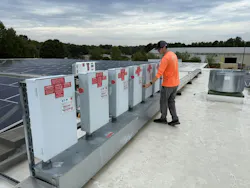
C&K Plastics, a contract manufacturer founded in 1962, has embraced solar energy technology in a major fashion, installing systems at all four of its manufacturing facilities.
The company runs three thermoforming operations and one profile extrusion operation. The company produces cut-sheet, heavy-gauge thermoformed components using vacuum forming, pressure forming, twin-sheet forming, and thermoplastic and thermoset profile extrusion.
“I had always been interested in the fact that you could turn photons into electricity,” company CEO Robert Carrier said. “I thought it was a good idea.”
C&K Plastics’ first solar installation launched about 15 years ago. The company installed a $2.2 million, 498-kilowatt system at its Metuchen, N.J., thermoforming facility and headquarters. The system supplied 41 percent of the plant’s electricity needs.
A New Jersey program made the project particularly attractive because it required no money down for the project.
It was financed largely through a loan from the local electric utility company, Public Service Electric and Gas (PSE&G), Carrier said. The loan was repaid with money from New Jersey’s Solar Renewable Energy Certificate (SREC) program, which lets solar panel owners earn money for every megawatt-hour of electricity their system generates.
The loan, which was expected to take about 12 years to repay, was paid off in about eight or nine years, without C&K having to write any checks toward it, Carrier said. Many states do not offer an SREC program.
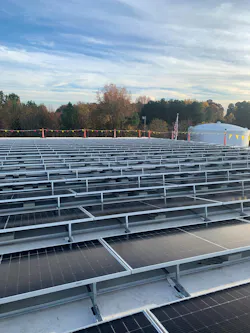
After the loan was repaid, C&K Plastics began receiving payments from the New Jersey SREC program. The value of the SRECs over 15 years was about $3 million, Carrier said in an email to Plastics Machinery & Manufacturing.
New Jersey also offers full retail-rate net metering, allowing solar customers to offset their electricity bills dollar-for-dollar with excess power sent to the grid.
“In New Jersey, when you sell electricity, they have to buy it at the same rate that you're paying for it, which is unbelievable,” Carrier said.
C&K Plastics also received a federal grant of $660,000 for the New Jersey solar installation completed in about 2011, Carrier said.
The combination of avoided electricity costs and state and federal incentives made the economics compelling, Carrier said. He called the results “spectacular.”
However, the federal government has begun phasing out grants and solar investment tax credits that can make solar energy projects extremely appealing.
In 2025, the One Big Beautiful Bill Act significantly tightened the timeline for solar projects, according to information on the Solar Energy Industries Association website. Under the new requirements, any solar project that begins construction after July 4, 2026, must be placed in service by Dec. 31, 2027. Projects started before July 4 may have later deadlines.
“The federal gravy train has ended, unfortunately,” Carrier said in an emailed comment to PMM. “[I’m] not sure how far the price has dropped on installation, but the panels are only part of the cost. Wire costs have doubled since tariffs were implemented, and inverters are probably up also.”
Success prompted C&K to move on to other plants
The success in New Jersey prompted Carrier to investigate installing solar energy systems at C&K Plastics’ other plants, as well as replacing the system in New Jersey. Construction on these projects began while federal grants and federal tax incentives were still available.
In 2022, C&K installed a $1 million, 772-kW solar energy system at its 100,000 square-foot facility in Conyers, Ga. The company received a $185,000 federal tax credit and saved $120,000 per year on electricity. With tax depreciation, the company will achieve payback in about five years, Carrier said.
In 2026, C&K has been installing:
- A $2.68 million, 1.27 MW solar electric system at its 95,000 square-foot plant in Mooresville, N.C., which received an $802,000 federal tax credit, and electric savings are forecast at $100,000 per year.
- A $2.65 million 1.3 MW solar energy system at its extrusion plant in Easton, Pa., which received a $2 million federal tax credit, and estimated electric savings of $390,000 per year.
- A replacement $2.2 million, 1.14 MW solar electric system at its plant in Metuchen, N.J., which supplies double the energy of the original system installed 15 years ago. The replacement New Jersey system received a $1.48 million federal tax credit and is expected to produce electric savings of $340,000 per year, Carrier said.
The North Carolina solar energy system has resulted in about 84 percent average energy savings, Carrier said. The Georgia reduction is about 60 percent on average — a little higher in summer and lower in winter, and in New Jersey, the new system is expected to supply about 80 percent of the plant’s energy needs, Carrier said.
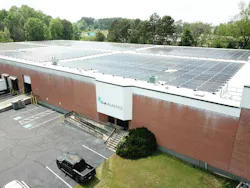
The projects also carry tax benefits involving depreciation, Carrier said.
Carrier estimates the three C&K Plastics solar energy projects undertaken this year will achieve payback in less than one year. The Pennsylvania facility’s solar energy project began construction in September.
The Pennsylvania and New Jersey replacement systems will benefit from state solar renewable certificate (SREC) programs, Carrier said. Incentives differ from state to state.
The North Carolina facility benefited from an $819,000 USDA Rural Energy for America Program (REAP) grant. The program guarantees loan financing and grant funding to agricultural producers and small rural businesses for renewable energy systems or energy efficiency improvements in eligible rural areas, according to the USDA website. The agency’s website in September stated that “the agency is not accepting REAP grant applications at this time. Guaranteed loan applications may be submitted.”
Without the various federal and state incentives, Carrier says he probably wouldn’t have moved forward with solar energy systems in his plants.
“Would I put these solar systems in if they didn’t come with the tax credits? Probably not at today’s cost of electricity, but I haven’t done the analysis because there’s no reason to,” Carrier said. “I don’t have another building to put solar on right now.”
Installation costs are going up
Carrier said the cost of electrical infrastructure has risen sharply, which makes installation more expensive.
When C&K this year replaced its original New Jersey solar energy system and doubled its size, the federal incentive he received required the old system to be completely removed, including its wiring, ballasting and conduits, rather than allowing C&K simply to upgrade or expand the existing installation, Carrier said.
Carrier anticipates the solar energy systems he is putting in today will last for 25 years or more.
In addition to installing solar energy systems, C&K Plastics has undertaken energy conservation measures, including adopting summer hours in New Jersey to reduce demand, which is very high in the PJM (Northeast U.S.) territory, Carrier said.
PJM is a regional transmission organization that coordinates the movement of wholesale electricity in all or parts of 13 states and the District of Columbia, according to its website.
C&K Plastics has been consistently updating its equipment, which improves its energy efficiency.
“Ninety-five percent of our equipment is microprocessor controlled for reducing peak demands and total power consumption,” Carrier said.
C&K has also converted all lighting to LEDs.
Solar integrator offers advice
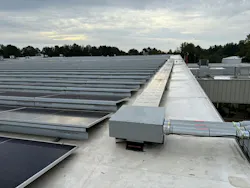
Hannah Solar, a full-service solar and battery-storage integrator based in East Point, Ga., designed and installed the solar energy systems at C&K Plastics facilities in Georgia and North Carolina.
When helping a manufacturing client decide whether to install a solar-electric system and the size, Hannah Solar evaluates a customer’s energy bills, how much space they have available for solar panels, and the local electric utility’s policies regarding solar electric systems and how they compensate for excess power sent to the utility grid.
Solar installations must be engineered around both energy consumption and available roof space, said Pete Marte, Hannah Solar CEO. A large roof alone doesn't necessarily make a facility a good solar candidate. It also should have significant energy requirements.
“When you have a manufacturer, especially in plastics, which uses quite a bit of energy and has a good-sized roof, it’s a really good option,” Marte said.
A facility with a huge roof but relatively low electricity needs could produce more solar power than it can use, forcing it to sell excess electricity to the electric company often at a relatively low rate. Conversely, an energy intensive facility without adequate roof space might not generate enough solar electricity to make a meaningful reduction in grid purchases, he said.
Marte said that a commercial customer in Georgia might pay 14-15 cents per kWh for electricity, while receiving only about 3 cents per kWh for excess electricity sent back to the utility grid. The utility calls the latter its avoided cost. However, a few states offer true net metering, which compensates the owner of a solar electric system for the same price per kWh as they pay for electricity from the power grid. The difference in compensation could affect decisions about the size of the solar electric system.
“Unfortunately, it's not one size fits all,” Marte said. “It's pretty much all customized engineering solutions.”
It’s typical for commercial customers to use solar electricity during the day and purchase power from the grid at night.
Might federal incentives make a comeback?
A federal renewable energy tax credit, as noted above, is scheduled to expire at the end of 2027 for solar energy projects that are not already underway. That has sparked interest in installing systems quickly.
“Now, you have to be installed and operational by the end of 2027 or you’ll get zero,” Marte said. “Right now, our phone is ringing off the hook because people want to install, and they want to get going now. To do it by the end of 2027, you need to have a conversation with someone like us very quickly. There’s no time to dawdle.”
Today, that tax credit can typically cover about 30 percent of a project’s cost. However, additional bonus credits are potentially available if certain conditions are met, such as domestic content requirements for steel, iron and manufactured products or if a project is installed in a designated “energy community.”
Projects that started on or before July 4, 2026, may have longer deadlines to complete their installations.
Installing a solar energy system can give a manufacturer an edge on controlling electricity costs, Marte said.
“You get a guy like Bob [Carrier], who was five or six years ahead of his peers, and he doesn't have to worry about the cost of power going up as much because all the power during the day is coming from his system that's on his roof that he owns,” Marte said. “He's already hedged his energy, at least 50 percent of it. It's smart business.”
Marte didn’t rule out the possibility of federal tax credits returning.
There are bipartisan efforts in the House to restore or extend the clean energy tax credits that are being phased out.
“There's already a bill that's been introduced by [four] Republicans to bring back the tax credits because they were halted too quickly,” Marte said. “They need to be halted at some point in the future, but it was just such a short timeline.”
The outcome of legislation that would restore the credits could depend on the outcome of the midterm elections, he said.
“That bill will probably be reintroduced if Democrats take control, and it will then have to go through the process, and we’ll see what happens,” Marte said. “We, in the energy business, will be sitting on pins and needles.”
About the Author
Bruce Geiselman
Lead Reporter
Senior Reporter Bruce Geiselman covers plastics processing technologies and end markets including automotive and packaging. He also writes features, including In Other Words and Problem Solved, for Plastics Machinery & Manufacturing and The Journal of Blow Molding. He has decades of experience in daily and magazine journalism, including eight years at PMM, and is the recipient of a Jesse H. Neal Award, among other recognitions.