New Kiefel thermoformer produces more with less energy
Key Highlights
- Kiefel's KTR 6.2 Speed can produce up to 86,000 cups per hour.
- Patent-pending features like SpeedGuard and ProSpacing improve process speed, safety and product handling.
- The machine supports multiple materials, including recycled plastics, and can form products up to 10 inches tall.
- Integration with Siemens' digital twin software allows real-time simulation, training, and performance optimization.
- Enhanced user interface and process automation reduce training time and increase operational efficiency.
By Ron Shinn
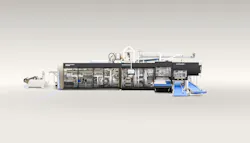
Kiefel GmbH drew plenty of attention at the K show with its new Speedformer KTR 6.2 Speed, which it claims can deliver 50 percent more production with 10 percent less energy.
The KTR 6.2 Speed follows an earlier model called the KTR 5.2 Speed, which could produce standard plastic cups up to about 7.5 inches. The company also previously released a Speedformer KTR 6.2.
The redesigned KTR 6.2 Speed can make standard cups and coffee capsules up to about 10 inches tall.
The new, high-performance thermoformer has a maximum forming surface of about 33.1 inches by 23 inches. Punching force is 90 tons and production speed is 45 cycles per minute. It can process PP, PET, PS, polylactic acid (PLA) and recycled materials, as well as PET and recycled PET (rPET) in a single operation.
Kiefel said a machine redesign and optimization of processes, along with intuitive operator guidance, make production increases possible. The machine can produce up to 86,000 cups per hour, according to a Kiefel spokesman.
“What matters to our customers is how they can work as profitably as possible with our solutions,” said Michael Staudinger, product manager at Kiefel, which is part of the Brückner Group. “Pure output is only one aspect. Energy costs, flexibility and usability are equally important.”
The KTR 6.2 Speed includes two patent-pending features, the SpeedGuard film guide and ProSpacing system.
The trademarked SpeedGuard film guide automates transfer of the remaining film after punching with no human intervention. It adapts to different film widths and enhances process speed and safety.
The trademarked ProSpacing system optimizes handover of formed products to downstream automation, regardless of product geometry. This can be a critical task at higher machine speeds.
Production and performance data is available through one of Kiefel’s preconfigured data packages. Data is transferred through a standard OPC-UA interface that is independent from the control system. The data can also be integrated into a company’s ERP or other data system.
Kiefel’s data analyzes energy consumption per 1,000 parts, film consumption and machine availability. The company said this permits better identification of efficiency potential, faster detection of the causes of errors and long-term improvement of the production process.
The controller is a new Simatic S7-1518 from Siemens. Staudinger said the goal in developing the controller was that operators “who had never worked with the KTR machine before can quickly find their way around the user program and add value without extensive training.”
As a crowd clogged the aisle watching Kiefel’s KTR 6.2 Speed operate, a dozen or so booths away another crowd standing in front of a wall-sized screen in the Siemens booth watched a digital twin of the same machine operating in real time. Siemens did not have cups to hand out, but the crowd was digitally wowed.
Siemens designed the control and drive systems on the KTR 6.2 Speed, and the software supports digital twin capabilities.
Siemens sells digital twin software, which Kiefel said it uses to simulate operating scenarios and errors, train users and test performance limits without risk to the machine.
In addition to the new KTR 6.2 Speed, Kiefel ran a Natureformer KFT Lab producing margarine containers from pulp using the double-dip wet-fiber process. The food-compliant containers included barriers for oils and fats but are still suitable for recycling.
The KFT Lab has a pressing force of 2.6 tons and maximum forming service is about 12 inches by 8 inches. The maximum part height is about 5 inches. The machine is designed for product development and sample production.
Contact:
Brueckner Group USA Inc., Dover, N.H., 603-929-3900, www.kiefel.com
About the Author
Ron Shinn
Editor
Editor Ron Shinn is a co-founder of Plastics Machinery & Manufacturing and has been covering the plastics industry for more than 35 years. He leads the editorial team, directs coverage and sets the editorial calendar. He also writes features, including the Talking Points column and On the Factory Floor, and covers recycling and sustainability for PMM and Plastics Recycling.