Granulators, shredders cut plastic waste down to size
Key Highlights
- At K 2025, manufacturers of recycling equipment emphasized bigger granulators and smarter controls to cut cost, energy and downtime.
-
Bruno Folcieri’s 38-ton EZ10 targets 24/7, high-volume grinding, claiming it can replace three standard granulators.
-
Hellweg added Smart Flow bulk-rate measurement, feeding Smart Control and setting the stage for self-learning AI modules.
-
CMG’s EV 92-220 advanced granulation system targets post-consumer plastics, claiming 8,800–14,300 pounds per hour and up to 50 percent energy savings.
-
Vecoplan’s Intelligent Detect vibration monitoring can alert operators or stop shredders, reducing machine damage and delays.
-
Weima expanded its W5 single-shaft line with the larger W5.22, adding high-torque drive options for difficult-to-shred materials.
By Ron Shinn
Bigger, more powerful granulators and shredders dominated recycling display areas at K2025.
CMG and Bruno Folcieri showed massive granulators capable of high throughputs of multiple materials, designed to save processors time and money.
New sensors and controls for shredders and granulators are moving these machines closer to adoption of artificial intelligence (AI). Hellweg has developed a system to measure bulk flow rate, which it says is a final step before adopting AI in the control system. The company is currently working on adding AI learning modules.
Vecoplan also unveiled an interesting technology that monitors vibration in its shredders, then sends the data to an evaluation unit. The evaluation unit can take actions, such as notifying the operator or shutting the machine down, before damage is done.
Here are some highlights.
New CMG granulator handles massive volumes
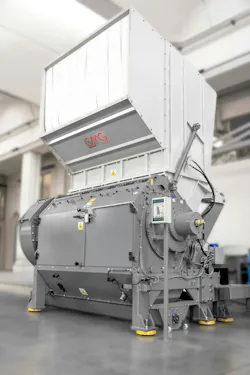
Italian equipment manufacturer CMG introduced the EV 92-220 advanced granulation system designed specifically for wet or dry post-consumer plastics.
CMG described the EV 92-220 as the largest and most powerful granulator ever introduced in the industry. It is designed for heavy-duty applications and massive volume streams. The output capacity, ranging from about 8,800 to 14,300 pounds per hour, exceeds any existing machine on the market, the company said.
The EV series is designed to reduce energy consumption by up to 50 percent, compared with similar models. This is achieved through advanced cutting geometries, unique rotor design and intelligent drive systems, the company said. These design advancements provide the highest energy efficiency and the lowest total cost of ownership (TCO) of the category, according to CMG.
It is designed for simplified and quick access to key mechanical components, with self-lubrication systems and predictive diagnostic capabilities. The machines minimize downtime and make operational procedures safe and simple to implement.
The cutting chamber is a proprietary design to produce clean, dimensionally consistent regrind, with no powder or micro particles, and the highest possible yield.
Rotating knives with double sharpening and 55-degree inclination can be configured in a group of six or eight. Cutting chamber components are made of Hardox wear-resistant steel.
The control system monitors operating temperature, blade wear, productivity, operational efficiency and energy use. Operators can manage all functional parameters on board the machine or remotely with connectivity based on OPC-UA protocols.
The machine’s footprint is 7 feet by 4.3 feet.
CMG also offers two smaller EV models, its EV 916 and EV 616.
CMG also introduced its Regrind Evac System for evacuation, dedusting and powder containment with a capacity of up to 15,400 pounds per hour. It is available in 10 sizes, with the smallest having a capacity of about 441 pounds per hour. The system operates under negative pressure so it does not generate dust and avoids impact against the blower impeller blades.
CMG products are distributed in the U.S. by Universal Dynamics. CMG SpA is based in Budrio, Italy.
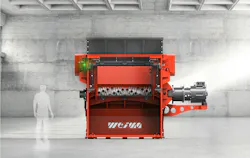
Giant Folcieri unit can replace 3 granulators
Italian granulator manufacturer Bruno Folcieri developed its EZ10 for processors with massive amounts of plastics to process.
The granulator weighs 38 tons and stands more than 21 feet high. The company describes it as a full-scale grinding plant that is designed to operate 24/7.
The EZ10 can process HDPE, PET, PP, post-consumer bottles and cans, and even pre-shredded thin PP films. Processing low-density materials can be a problem for some granulators.
The granulator has a 315-kilowatt motor and 76-inch-wide cutting rotor. Its input hopper opening is 59 inches by 78.7 inches.
The company said it can replace three typical-sized granulators, making it efficient and reducing costs, since there is less maintenance and downtime.
For maintenance, the rotor can be rotated using an auxiliary motor to simplify blade replacement. The screen holder opens automatically and the screen can be removed with a hoist.
A water-cooling system cools the rotor, housing and bearings to keep the temperature stable.
An energy-saving system recovers excess energy and feeds it back into the cycle to improve overall machine efficiency.
Bruno Folcieri, located in Volongo, Italy, is a family-owned company that has been building granulators for 80 years. CEO Esmeralda Zoppi represents the third generation to lead the company.
Hellweg technology now measures bulk flow rate
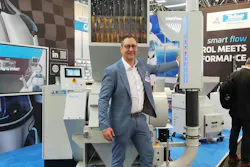
Hellweg Maschinenbau has developed an online system to measure bulk flow through a shredder, data the company said is the next step in the evolution of its Smart Control system and a precursor to implementing AI control modules.
The digital Smart Control system was introduced in 2019 and is available on all Hellweg shredders and granulators. It records power consumption, motor speed and bearing temperatures. It can optimize the ratio between motor load and throughput.
The new Smart Flow technology uses a sensor in the riser pipe of the extraction piping system to continuously measure bulk flow rate. The non-contact sensor uses microwave technology to measure changes in particle concentration and velocity.
The Smart Flow data is fed to the Smart Control system to be processed and displayed as mass ground per hour. This provides extrapolated statistical data such as grinding performance per day, week or month and can be sent to users’ MES systems.
Managing director Mark Hellweg said with the new data, Smart Flow users “have access to a valuable additional option for planning maintenance work and avoiding unforeseen downtime. Ultimately, it is not the machine’s grinding time that determines the service life of components such as knives, screens and V-belts, but the grinding work it performs.”
Hellweg said the control system is now ready to integrate self-learning AI modules that can calculate the optimum ratio between material properties, feed and required power, then independently regulate the machine to maximize energy efficiency.
The Hellweg company, which has a reputation for its cutting-edge technology, is currently working on AI modules. Mark Hellweg, whose father, Bernd, founded the company in 1985, said in a recent email interview that he expects AI integration will begin early next year.
The company builds a range of machines, including mobile machine-side mills, slow-running and central granulators/grinders in different sizes, as well as complete, fully automated recycling lines.
Weima introduces larger W5 shredder
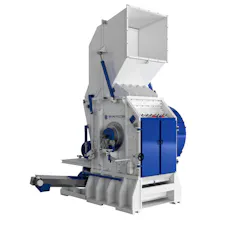
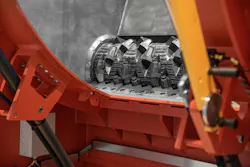
Weima Maschinenbau expanded its W5 line of single-shaft shredders with the W5.22, designed for hard plastics, films and tear-resistant fibers.
The new model has a rotor length of 86.6 inches and a rotor speed range from 50 to 200 revolutions per minute, depending on the drive configuration.
The V rotor is designed to handle large start-up lumps, hollow bins and other voluminous parts. The F rotor has a knife arrangement designed for shredding flexible materials such as fibers or film.
Maximum number of knives is 218. Available knife sizes are 40mm, 60mm and 80mm. The standard counter knives can be adjusted from outside of the cabinet.
Hopper opening is 86.6 inches by 78.7 inches.
Two other W5 shredders are smaller, the W5.14 with a 55.1-inch rotor, and the W5.18 with a 70.9-inch rotor.
The W5 series shredders use a Siemens PLC that can also control peripherals — including conveyor belts, separation technology and secondary shredders. An optional remote control is also available.
At K 2025, the W5.22 was shown with a Baumüller hydraulic drive. Since then, the drive has been upgraded to a high-torque drive that includes a servo controller. This direct-drive system was developed for demanding applications involving difficult-to-shred materials.
The motor provides high torque even at low rotational speeds. Due to precise coordination between the drive and the rotor shaft, power transmission is optimally utilized. At the same time, the innovative drive concept enables energy-efficient, economical and sustainable operation, according to Weima.
A swing ram is integrated into the cutting chamber. Material falls to the rotor by gravity and is continuously or cyclically pressed against the rotor by the hydraulically moveable swing ram. There is also an available option to equip the ram with additional pressure.
The W5.22 has easy access to the rotor and cutting chamber. A built-in rear inspection flap can be opened hydraulically once the swing arm is secured in the upper position.
Vecoplan system protects against vibration damage
Shredding is a violent process, and the inherent vibration can cause extreme wear and tear on even the sturdiest machines.
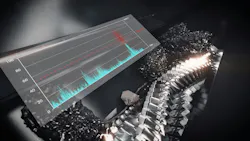
Vecoplan AG is tackling the problem with a new system called Vecoplan Intelligent Detect (VID) to monitor vibration and take action — such as shutting the machine down — before it is damaged. Vecoplan claims VID can reduce the risk of machine damage by up to 60 percent and machine delays by up to 70 percent.
VID is a new module for the Vecoplan Smart Center (VSC) digital platform, which networks machines and processes. Both VSC and VID are available in new shredders and can be retrofitted to existing machines.
VID relies on a self-learning system that uses high-frequency vibration sensors to detect even the smallest vibrations and sends data to an evaluation unit. The evaluation unit compares the signals with material-specific thresholds and decides if it should intervene in the machine’s operation.
If foreign material gets into the shredder, the system shows its precise location so an operator can take corrective action.
When a new machine load of material is being set up, VID analyzes the vibration values and within a few minutes creates threshold values for that material. Vecoplan said it can recognize the differences between all materials from lightweight film to hard plastics.
VID also takes into account the shredder’s speed and ramming values. There is a recipe function that allows operators to develop programs to quickly set up material changes. Vecoplan said it can also account for a rotor change or adjustment to the shredder’s geometry.
Shredder operators have generally relied on predictive maintenance programs to deal with machine failures.
Patrick Pfeiffer, director of sales at Vecoplan AG in Bad Marienberg, Germany, said VID offers a new level of shredder reliability because it can detect a bearing failure long before it occurs. He said VID is a crucial component in making processes transparent and controllable, while actively protecting shredders from damage.
Contacts
Bruno Folcieri Srl, Volongo, Italy, +39 0372 845921, www.brunofolcieri.com
Hellweg Maschinenbau GmbH & Co. KG, Roetgen, Germany, 49-2471-4254, www.hellweg-granulators.com/en
Universal Dynamics Inc., Fredericksburg, Va., 703-490-7000, https://unadyn.piovan.com, www.cmg-granulators.com/en/
Vecoplan LLC, Greensboro, N.C., 336-542-1390, www.vecoplanllc.com
Weima America Inc., Fort Mill, S.C., 803-802-7170, www.weima.com/us
About the Author
Ron Shinn
Editor
Editor Ron Shinn is a co-founder of Plastics Machinery & Manufacturing and has been covering the plastics industry for more than 35 years. He leads the editorial team, directs coverage and sets the editorial calendar. He also writes features, including the Talking Points column and On the Factory Floor, and covers recycling and sustainability for PMM and Plastics Recycling.