Optical sensors can withstand high heat
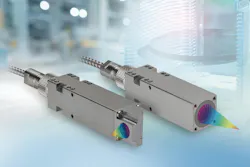
confocalDT IFS2407-xHT/VAC These Micro-Epsilon optical sensors can be used for displacement and distance measurements on reflective and diffuse surfaces as well as for thickness measurement, such as the thickness of transparent and semi-transparent plastics. They are especially useful for vacuum processes or hot zones, such as near the extrudate exit. Also, the sensors are designed for use in ultra-high vacuum (UHV). Due to their modular design, the sensors can be retrofitted, especially for monitoring/inspection. For closed-loop process control, they’re more often installed by the machine builder or a specialist integrator.
What’s new? The sensors, available since November. The first optical sensors in Micro-Epsilon's portfolio that can withstand temperatures of up to 392 degrees Fahrenheit, they are ideal for measurement tasks in precision machine building and the semiconductor industry. They are available in measuring ranges of 0.8mm, 2mm and 4mm.
Benefits Precision, even at high temperatures. The sensors do not emit any heat radiation into the environment.
Micro-Epsilon USA, Raleigh, N.C., 919-787-9707, www.micro-epsilon.com
About the Author
Karen Hanna
Senior Staff Reporter
Senior Staff Reporter Karen Hanna covers injection molding, molds and tooling, processors, workforce and other topics, and writes features including In Other Words and Problem Solved for Plastics Machinery & Manufacturing, Plastics Recycling and The Journal of Blow Molding. She has more than 15 years of experience in daily and magazine journalism.