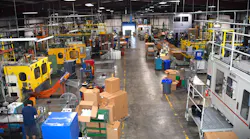
U.S. plastics industry employs more than 1 million workers
The U.S. plastics industry supported more than 1 million jobs and over $533 billion in annual shipments in 2025, according to the Plastics Industry Association’s (PLASTICS) annual Size and Impact Report.
The report, released Sept. 16 at the National Plastics Conference, measures the industry's economic footprint, including employment, shipments, investment and production. This year’s findings show the industry is outpacing broader manufacturing employment growth, with a significant economic presence in all 50 states and the District of Columbia, despite ongoing economic uncertainty.
According to the report, the U.S. plastics industry (resin, products, machinery and molds) accounted for 1,049,200 jobs and $533.6 billion in shipments in 2025. That figure excludes upstream suppliers; when those are added in, plastics-related employment rises to 1.66 million jobs, with total shipments reaching $715.8 billion.
Those figures are down from last year's Size and Impact Report. In 2024, the industry employed more than 1,066,500 and shipment value was $550.7 billion, not counting the impact of suppliers. With suppliers added in, plastics-related jobs in 2024 numbered 1.71 million, and total shipments were $754.5 billion.
In the latest report, 394 plastics machinery establishments employed 11,000 people in the U.S., with a shipment value of $3.85 billion. Mold making employed 11,200 people in 503 establishments, with shipments totaling $2.58 billion.
From 2015 to 2025, plastics manufacturing employment grew at an average annual rate of 0.8 percent, outpacing overall manufacturing employment growth of 0.3 percent, according to the new report.
Plastic products was the eighth-largest U.S. manufacturing industry by gross output in 2024, the latest year for which data is available.
Texas had the largest workforce in 2025 with 91,600 employees, followed by Ohio (77,500) and Michigan (69,000).
As defined by U.S. government data, the U.S. plastics industry operated 14,983 manufacturing establishments in 2025; that definition excludes companies producing captive plastics products, such as milk bottling facilities.
“The U.S. plastics industry continues to demonstrate its resilience, even amid economic uncertainty and a challenging operating environment,” said Matt Seaholm, PLASTICS president and CEO. “That strength comes from the essential role plastics play across our economy — from medical care and transportation to food preservation, infrastructure and manufacturing.”
“This year’s report reinforces what the data have shown over nearly three decades: the U.S. plastics industry is a durable and important part of the nation’s economic output,” said Perc Pineda, PLASTICS chief economist. “Over the past 28 years, the plastics industry has outperformed the overall manufacturing sector in employment, real shipments and real value added. That sustained endurance, combined with the industry’s scale and broad domestic footprint, underscores its resilience and enduring contribution to the U.S. economy.”
Looking ahead, Pineda said in the report that while plastics demand remains stable, the recovery is increasingly uneven across end markets. Interest rates are constraining housing and other sensitive markets, and trade and tariff uncertainty continues.
Automotive and manufacturing are poised for growth, but higher borrowing costs, affordability pressures and trade policy may limit those gains, he said.
"Growth is expected, but the employment outlook remains constrained by continued structural pressures. Real plastics shipments are projected to rise 1.2 percent in 2026 and 0.8 percent in 2027, while employment is expected to decline slightly in 2026 before improving thereafter," Pineda wrote in the report's executive summary. "The outlook will depend heavily on economic growth, key end-market performance, interest rates and a resolution of trade and tariff uncertainty."