Plastics machinery shipments fall in Q2 2026
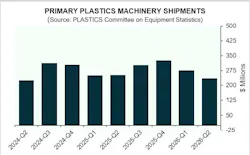
Shipments of primary plastics machinery in North America during the second quarter of 2026 dropped 14.8 percent from the previous quarter and 7.2 percent year-over-year, according to a report from the Plastics Industry Association’s Committee on Equipment Statistics (CES).
Shipments of injection molding and extrusion equipment totaled an estimated $235.8 million in Q2. Twin-screw extrusion shipments jumped 25.4 percent quarter over quarter (QoQ), but single-screw extrusion and injection molding shipments dropped 21.7 percent and 16.0 percent, respectively.
Twin-screw and single-screw extrusion shipments declined 60.1 percent and 35.0 percent year-over-year, respectively, while injection molding shipments increased 4.5 percent.
New orders increased in Q2, and the continued weakness in shipments primarily reflects the normal lag between new orders and deliveries for capital equipment, according to Perc Pineda, PLASTICS’ chief economist.
“An order is recorded when the customer commits to the equipment, while the shipment occurs later, after engineering, production, testing and delivery,” he said.
The second-quarter CES survey also showed a cautious near-term outlook but greater confidence over the next 12 months. For Q3, 35 percent of respondents expect improvement, while 35 percent anticipate deterioration, compared with 32 percent and 20 percent, respectively, in Q1. Over the next 12 months, 39 percent expect conditions to improve, while 28 percent anticipate deterioration.
The results suggest continued near-term uncertainty but stronger longer-term expectations, consistent with the increase of new orders in Q2.
That caution mixed with optimism was also reflected in PMM’s midyear survey of processors and comments from equipment OEMs in response to the results.
Respondents to PMM’s survey indicated that 39 percent were spending about what they had expected on equipment so far this year, while 33 percent were spending less and 25 percent were spending more (3 percent had no response).
Tariff whiplash, interest rates, the labor shortage and supply chain issues, including resin price spikes due to the war in Iran, were among processors’ concerns that affected equipment purchases.
Looking ahead, 50 percent of respondents to PMM’s survey expected conditions to improve over the next six months, and only 5 percent believed they will be worse. Twenty percent expect things to remain steady, while one-quarter say they don’t know or can’t tell yet.
The CES report also gives a snapshot of trade in U.S. plastics machinery. Exports totaled $755.8 million and imports $275.5 million, resulting in a $480.3 million trade surplus, a 24.1 percent increase year over year. U.S. economic growth moderated in Q2, with advance GDP estimates showing 1.5 percent growth following 2.1 percent growth in Q1. Real gross private investment in equipment, however, increased 27.7 percent in Q2, annualized, following a 4.7 percent increase in Q1.
“The combination of strong industrial equipment orders and modest shipments could be interpreted as a sign of strengthening pipeline demand rather than immediate weakness in market conditions. The lag between orders and shipments helps explain the softer shipment numbers,” Pineda said.
Further reading

 Injection molding and extrusion equipment trends 2024-2026
About the Author
Lynne Sherwin
Managing Editor
Managing editor Lynne Sherwin handles day-to-day operations and coordinates production of Plastics Machinery & Manufacturing’s print magazine, website and social media presence, as well as Plastics Recycling and The Journal of Blow Molding. She also writes features, including the annual machinery buying survey. She has more than 30 years of experience in daily and magazine journalism.