Fanuc America plans to build more robots in the U.S.
By Lynne Sherwin
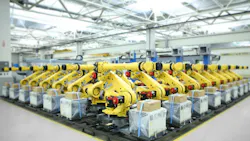
Fanuc America, a major manufacturer of robotics and automation systems, is planning a $90 million investment in a new 840,000-square-foot production-ready facility in Michigan for potential expansion of the company’s U.S.-based manufacturing capabilities for robots.
The project is targeted for completion in late 2027 and is expected to add 225 jobs. It will expand the company’s engineering capacity and advanced manufacturing capabilities to support growing demand for automation solutions across North America, including physical artificial intelligence (AI), virtual commissioning and digital-twin technologies.
“This investment builds on Fanuc America’s Michigan manufacturing footprint, which has included producing robots for paint application domestically for more than four decades,” President and CEO Mike Cicco said. “By expanding its U.S. presence, Fanuc America will strengthen domestic manufacturing, improve responsiveness to customer needs and support industries that rely on automation to stay competitive.”
When the new space is complete, Fanuc America will have invested nearly $300 million in multiple new facilities in the U.S.
“Fanuc America is committed to supporting U.S. reindustrialization by delivering state-of-the-art automation technologies to customers and broadening access to advanced manufacturing workplace training services,” Cicco said.
He cited the upcoming opening of the expanded Fanuc Academy in Auburn Hills, Mich., as “the largest robotics and automation skills-development center in the United States, helping address the national manufacturing skills gap, rising demand for automation talent, the shift toward AI-enabled robotics and the country’s overall competitiveness.”
Fanuc is not the only company expanding robot production in the U.S. In 2025, Yaskawa America announced it would construct a state-of-the-art robotic manufacturing facility at its campus in Franklin, Wis., marking the first time its high-volume industrial robots will be manufactured on U.S. soil.
Also in 2025, Teradyne Robotics announced it was building a facility in Wixom, Mich., to manufacture Universal Robots (UR) industrial collaborative robots (cobots), with future potential to include MiR autonomous mobile robots (AMRs). It will also serve as a customer training, service and visitor experience center.
Samantha Mou, senior analyst at market intelligence firm Interact Analysis, said Fanuc’s announcement shows the U.S. is becoming a critical destination as robot manufacturers work to bring production closer to key markets.
“Interact Analysis expects the industrial robot market here to see steady growth over the next five years, driven by reshoring initiatives and policies like tariffs, which are forcing robot makers to rethink their manufacturing strategies,” she said in a news release.
“That said, questions remain about the depth of localization. It is possible that the new facility will primarily support assembly instead of full-scale manufacturing,” she continued. “Given that Fanuc produces its core motion control components in Japan, and with limited domestic supply of key parts such as precision gearboxes in the U.S., it is likely that critical components will continue to be imported, with final robot assembly conducted locally.”
Demand for automation remains stubbornly slow in the plastics and rubber sector following its COVID-fueled buying surge, according to the Association for Advancing Automation (A3), but some industry watchers are seeing signs that increased investment could be on the horizon.
Nearly half of respondents to a Plastics Machinery & Manufacturing survey conducted in late 2025 said the labor shortage had a negative effect on their businesses in 2025, and 57 percent of survey respondents planned to buy robots or other automation equipment this year, in part to help mitigate the lack of skilled workers.
About the Author
Lynne Sherwin
Managing Editor
Managing editor Lynne Sherwin handles day-to-day operations and coordinates production of Plastics Machinery & Manufacturing’s print magazine, website and social media presence, as well as Plastics Recycling and The Journal of Blow Molding. She also writes features, including the annual machinery buying survey. She has more than 30 years of experience in daily and magazine journalism.