What to consider before going with solar energy
Ready to start thinking about a solar system? Here are some factors to consider from Tyler Crossno, Revel Energy’s digital marketing manager, and Pete Marte, CEO of Hannah Solar.
Stagger startups to avoid a spike in demand
Before Revel Energy installs solar panels at a business, it examines how the customer is using electricity.
One simple strategy is staggering equipment startups rather than switching everything on simultaneously. Crossno also recommends examining a plant’s time-of-use rates. If a processor can start equipment before a higher-cost period begins, it might avoid triggering expensive demand charges. For plastics processors, this is especially relevant because injection molding machines, extruders and other production equipment can create substantial electrical loads upon startup.
When a plastics processor starts multiple pieces of equipment simultaneously, it can create a large electricity spike. Depending on the utility, that spike could substantially impact the customer’s bill.
Heating and cooling systems can sometimes be adjusted to avoid simultaneous demand spikes, Marte said. HVAC loads are often easier to manage than production equipment since it can be done without slowing production.
Roof space can be a major constraint
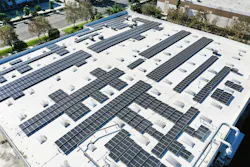
When it comes to where solar panels are installed, Revel Energy generally looks at rooftops first.
About 10,000 square feet of flat roof space is generally the starting point, Crossno said. But a company shouldn’t necessarily fill its entire roof with solar panels just because it has space, Crossno said, emphasizing the need to size the system properly.
However, solar panel installations aren’t necessarily limited to rooftops. Revel Energy also installs systems on carports and truck ports. These installations can work when appropriate space is available. However, they tend to be more expensive, in part because of the need to run underground cables to the manufacturing plant.
Size it right
Right-sizing a solar installation is important, and a commercial client shouldn’t necessarily size a system to provide 100 percent of their energy consumption.
Revel Energy increasingly targets about 80 percent of a facility’s electricity requirements. Oversizing a system can result in excess electricity going to the grid, where the economics aren’t necessarily attractive under California’s newer net-billing rules.
The sun doesn’t always need to shine brightly
Solar generation isn’t limited to only bright, sunny conditions, Marte said. Even on cloudy days, panels can produce a substantial portion of their normal output, depending on cloud thickness.
Solar panels operate more efficiently at cooler temperatures, meaning the strongest production months in the South aren’t necessarily the hottest months. April and October, as the seasons change, are particularly productive periods, Marte said.
Storage systems are growing in popularity
Energy storage systems can help a manufacturing facility in a couple of ways, according to Revel Energy.
First, by storing electricity in a battery system, either with power generated from the solar panels or off the grid, it can supplement energy needs during periods of high demand from the customer’s equipment and eliminate electricity spikes that could drive up the customer’s bill.
In addition, energy storage systems can help provide electricity to plants at night, when the sun isn’t shining, to supplement power purchased from the utility.
“The cost has dropped so much, and the cost of energy has gone up so much that it definitely makes sense to look at battery systems,” Marte said.
Hannah Solar is increasingly proposing battery systems to commercial and industrial customers.
While federal tax credits for solar energy systems soon will expire, that is not the case with commercial battery storage systems.
“They sunsetted most of those tax credits, except for the one for battery storage systems, which is good because that is really what's now driving a lot of this as well because the cost of all of our power has gone up so dramatically in the last 18 to 24 months, and it's only going to continue to go up over the next probably six, seven, eight, 10 years,” Marte said.
About the Author
Bruce Geiselman
Lead Reporter
Senior Reporter Bruce Geiselman covers plastics processing technologies and end markets including automotive and packaging. He also writes features, including In Other Words and Problem Solved, for Plastics Machinery & Manufacturing and The Journal of Blow Molding. He has decades of experience in daily and magazine journalism, including eight years at PMM, and is the recipient of a Jesse H. Neal Award, among other recognitions.