Plastics processors must act soon to qualify for solar tax credits
Key Highlights
- The federal government is phasing out solar tax credits, creating urgency for plastics processors considering new projects.
- Rising electricity prices are improving solar economics for manufacturers, particularly in California, where rates rank among the nation’s highest.
- Orange County Industrial Plastics installed a 372-kilowatt rooftop system designed to offset 100 percent of plant electricity demand.
- Nubs Plastics installed a 260-kilowatt rooftop system expected to offset 41 percent of its energy use.
By Bruce Geiselman
Manufacturers, including plastics processors, need to act quickly to qualify for a federal tax credit for installing solar energy systems.
That’s because a federal investment tax credit (ITC) for solar projects is set to run out soon, according to a spokesman for Revel Energy, a California solar energy engineering, procurement and construction (EPC) company.
The credit is formally known as the Clean Electricity Investment Credit. It’s a federal tax credit of up to 30 percent that applies to eligible solar project costs. Additional bonus credits are potentially available if certain conditions are met.
Companies can still qualify for the credit, but projects started after July 4, 2026, must be installed and connected to the grid with utility approval by Dec. 31, 2027, to retain the incentive, said Tyler Crossno, Revel Energy’s digital marketing manager.

Projects that began construction, as defined by the IRS, by July 4, 2026, have until the end of the fourth calendar year after construction started to be placed in service. That would be Dec. 31, 2030, for projects started this year prior to July 4.
While many people associate solar energy projects with environmental benefits from reduced power plant emissions, financial considerations, rather than sustainability, are driving many companies to invest in solar energy.
While sustainability is important, Revel Energy’s experience shows that businesses generally decide to invest in solar energy installations based on economics. Rising electricity prices have made solar projects increasingly attractive, even as incentives are reduced.
Meeting the deadline to qualify for the tax credit could be challenging because a commercial solar project can take a year or more from beginning to completion, with utility interconnection and approvals outside a customer’s control, Crossno said. The loss of the tax credit could be significant to a company’s bottom line, he said.
The federal One Big Beautiful Bill, passed in 2025, accelerated the phaseout of the tax credit.
Rising energy prices in California make solar energy popular
Even without the federal tax credit, solar energy projects could still be appealing, especially in California, which has among the highest electricity rates in the country, according to data from the U.S. Energy Information Administration.
Revel Energy installs solar energy systems primarily in California. It also has active projects in Nevada, Arizona, Oregon and Washington.
Revel Energy’s earlier projections assumed electricity prices in California would rise about 3.5 percent annually. However, actual increases have been two to three times that rate, Crossno said. These higher-than-anticipated price increases make solar energy investment increasingly attractive, he said.
“The financial math on solar and the investments like this just keep getting better and better, even while the incentives start to go away,” Crossno said. “It's not just California that's losing the incentive; it's a federal incentive.”
The cost of delivering electricity has been rising faster than the cost of generating it, Crossno said. Electric utilities must invest in replacing aging transmission and distribution equipment, while growth in electric vehicles and data centers is boosting demand for power. There is no single cause for the demand for greater electric generating capacity in the state, he said.
He estimated that a typical project could have a three- to five-year payback, depending on the facility, utility rate structure and energy usage.
California plastics companies install solar panels
Revel Energy worked with two plastics processors on installing solar panels to reduce their electric use from the grid.
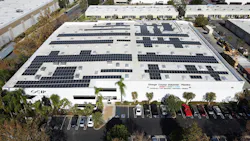
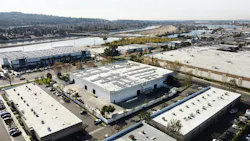
Orange County Industrial Plastics partnered with Revel Energy to design and install a custom 372-kilowatt (kW) rooftop solar energy system at its 80,000-square-foot facility in Anaheim. It consists of 942 solar panels, 471 power optimizers, and three energy inverters, according to Revel Energy.
Revel Energy posted a case study on OCIP’s solar energy system.
Revel Energy, using OCIP’s utility data, designed a solar panel system able to offset 100 percent of the plant’s electricity demands. It was able to do so because of the building’s abundant roof space. Any extra generation is sent back to the utility through California’s net energy metering (NEM) program, earning credits to use for energy when the sun goes down.
While Revel Energy today recommends sizing solar energy systems to meet less than 100 percent of a plant’s energy requirements, OCIP installed its system under older NEM rules that allowed the owners of solar electric systems to receive more substantial credits for the excess electricity fed into the power grid. OCIP was grandfathered and allowed to continue receiving the larger credits.
“They're still on the old NEM system, so the energy they send back to the grid still gets that full value,” Crossno said. “We've changed the calculus going forward. I think that project was completed back in 2022.”
Under NEM 1.0 and 2.0, exported solar power was credited at roughly the full retail rate. Under NEM 3.0 (the Net Billing Tariff, in effect since April 2023), exports are credited at the utility's avoided cost — on average about 75 percent less.
“Customers on NEM 1.0 or 2.0 keep that tariff for 20 years from their PTO (permission to operate) date,” Crossno said. “OCIP came online in 2022 under NEM 2.0, so they have roughly 16 years left.”
Orange County Industrial Plastics President Jim Billiter, in a statement emailed on his behalf to Plastics Machinery & Manufacturing, said the company was pleased with the results of the system.
“Very happy,” Billiter said. “We are able to pass on the savings to our customers.”
OCIP expects to break even on its investment by the end of next year.
OCIP specializes in custom plastic fabrication, including bending, forming, bonding, assembly, digital printing, polishing, beveling, design, CNC machining, laser cutting and packaging, according to the company’s website. It is a point-of-purchase merchandising display manufacturer and offers displays for trade shows and other purposes.
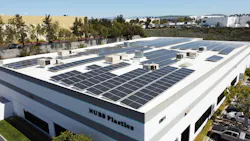
Nubs Plastics, a Vista, Calif., injection molding company, worked with Revel Energy to install a 260-kW rooftop system. That represents a 41 percent energy offset. The system is expected to produce $4.2 million worth of electricity in its 30-year lifespan, according to Revel Energy’s case study.
About the Author
Bruce Geiselman
Lead Reporter
Senior Reporter Bruce Geiselman covers plastics processing technologies and end markets including automotive and packaging. He also writes features, including In Other Words and Problem Solved, for Plastics Machinery & Manufacturing and The Journal of Blow Molding. He has decades of experience in daily and magazine journalism, including eight years at PMM, and is the recipient of a Jesse H. Neal Award, among other recognitions.