Epson robot streamlines welding process
Key Highlights
- Marne Plastics integrated Epson VT6-A901S robots to automate part transfer and welding, eliminating the need for manual operator intervention.
- The company invested approximately $50,000 in robots and programming, achieving an annual savings of about $75,000 with a return on investment in less than a year.
- Employee upskilling through Ohio’s TechCred program enabled internal automation support, facilitating quick and cost-effective robot deployment.
- Automation has allowed the company to redeploy labor to higher-value tasks, supporting its growth and operational flexibility.
- Marne Plastics plans to expand automation to secondary operations, aiming to automate all tasks except quality checks, to meet customer demands and reduce labor costs.
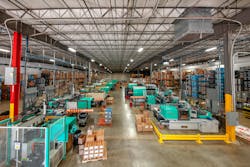
Problem: The process of welding together two family-mold parts created the need for an operator to remain at one injection molding machine throughout production.
Solution: An Epson robot, in communication with the press, welder and takeout robot, now presents the parts to the welder and puts them in a box.
By Karen Hanna
Although small, an automotive transmission breather box manufactured by Marne Plastics LLC was proving time-consuming and laborious to produce.
After receiving the top and bottom half of two components from a takeout robot assigned to the press producing a breather box family mold, an employee would orient them, insert electronics and present the pieces to a vibration welder. The resulting part weighs about 60 grams and measures about 3 inches in every direction, and it took about a minute to make.
Fresh from an upskilling program, an employee redeployed from a maintenance job to one emphasizing robotics knew just how to labor requirements: Automate. It’s a strategy the company is leaning into.
“Everything needs to be more automated just to remain competitive,” said Mike Fitzsimmons, president of the Grove City, Ohio, molding shop, which employs about 55 people and makes parts for Japanese automakers, along with other customers.
Automation can save companies man-hours and money. But, before they can enjoy those benefits, manufacturing plants have to ante up an investment in training and equipment.
For Marne Plastics, the effort started with the decision to invest in labor — with the end goal of actually reducing some labor needs.
“We increased the level of our staffing, basically, so that we could do automation projects internally,” Fitzsimmons said.
Taking the plunge into automation
A couple years ago, the molding shop opted to support one of its maintenance employees in returning to school to study automation at nearby Columbus State Community College. An Ohio government program called TechCred, which supports employers’ reskilling and upskilling initiatives, funded part of the investment; according to its website, it reimburses up to $2,000 per credential when current or prospective employees complete eligible technology-focused courses.
Over about six months in 2024, the employee involved in the training began putting his newly acquired skills to the test — by tackling the challenge of streamlining the breather box process.
He suggested that, in addition to the takeout robot, the company should integrate a robot with the welding machine in the post-molding stage, eliminating the need for an operator to hand off parts for joining.
“We thought we could automate it by having a second robot that pulls the parts from the molding machine and then loads the welder, and so we ran the numbers, and we thought it’d be good savings project,” Fitzsimmons said.
The employee suggested a six-axis VT6-A901S robot from Epson with a 39-inch-plus reach and payload in excess of 14 pounds
According to Fitzsimmons, the price was right, and programming was no problem.
“Just the tutorial for the Epson was all he needed to do the program,” Fitzsimmons said. “It was very intuitive and very easy for him to learn how to do this program. As far as choosing Epson, they’re very price-competitive, and they had visited us, and we discussed the project with them, and their support and price level was very good for us to decide to use them. ... The robots have worked out very well for us.”
To manufacture the breather box — an application it performs about two weeks out of every month — the company uses an 720 E Golden Electric molding machine, with a machine-mounted Arburg robot for part takeout.
Weston Harbaugh, territory sales manager for Arburg, said the company’s software helps streamline changeovers.
"Although their machine is equipped with Selogica controls rather than the more advanced Gestica, they still benefit from helpful functions such as robot programming features and auto start-up options, which simplify operation,” Harbaugh said. “The machine in question is not dedicated to a single breather part and is used for multiple products, and the control software plays an important role in making changeovers and multi-part production more manageable."
Epson robots aren't picky about the machines they pair up with. That's one of the reasons users are drawn to them, according to Scott Marsic, group product manager for Epson America Inc.
Fitzsimmons agreed that adding the Epson robot was a straightforward process.
“The Epson robot is communicating with the welder. It’s also communicating with the Arburg molding machine, and we have no labor there. The parts are just put in a box by the Epson robot. So, we went from a full operator to no operator just by automating the process,” Fitzsimmons said.
Reaping rewards of robots
Redeploying the most laborious, tedious jobs already is paying off for Marne Plastics.
It now has completed three projects adding automation to tasks that were previously performed manually, and it’s looking at doing more.
“That was just an investment in our overall manpower in the company,” Fitzsimmons said.
“The first one we chose, it was about a $50,000 investment to purchase the Epson robot and build the stand and do all the programming and everything. It saves us an operator and a half for a year. Our savings is about $75,000 a year, and investment is only $50,000, so the return is less than a year,” he said.
With about $10 million in sales, the company, founded in 2013, is growing 15-20 percent a year. In May, it expanded its plant floor space, from 36,000 square feet to 58,000 square feet, and added two injection machines, bringing its stable to 17 Arburg machines and one Sumitomo IMM. Clamping forces range from 60 tons to 550 tons.
Fitzsimmons said the plant could probably accommodate as many as 30 machines.
He said it’s been very satisfied with Arburg IMMs.
“Arburg presses are German-made, so they’re very, very reliable,” he said. “And we feel that our maintenance costs are extremely low for how many hours we’re putting on them.”
Arburg’s technologies also make possible short runs and frequent changeovers.
“If we wanted to do two ejections, or open the mold halfway, do something, and then open it the rest of the way, it’s more of an open structure as far as programming. So, some people see that as more difficult, but we see that as more of an advantage to us, because we can be more versatile to run a lot of different parts,” Fitzsimmons said.
Continued success relies on automation, he said — which is why the company was willing to invest in both equipment and training.
So far, all of the company’s machines have part-removal robots, but Fitzsimmons said the company wants to continue to automate secondary operations, just as it did with the breather box.
The end goal is to automate everything, so that the only task humans perform is quality checks.
“It’s lower-level labor, so it’s just repetitive motion, so we’re not cutting actual labor overall, because our revenue is growing. It’s preventing additional labor [needs] from being hired, and then it’s very difficult to get labor, and then our customers are pressuring us to meet price levels,” he said. “Automation helps us meet customer expectations as far as pricing. We can train our current laborers to do higher-level tasks than just stand there and put parts in a vibrational welder.”
Contact:
Arburg Inc., 860-667-6500, www.arburg.com
Epson Robots, Carson, Calif., 562-290-5910, www.epsonrobots.com
About the Author
Karen Hanna
Senior Staff Reporter
Former Senior Staff Reporter Karen Hanna covered injection molding, molds and tooling, processors, workforce and other topics, and features including In Other Words and Problem Solved for Plastics Machinery & Manufacturing, Plastics Recycling and The Journal of Blow Molding.