Wittmann's green innovations and industry outlook: An interview with Sonny Morneault
Key Highlights
- Sonny Morneault began his career CAD drafting and rose to leading Wittmann's U.S. operations, with a focus on innovation and environmental responsibility.
- Wittmann showcased energy-efficient and digitally connected machinery at the K show, emphasizing sustainability and Industry 4.0 integration.
- He recognizes the plastics industry's environmental challenges, which Wittmann addresses through advanced recycling and process technologies.
- Technological evolution, especially digitization and AI, has transformed plastics manufacturing.
- His leadership lessons include the importance of hard work, communication, creating a supportive workplace environment and understanding diverse perspectives.
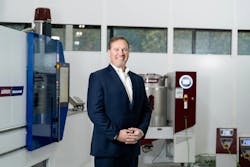
At the K show in October, Wittmann touted the green characteristics of a number of its latest innovations, including the energy efficiency of its new EcoPrimus injection molding machine and the consistent regrind quality of its S-Max primus screenless granulator.
Those trends — together with the digitalization that has allowed Wittmann to seamlessly link upstream and downstream technologies — have created a throughline for the career of Wittmann USA Inc. President Sonny Morneault.
“We did see a much more significant amount of U.S. visitors this last K show cycle,” he said following the show. “Our U.S. team was busy all day and booked for dinners almost every night.”
He sees the environmental issues tied to plastics as the industry’s biggest challenges. Recently, he reflected on his career with Karen Hanna, senior staff reporter for Plastics Machinery & Manufacturing.
How did you get into the plastics industry?
Morneault: My first entrance to the plastics industry was through a college job fair. I was about to finish my associate’s degree in engineering, and they had a CAD engineer position open. I was hired by Branson Ultrasonics in Danbury, Conn. They are a plastics joining and ultrasonic cleaning company owned by Emerson. My first role was as a draftsman doing tooling layout and designs.
Although I was hired as a CAD specialist, I [had] four years of computer-based drafting and design under my belt. They did not have a computer for me when I arrived, so I spent my first six months on the board with mechanical pencils, templates and a beautiful electronic drafting board, of which, creating hand drawings, I had zero experience in. Even in high school, we used a CAD terminal for all our drafting and design work. Fast forward [about] 20 years, and I came to Wittmann as their dryer product manager, and never looked back. It was the best decision of my professional life.
What have been some of the best and worst aspects of working in the plastics industry?
Morneault: The plastics industry, in my 36 years [in the industry], has been exceptionally good to me, my career, my family and my community. One of the best aspects of plastics is its endless uses for innovative products and diversity. I’ve worked with clients, [from] projects that saved lives to [sending] people to space. I enjoy walking through stores and looking at various products that I and the companies I’ve worked for have had an influence on, whether it be design or manufacturing.
Some of the worst aspects of plastics are when your concept, design, engineering fails to meet their intended use, resulting in ugly potential recalls or lawsuits. This, however, is true for any industry, not just plastics.
The one concern we all share in the plastics industry is how we affect the environment. The plastics industry is united in its commitment to minimizing environmental impact. Seeing plastic waste in our oceans, rivers and communities concerns all of us. In many cases, improper disposal results from limited education or inadequate disposal options. By engaging with those who may unintentionally dispose of materials incorrectly and by providing easy, accessible solutions, we can support better habits and protect our environment.
How has technology within the industry evolved over the years? What are the biggest and most important changes? What's your outlook for the years to come?
Morneault: In my years in plastics, a lot has changed with technology. We didn’t even have cell phones when I started. Ugh. So, of course, I’ve seen countless changes to technology. The digitization of everything has been the biggest change to our industry overall. The ease of use, simplified maintenance and, of course, the interconnectivity of equipment, or, as we call it, Wittmann 4.0, has really changed the industry. This has been the single most important change to our industry. Wittmann can now control all the work cell devices through a single control network embedded in the machine, allowing all commands, error messages, troubleshooting and online support for all the devices through one connection point.
AI, of course, is what will set the course for the future. Our R&D group is already looking at ways to implement AI, some of which they are already working on, including using AI for troubleshooting and [developing] FAQs to help diagnose equipment issues.
What do you see as the biggest challenges to the plastics industry in the years to come? How do you plan to confront them in your own business?
Morneault: I think the biggest challenge for the plastics industry is going to be our impact on the environment and how we change our materials and products designs. We have major packaging clients that have already tested and proved they can manufacture their goods using [alternative] bioresins and have offered these to their end customers but, because of the price, they do not get adopted. So, we have to mandate change or drive down the cost for these new, better, safer alternative materials to be mainstream.
Of course, this won’t impact our whole industry; you will still be able to buy an autoinjector drug administrator, use it once or twice and throw it into mainstream waste. This also must change. The EPR bills that are being proposed in many states try to address this, and, to some extent, I agree. If you buy a weight-loss drug that comes in an autoinjector format, the drug producer should be responsible for somehow offering or developing a recycling stream for that pen.
Our business is ready to adopt any environmental changes needed to improve our waste streams. We offer a full range of screenless and conventional granulators [and] blenders to mix this regrind with virgin material, and a de-dusting system to take out process-prohibitive fines and dust. Of course, our molding machines also have smart technology called HiQ that can help process material with fluctuating viscosities to optimize the process and to produce consistent parts. We have already adopted a “Zero Pellet” policy in our factories in America.
What leadership lessons have you learned that you'd like to pass on to newer/less-experienced leaders?
Morneault: I often think about this. My journey to where I am today has taken me down a lot of roads and has exposed me to some great leaders and some not so great. Call me old-school, but I still believe hard work and business smarts is the path to success. So many young people today have been told they should make a certain amount of money to perform a certain job. What these people forget to tell them is you must start at the bottom, show your worth, work harder than anyone else, and great things will happen in your career. I always thought it was my job to make my boss look good and make my company successful, plain and simple.
If there is one piece of advice I could give newer/less-experienced leaders, it’s to constantly communicate with your team, be open to suggestions and develop an atmosphere of family, meaning create an environment in the workplace that is open to understanding employees’ personal and private issues and help support them as family would.
What do you like to do outside of work?
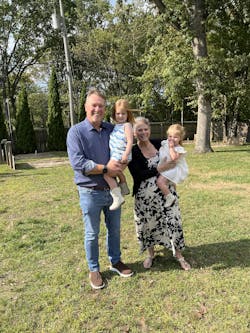
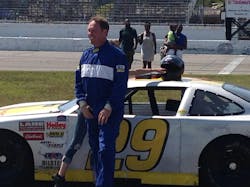
Morneault: Outside of work, my wife tells me I do too much. The list of outside work activities is long, from hunting at our camp in Pennsylvania to boating at a small lake in Connecticut. Of course, golfing, fishing, hiking, racing [cars] are all on the list. But the most fun I have are with my two beautiful, almost 2- and 3-year-old, granddaughters. I also have a pretty big family, including my wife, Dee, my two daughters Hailey and Alexa, three brothers and a sister, two sisters-in-law and brother in-law, a son-in-law, four moms and stepmoms, and countless aunts, uncles and cousins. I even have a 105-year-old grandmother in Florida.
What would you like your legacy to be ?
Morneault: I would like my legacy to be one of understanding and cooperation. That is, I always try to see the other side of a situation and fully grasp what others’ point of view may be and try to find a mutual common ground that benefits all parties. I also have always admired my colleagues like family and treated them as such, including, occasionally, giving someone a metaphorical “head-skip” — giving someone a corrective nudge to keep things moving in the right direction — to knock them back in line.
Many people may say I have always lived my life under the motto of “Play Hard — Work Hard,” and that is certainly true, but for me it’s always been about the people and connections we make along the journey of life.
Just the facts
WHO IS HE: Sonny Morneault, president of Wittmann USA Inc.
AGE: 57
YEARS AT WITTMANN: 18
EDUCATION: Bachelor of Arts, marketing, Western Connecticut State University, 2006; Associate of Science, computer-aided drafting and design engineering, Waterbury State Technical College, 1988
About the Author
Karen Hanna
Senior Staff Reporter
Former Senior Staff Reporter Karen Hanna covered injection molding, molds and tooling, processors, workforce and other topics, and features including In Other Words and Problem Solved for Plastics Machinery & Manufacturing, Plastics Recycling and The Journal of Blow Molding.