By Karen Hanna
As it rolls out an upgrade of its horizontal, elevated injection molding machines (IMMs), known as the HE series, Wilmington is seeing molders adopt its large, low-pressure IMMs for an increasingly diverse array of applications, said Jim Boos, the company’s sales and marketing manager.
“Structural foam has always been looked at as kind of an industrial process because of the finish of a structural part. But more and more people are using gas-assist molding to do thinner-walled parts with good surface quality on the finished product,” Boos said. “This machine is capable of doing gas-assist, and it’s really expanding what people are using these large machines for, to do some thinner-walled parts and still get a quality surface finish.”
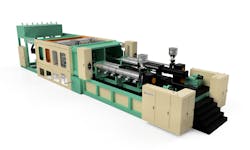
Designed to optimize space, the presses are appropriate for large molds with vertical core movements, and come in three sizes, with clamping forces of 750, 1,000 and 1,500 tons.
Based on the original, low-profile HE series introduced in 1992, the presses have been updated to accommodate both robotic and beneath-the-press product removal. The injection unit of the new machines is also elevated, creating a raised deck to make setting up the nozzle/manifold components easier.
Single- and dual-stage versions are available, as well as versions with reciprocating screws. Depending on machine size, they have shot capacities ranging from 75 to 300 pounds, and they can melt more than 6,000 pounds of plastic per hour, Boos said.
“There’s room between the lower portion of the platen and the floor. It just gives you a little bit more versatility, if you have some large molds with hydraulic cylinders and core pulls hanging off of the molds, that’s why they’re elevated,” he said.
In general, the HE machines can make large parts with comparatively thick cross-sections. These might include bins and materials-handling enclosures, as well as parts for the construction, consumer-goods, recreation and automotive industries; the series can even be used to make components for medical equipment.
The HE machines are equipped with Versafil controls, which have features for overseeing temperature, press motion, injection velocity and pressure. The controls enable remote troubleshooting, and provide trend analysis and graphs.
Overall, Boos said, demand for Wilmington’s low-pressure molding machines is rising, as molders realize how versatile they are. In addition to the HE machines, Wilmington offers nine low-profile horizontal and vertical machines, with clamping forces ranging from 350 to 2,000 tons and shot capacities of 25 to 300 pounds. All of them are capable of low-pressure molding, and distinguished by their ability to process recycled materials.
“People are always looking to use less plastic and use recycled plastic, and that's what low-pressure structural foaming is good for,” Boos said.
The capabilities are especially valuable at a time when resin prices have skyrocketed.
“Most of our customers are interested in using recycled plastic,” Boos said. “Generally, it’s the least-expensive plastic on the market, and our machines can use 100-percent recycled material, even in flake form.”
Though Wilmington’s machines generally have been used to make large parts with comparatively thick cross sections, like pallets, Boos said molders are recognizing the possibilities go beyond industrial-type components.
“You can do a lot bigger part with a low-pressure machine than you can with a high-pressure machine,” he said.
Karen Hanna, senior staff reporter
Contact:
Wilmington Machinery Inc., Wilmington, N.C., 910-452-5090, www.wilmingtonmachinery.com
About the Author
Karen Hanna
Senior Staff Reporter
Senior Staff Reporter Karen Hanna covers injection molding, molds and tooling, processors, workforce and other topics, and writes features including In Other Words and Problem Solved for Plastics Machinery & Manufacturing, Plastics Recycling and The Journal of Blow Molding. She has more than 15 years of experience in daily and magazine journalism.