PLASTICS: Boosting productivity is crucial for U.S. recovery

The COVID-19 recession was the shortest in U.S. history according to the National Bureau of Economic Research. It technically started in February and ended in April last year. While the recession was short, it stopped our economy in its tracks. Specifically, the recession caused a contraction of 5.1 percent in Q1 2020 and a contraction of 31.2 percent in Q2 2020 measured by real gross domestic product (GDP) on an annualized basis. Thereafter, real GDP growth bounced back at 33.8 percent in Q3 2020 and 4.5 percent in Q4 2020. In the first and second quarters this year, real GDP increased 6.3 percent and 6.5 percent, respectively. Let’s dig into how this happened and what may come next.
— PLASTICS Chief Economist Perc Pineda, Ph.D.
Mind the gap: Increased productivity is key to U.S. economic recovery
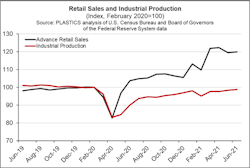
It’s been over a year since the end of the COVID-19 recession and the U.S. economic recovery continues to face challenges. The gap between demand for goods and services and the economy's production of them has continued to widen. Advance retail sales and industrial production show the economy's demand and supply growth rates are out of sync.
The economic recovery was fueled by strong household spending. The fiscal policy response of the U.S. government to the COVID-19 recession helped put money in families’ pockets. This initially caused a surge in consumer essential expenditures and eventually led to higher spending on durable goods and residential fixed investments spending.
Supply chain difficulties as business activity restrictions started last year and low labor supply have caused the supply of goods and services to lag behind rising demand. While the economy added 943,000 nonfarm payrolls in July — taking the unemployment rate to 5.4 percent — the economy’s labor participation rate needs to rise to keep up with demand. This will cause an increase in the economy’s productivity.
In July, the plastic and rubber manufacturing unemployment rate was 2.9 percent. At that rate — lower than the overall manufacturing unemployment rate of 4.2 percent — the plastics industry continues to fill open positions. Looking ahead, the extended unemployment benefit ending in September could increase the economy’s labor participation rate and, in turn, productivity.
To sustain the economic recovery, industrial production needs to increase. To get to that point, the economy's consumption and production need to be more in sync. As we continue to navigate the uncertainties of the pandemic, however, it could continue to be a slow-moving process, so stay tuned.
PLASTICS provides members with industry insights like this, as well as exclusive macroeconomic analysis and forecasts year-round for a tailored perspective on what might be around the corner. Additionally, industry and trade data are always available at members’ fingertips. Learn more at www.plasticsindustry.org