KraussMaffei process simplifies production of PVC roofing membranes
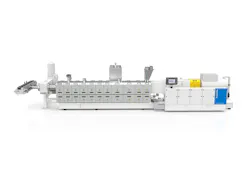
KraussMaffei’s new InlineMixing extrusion process for PVC roofing membranes cuts energy usage and production time with its single-stage technology.
PVC roofing membranes are usually manufactured in two stages. First, PVC powder, plasticizers, additives and fillers are processed in a hot-cold mixer combination to produce a dry blend. Then, after cooling and intermediate storage, the mixture is plasticized in a twin-screw extruder and processed into membranes. With InlineMixing, all solid and liquid components are fed directly into the extruder via gravimetric dosing.
KraussMaffei said in a press release that users of the system do not need a separate heating-cooling-mixing combination, and the material needs to be heated only once, reducing energy costs by up to 75 percent.
PVC InlineMixing offers high flexibility, the company said, as formula adjustments and color changes can be implemented during operation via the integrated control system. It also requires fewer staff and less space than a traditional setup.
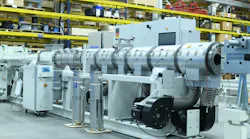
The process was developed at the KraussMaffei Extrusion Technology Center in Laatzen using a co-rotating twin-screw extruder from the ZE 65 BluePower series, equipped with loss-in-weight feeders for solid components and multiple liquid feeders for free-flowing components.
The ZE BluePower series has a Da/Di ratio of 1.65. The combination of high torque and large free volume provides a wide process window for different formulations.
Multiple upgrades to the BluePower series were introduced at K 2025, improving operation, energy efficiency and digital networking via the Pioneer ProcessControl (ppC) system.
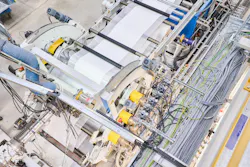
PVC InlineMixing is already in use in an industrial production line, which KraussMaffei said is achieving a total throughput of 3,968 pounds per hour using two extruders and two calenders. PVC, additives, fillers and edge trimmings are continuously processed directly into finished membranes.