Bay Plastics Machinery's Jason Forgash talks about business and family
Key Highlights
- Jason Forgash joined his family's company, Bay Plastics Machinery, in 2005 and has helped grow the pelletizer maker into a 55-employee operation with global reach.
- He emphasizes employee support, customer service and quality as cornerstones of his business philosophy.
- Bay Plastics Machinery serves processors with strand pelletizers, conveyors, water baths, air knives, dewatering units and spare parts.
- The company is investing in a new technology center to expand customer training and equipment-processing education.
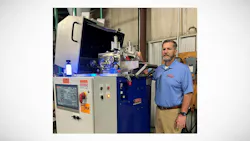
"The plastics industry has been in my blood since birth," Jason Forgash says.
In 2005, he became part of the third generation at Bay Plastics Machinery, which specializes in the manufacture and sale of pelletizing equipment.
Jason's grandfather, Tony Forgash Sr., owned and operated a tool-and-die shop known as JETRO Inc. in the 1950s. Jason's father, Tony Forgash Jr., joined the company in 1961. They led the design and development of the company’s pelletizer technology. JETRO was sold to Conair in 1974; Bay Plastics Machinery was founded in 1997.
Jason Forgash has been part of the Plastics Industry Association Equipment Council since 2013 and on the operations committee for NPE since 2006. He is currently the vice chair of the operations committee.
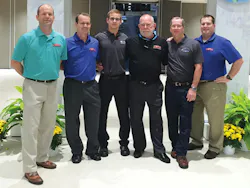
Bay Plastics Machinery is truly a family affair. Jason’s older brother, Jeffrey, is the vice president of sales, parts and service. His brother James is vice president of sales. James’ daughter, McKenna, is on the sales team, and Jason’s son, Dakota, graduated from Alma College and joined the company in the spring, working in the accounting department.
In an interview with Bruce Geiselman, senior reporter for Plastics Machinery & Manufacturing, he discussed the history of the family business, his professional goals and business philosophy.
What has been your career path?
Forgash: After high school, I went to work for Conair JETRO Division as an inventory clerk while attending community college. My first job out of college was at State Chemical selling cleaning products.
How did you get interested in the plastics industry?
Forgash: The plastics industry has been in my blood since birth.
At 16 years old, I cleaned the machine shop at Conair JETRO after school. When I was young, I would listen to my father and grandfather talk business around the dinner table. I always knew that I wanted to enter the industry.
What was your first job in the plastics industry?
Forgash: My first job in the industry after college was in 1992 as a sales rep for Value Systems, selling products for several different auxiliary equipment suppliers. Value Systems was Roger Doherty’s sales rep agency, and he was based out of Charlottesville, Va. I worked and lived in Charlottesville near Roger, and I covered Virginia, Maryland and Delaware, selling Conair and Xaloy mostly.
What brought you to Bay Plastics Machinery, and at what position did you start?
Forgash: In 2005, I was working for UBE Machinery, selling large-tonnage injection molding machines. I had started a family and was looking for a change.
After speaking with my father, we discussed my coming to work for Bay Plastics. I started in July 2005 as a sales manager covering the Eastern U.S.
I know that Bay Plastics Machinery is a family business. What can you tell me about the history?
Forgash: In 1961, my father and grandfather developed our first strand pelletizer under the company name JETRO.
In 1974, Conair purchased JETRO and renamed it Conair JETRO Division. In 1997, Conair centralized all remote manufacturing to its facilities in Franklin, Pa. At that time, my father and a core team formed Bay Plastics Machinery.
In 1998, Bay Plastics Machinery and CF Sheer created a joint venture named Scheer-Bay. We operated as Scheer-Bay until 2008, when Scheer declared insolvency in Germany. At this time, we reverted to our original name as Bay Plastics Machinery.
Why did your family decide to focus the business on pelletizers?
Forgash: My grandfather owned and operated a tool-and-die shop in Bay City, Mich., in the late 1950s.
He was doing work for Dow Chemical, repairing their strand pelletizers, when he told them that he could build a better system. His contacts at Dow said, “Show me,” and he built his first strand pelletizer.
My father and grandfather sold their new line of strand pelletizers under the JETRO name to Dow and several other chemical companies in the Midwest until Conair purchased JETRO in 1974.
What does Bay Plastics Machinery do today, and who are your customers?
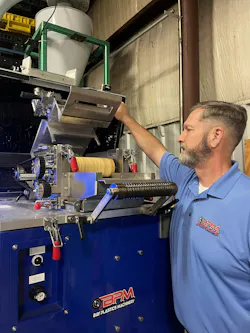
Forgash: We offer a complete line of strand pelletizers, conveyors, water baths, air knives, strand dewatering units and spare parts.
We specialize in repair and replacement of cutting rotors and feed rolls for every make and model of strand pelletizer. Our customers range from small compounding companies to large polymer plants.
What is your greatest career accomplishment?
Forgash: I have two accomplishments that mean the most to me.
The first is the ability to offer our employees a place to work that allows them to be family-focused while still providing equipment and service at a level that exceeds our customers’ expectations.
The second is how we have grown our business over the last several years. We have grown from 15 employees in one small manufacturing facility to 55 employees with three manufacturing facilities in Bay City, as well as offices in Georgia and the Netherlands for parts sales and distribution.
Opening our office in the Netherlands has been an important tool for us. It allows us to support our European customers better, as we can hold spare parts in Europe for them with next-day delivery if needed. Shipping and receiving through that office has been a logistical help for us.
The new technology center that we’re opening up (in Bay City) will allow us to do a much better job of providing training for our customers right outside of our laboratory. We have a nice conference room with windows facing the lab. It’s going to be a really good tool for us to help our customers educate their employees to do a better job in processing their equipment. Our open house is Oct. 21.
We are doing our feed roll recovery in that new facility as well, and [it houses] our training and technology center. It’s going to be a very nice addition to our footprint.
We’re growing our business in the United States, as well as in Europe and Asia.
What is your business philosophy?
Forgash: My business philosophy is not my own. It is a philosophy that was handed down by my father and grandfather.
Treat your employees as you would want to be treated and exceed your customers’ expectations for quality and support. If we take care of our employees and customers, we are already successful.
What do you do outside of work?
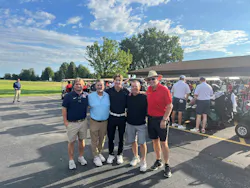
Forgash: I enjoy golf, hunting and fishing with my boys, hanging out with my wife, relaxing on our deck, and some boating.
We’re an outdoor family. We have a cabin in West Branch, Mich., with a bunch of property and some trout streams and ponds, and we love just hanging out at the cabin and tooling around on side-by-sides and having fun being outside.
Bay Plastics Machinery has been a part of your family for a long time; do you plan to keep it that way?
Forgash: It’s 100 percent our intention. We strive because we’re a small, family-oriented business that allows us to be very nimble and custom design our equipment.
We answer to our customers and don’t answer to a big corporate structure, which I think gives us a lot of advantages. It allows us to be able to exceed expectations for our customer base.
We have sales reps in our organization who look at us and go: “You guys do way too much. You do too much to satisfy customers’ needs. Nobody else we deal with does it. We love that you do it, but nobody in the industry does what you guys do.”
We pride ourselves on that because the mentality is, if we take care of our customers, they’re going to take care of us. It’s been proven, and it’s very successful for us that way.
Is there anything you would like to add?
Forgash: It’s difficult having a small business right now in the U.S.
There’s lots of pressure for us to talk to larger companies interested in purchasing us, and it’s a struggle that we live with every day. Trying to maintain our unity as our own privately held company is sometimes pretty tough. There are a lot of people out there looking to gobble people up that are successful. I’ve seen it happen in the industry, and I’ve seen what happens to a lot of those companies in the industry. They lose those customer-centered focuses.
Us being lucky enough and fortunate enough to maintain that independence has really been important for our business. If we can stress anything, I would really work toward that area. Being small isn’t bad. Being small is sometimes a really good thing. It allows us to do the right thing by our customers and our employees.
We’re very flexible. If there’s a child’s play at school and you need to take time off to go see your child’s play, we want you to be with your family and enjoy that time with your kids because you don’t get it back. We all know when our kids grow up and are on their own, they’re gone, and they’re doing their own thing, and we get to go see grandkids and those type of things. Those are the things that are really important to us.
Further reading

 Bay Plastics Machinery President Jason Forgash shows off a system he devised for cutting and collecting straws for recycling.
Just the facts
WHO IS HE: Jason Forgash, president and CEO at Bay Plastics Machinery, Bay City, Mich.
AGE: 60
EDUCATION: Bachelor’s degree in marketing and sales from Ferris State University, Big Rapids, Mich.
NUMBER OF EMPLOYEES: 55
About the Author
Bruce Geiselman
Lead Reporter
Senior Reporter Bruce Geiselman covers plastics processing technologies and end markets including automotive and packaging. He also writes features, including In Other Words and Problem Solved, for Plastics Machinery & Manufacturing and The Journal of Blow Molding. He has decades of experience in daily and magazine journalism, including eight years at PMM, and is the recipient of a Jesse H. Neal Award, among other recognitions.