Agri-Industrial Plastics wins 2026 SPE Blow Molding Division Recognition of Excellence
Key Highlights
- Agri-Industrial Plastics has paired long-term customer relationships with strategic investments in multilayer blow molding, automation and data-driven manufacturing.
- The Iowa custom molder produces more than 500,000 multilayer fuel tanks annually after betting on EPA-driven barrier technology.
- Leadership says flexible automation, AI tools and real-time production data are helping improve quality while preparing for future manufacturing demands.
- AIP credits its employee-first culture, community involvement and internal talent development with supporting nearly five decades of steady growth.
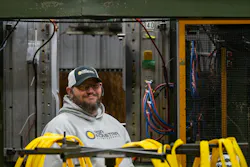
When Richard “Dick” Smith founded Agri-Industrial Plastics (AIP) in 1978, he had four employees, two clients and one used blow molding machine.
Forty-eight years later, both of those original clients are still with the company. So is the 1969 Black-Clausen blow molder. And so are Dick Smith, who comes into the office daily at age 89, and Bill Shipley, one of those original employees, who started out of high school as a machine operator and now works in maintenance.
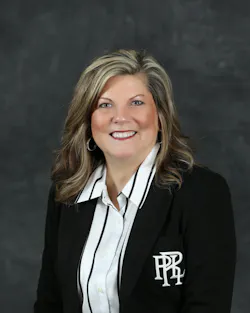
“Back in the ’70s, there were a lot of farm kids. They grew up problem-solving and doing things with equipment and they were just handy. And so that made a great entry into our manufacturing floors,” said Lori Schaefer-Weaton, Smith’s daughter who is now president and owner of AIP.
Now, she said, “you’ve got to look a little harder and you’ve got to do a lot of internal training and development in those positions.”
Giving employees room to grow is one of AIP's calling cards. Its commitment to customers, workers and its home community of Fairfield, Iowa, helped the company earn the 2026 Recognition of Excellence award, to be presented at the Annual Blow Molding Conference (ABC) in October.
The Recognition of Excellence is given annually by the Board of the SPE Blow Molding Division to a regional molder near the ABC site. Winners must demonstrate innovation in their activities, investment in their operations, engagement of employees and a commitment to core values to promote the blow molding craft and industry.
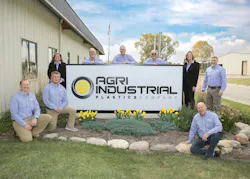
True to the “Agri” part of its name, AIP’s earliest products were for the agricultural market, including parts for field drainage systems, animal feeders and warming mats for baby pigs.
“Much of the growth of the company through the first few decades was achieved by identifying existing products from other materials, such as wood or metal, that would be good applications for blow molding and then reaching out to those customers to educate them about this fairly unknown process” of blow molding, said Geoff Ward, the company’s director of engineering and strategy. “Agri would design a concept to assist in that conversion and oftentimes get those items into production. Probably the best-known example of that was the original Koala [Kare] baby changing station.”
Design is still an essential part of the process. Many OEM customers work with AIP early in product development to make sure their concepts are manufacturable for blow molding, Ward said.
“We use molding simulation software to assist with this, but even before simulation we can provide comprehensive feedback on initial designs to highlight areas for improvement,” he said.
Betting big on multilayer
The company has produced a diverse portfolio of products over the years, including traffic safety devices, food dispenser containers, dock floats, outdoor sheds, playground equipment, kayaks and other large, hollow parts.
AIP runs 20 monolayer machine lines, primarily made by Kautex, ranging from 5-pound to 100-pound accumulator heads; eight multilayer continuous co-extrusion machines in three different sizes; and about 400 active molds.
The company began investing in the multilayer machines in 2004 to produce low-permeability non-automotive fuel tanks to accommodate revised EPA regulations.
“We had actually made fuel tanks before that... We were doing monolayer tanks specifically for Arctic Cat and some others. But that [after the EPA rule change] was when we had to make the decision: Are we going to stay in fuel tanks or get out completely? And that's what spurred the investment in the multilayer machines,” Schaefer-Weaton said.
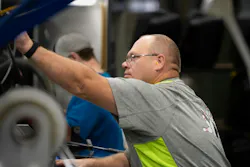
While the continuous extrusion multilayer process was new to AIP’s production floor, the company was able to adapt quickly. “Most of the technology is in the machine. Those machines are Kautex machines, and they were really the leader in that area,” Ward said, and the automotive industry had already been using the process for about a decade by the time AIP bought its first machine.
AIP’s design and engineering staff needed to learn what the new barrier material required, maintenance had to manage more parts, and “there was definitely some work involved up front, but you know, after the parison gets into the mold, everything else is the same,” Ward said.
AIP now makes more than 500,000 fuel tanks per year for prominent OEMs of products such as lawn equipment, golf cars, ATVs, side-by-sides and personal watercraft, along with a broad range of other engineered components, including oil tanks, coolant reservoirs, tailgates, air ducts and storage boxes. Sustained growth in the power equipment and powersports markets has positioned these segments to represent nearly half of its annual business, according to the company.
“Obviously, we would all say that was a good decision based on our customer list that we have today. There was definitely a need to serve these industries,” Schaefer-Weaton said.
Investing in automation, data
Expanding into multilayer production is not the only area where AIP is moving forward. The company has invested in automation and data monitoring, with an eye to a future driven by artificial intelligence (AI) and other advanced manufacturing processes.
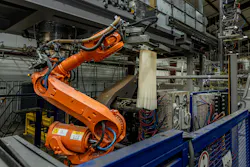
“We have been using flexible automation through customized robotic work cells for over 20 years, and we continue to find new applications for these cells,” Ward said.
As a custom molder running multiple parts on each machine, AIP can’t completely automate a full work cell, so the plant’s automation team must identify and implement opportunities to use the flexible systems to assist operators, he said.
Sensors are being installed across the plant, and tens of thousands of data points per second are collected in real time with a SCADA and Historian software package, “but in the big picture, we're still very early into what's probably a long-term project to set us up for the future,” Ward said.
The company is using large language models (LLMs) to assist with task automation and problem-solving, and is investigating machine learning tools and agents for data analysis and usage.
AI tools will be necessary to keep pace with the industry, Ward said, “but we also need to make sure to do what makes sense for us and provides the necessary value, and not just jump at the next exciting thing.”
He praised AIP’s ownership and leadership for investing in the future.
“It's not an easy thing. I go to them and say, I've got this idea and we need to spend all this money. And they're like, what am I getting out of it? I said, well, probably nothing for a little while, but ... we've been around for 48 years and this is for the next 48 years. It's not necessarily for next month. And that's what I appreciate about working in a place like this,” he said.
Schaefer-Weaton sees benefits for both the company and the customers as smart processes improve production and quality control.
“We're super proud of our customer list, and large OEMs’ expectations will continue to ratchet up. And one way we can meet those expectations for quality, for delivery, for production overall is to get more proactive versus reactive. We can't afford to run 24 hours with something out of sync and then have to redo it or, God forbid, let it get to the customers,” she said.
Solar array anchors sustainability efforts
In addition to serving its customers, AIP is also committed to improving its environmental footprint.
The company installed a 517-kilowatt (kW) roof-mounted solar array in 2020, which works in conjunction with a Tesla Powerpack battery energy storage system. During the day, the solar panels power about 5 to 10 percent of the plant’s energy needs, while charging the battery storage system.
The battery system allows AIP to shave its energy usage from the power grid during periods of peak demand. This maximizes the value of the solar array, so that the energy it generates can be used even when the sun is not shining.
At the time of installation, the estimated ROI was about nine years, which “definitely was much improved in reality,” especially as energy prices have gone up, Schaefer-Weaton said.
“Some of the benefits maybe can't be penciled out as easily, [such as] appealing to this next generation. People want to know that we're good corporate citizens, that we care about the environment, we care about our community,” she said.
An internal sustainability committee, formed in the wake of the solar project, works in tandem with the company’s other continuous improvement efforts. Lighting has been converted to LEDs, air leaks have been repaired, water filling stations have replaced single-use bottles, and packaging has been made more sustainable.
“We use a lot of stretch film and we had never really questioned it. We just kept buying the same stretch film. And we were able to study it and convert to a lesser weight, which genuinely is good for everybody. It's good from a cost perspective, it still was functional, and... you don't want that stuff just filling up landfills,” Schaefer-Weaton said.
The company is also exploring replacement of all of its silos to make sure materials don’t escape into the environment.
Improving sustainability “can be a very small thing or it can be a big thing,” she said.
A company that gives back
Good corporate citizenship extends far beyond the plant doors, and AIP is a force in community organizations and charitable efforts.
“We live in a town of 10,000 people. We all work here, but we all live here too, so we're pretty proud of our community. A company this size over the years has definitely been a community contributor, whether it's education initiatives, building a new civic center, building a rec center,” Schaefer-Weaton said.
Founder Smith was instrumental in growing the Fairfield Manufacturers Association, which promotes manufacturing interests and shares best practices. The company has also been represented on boards for the Chamber of Commerce, the Economic Development Association and local service organizations. At the state level, Smith, Schaefer-Weaton and Ward have all served on the board of the Iowa Manufacturers Association/Iowa Association of Business and Industry.
AIP has been partnering for more than a decade with the African Violet Foundation (AVF), which was initially launched to provide Christmas gifts to middle and high school children who might not otherwise receive any. It has expanded its services and now collects and distributes clothing, runs a boutique and helps families in many other ways.
The organization’s website credits retired AIP employee and former AVF board member Terry Neil, who “made it his personal mission to involve everyone at the factory in helping students and families in need,” collecting donations from employees and eventually leading to AIP’s sponsorship of the annual golf tournament fundraiser.
“That's been an amazing partnership,” Schaefer-Weaton said. “And again, I think what we all really appreciate is that it's in our own backyard and we really can trust that the value is being delivered to the right people.”
Making employees feel heard
The plastics industry, and manufacturing in general, has been struggling to attract and retain labor. While it may be tough for any of AIP’s almost 200 current employees to catch up to Bill Shipley’s 48-year tenure, the management team works hard to make its employees want to stay.

“I think we do a really good job of keeping the connection with all of our employees. Plant, office — we don't have a big ivory tower here. We all have to work together on all the challenges that come our way,” Schaefer-Weaton said.
Setting employees on a path for career growth is important to making them feel they’re contributing and getting something back from their work, and most of AIP’s open positions are filled from within, she said.
A quarterly recognition program called ECE (Exceeding Customer Expectations) allows employees to nominate each other for going above and beyond to support customers, either external or internal.
The privately held company prioritizes its culture of family values and taking care of its workers, with robust profit-sharing, bonus programs and 401k contributions. It hosts a company Christmas party, a fall tailgate cookout and a summer outing to the Adventureland amusement park.
Ward also credited Schaefer-Weaton's commitment to meeting individually with each employee every other year or so, “just to talk about how things are going” and making people feel they’re being heard.
Five decades, one community
AIP’s 50th anniversary, coming up in 2028, is “a big deal for any company,” Schaefer-Weaton said, and one she takes a lot of pride in.
Another reason to celebrate is approaching next year, as Smith will turn 90.
“He's here six hours a day, always contributing and always giving us lots of ideas. And he does have a lifetime of experience that can really be valuable to any of us,” Schaefer-Weaton said. “He absorbs more information at 89 than any person I know. And I mean, I know a lot of really smart people, but his ongoing desire to learn is staggering.”
She continued, “He loves still going out and solving an engineering problem. It's just his true heart. And he's also of the mindset that when you retire, you get sick and die."
Smith has been a longtime supporter of the Engineering College at the University of Iowa, which honored him last year by endowing its deanship in his name and that of his wife, Judy. He was the recipient of the 2008 Blow Molding Division’s Lifetime Achievement Award, and now AIP has earned another Division recognition.
“When you look at some of the other companies that have been recognized, it's definitely an honor to be in that group,” said Ward, who has served on the Division board of directors for nearly 20 years.
The award considers more than just industry performance, and he said he finds it satisfying that the company’s work in the community, its employee relationships and values are being seen.
“We don't often stop to take the time to appreciate the company that we've all been building. You're in it every day and you're grinding and you’ve got to get to the next problem, you’ve got to get to the next project. And so I think this will give our whole team a chance to step back and say, wow, we're being recognized from our industry peers, which is really something,” Schaefer-Weaton said.
“I'm looking forward to spending that time with our whole team to say thank you. It takes so many skill sets to run a successful manufacturing company, and we have a lot of really, really talented people. So I'm looking forward to celebrating them.”
Agri-Industrial Plastics Co.
Location: Fairfield, Iowa
Founded: 1978
Employees: About 200
Blow molding lines: 20 accumulator head extrusion, eight multilayer coextrusion
Website: www.agriindustrialplastics.com
About the Author
Lynne Sherwin
Managing Editor
Managing editor Lynne Sherwin handles day-to-day operations and coordinates production of Plastics Machinery & Manufacturing’s print magazine, website and social media presence, as well as Plastics Recycling and The Journal of Blow Molding. She also writes features, including the annual machinery buying survey. She has more than 30 years of experience in daily and magazine journalism.