Serial inventor Jim Bradac keeps finding niches to fill
Key Highlights
- Jim Bradac built St. Croix Valley Blow Molding around blow molded niche products, from concrete forms to insulated cat shelters.
- Bradac shifted from sheet metal to plastics after inventing Ceme-Tube, a polyethylene alternative to moisture-prone cardboard concrete forms.
- He launched in-house production in 2017, rebuilding a used accumulator-head blow molding machine and teaching himself the process.
- Bradac’s product line expanded from Ceme-Tube to fast-selling Kitty Tube shelters and Rodent Barriers for transportation infrastructure.
- With about five employees, Bradac wants to sell Ceme-Tube and focus on Rodent Barriers, Kitty Tube and new inventions.
Upper Midwest winters can be brutal. Maybe that’s why serial inventor Jim Bradac, the CEO of St. Croix Valley Blow Molding (SCVBM), located in Hudson, Wis., just east of the Twin Cities in Minnesota, takes so much pride in a product that protects outdoor cats.
“These little old ladies call me up on Kitty Tubes, and they just sit there and they [praise] me up and down, because ‘You’re just the greatest soul on Earth to invent this product,’ ” said Bradac, the inventor of a blow molded, insulated structure for outdoor cats.
Bradac’s Kitty Tube evolved from his first invention, the Ceme-Tube, which concrete pourers can use to form the bases of light poles. That’s the business that took him from working with metal in the early 2000s to working with LDPE and HDPE, and it’s one he’s hoping to sell, he told Karen Hanna, senior staff writer for Plastics Machinery & Manufacturing, during a conversation about balancing a growing portfolio of innovations with being the father to 10 kids.
How did you get started in plastics?
Bradac: My first invention started around 2007.
I used to work with only stainless steel. A couple years out of high school, I tried to decide what I wanted to do for life. I decided to be a sheet metal worker. … I ran that business for many years, while I supported my family early on. We used to install restaurant equipment, kitchens and stuff.
Then, I had a great idea of inventing a product, which is the Ceme-Tube.
In the world of concrete forms, have you ever gone to Home Depot and seen cardboard tools for making a deck footing? That is kind of the only thing out there for putting in the ground to pour concrete. There’s a lot of issues with the cardboard ones, because they can’t get wet.
… Even if you don't get groundwater, there’s moisture in the soil. So, if you put it down there, and let’s say you want to backfill it a little bit to hold it in place, that tube is going to get moist very quickly. It doesn’t take long, and then it caves in and fails. They don’t hold concrete in place long enough for the concrete to dry.
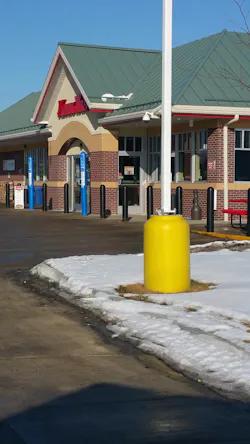
My plastic ones do not fail. The other good thing is my plastic Ceme-Tubes actually have a collar on one end, so you can stack them to go taller if you need to.
That product broke off into some other models that I sell that have become very successful. One is specifically for making light pole bases in a parking lot, like if you go to Target or the grocery store.
Mine are plastic, and they're colored. They can use those instead of the cardboard tubes, and just leave the plastic right on there, and it looks nice. They have, like, 900 Kwik Trip [convenience] stores; they use my Ceme-Tubes in every single store.
I had that thought for a long time: Why didn’t somebody else come up with this? But then, after doing this for so many years, nobody else had come up with it. And I have the only one.
Is production of the Ceme-Tube what led you to establish SCVBM?
Bradac: For the first several years at Ceme-Tube, I outsourced and used [other] companies. ... That was not going so well. I decided, “Hey, if I'm going to be successful, I've got to make these myself.”
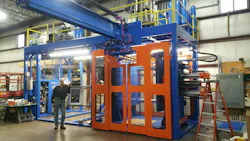
That was roughly 2017 that I pulled that trigger, and I bought a blow molding machine from Ohio. We have one machine. It's a Sterling, 50-pound accumulator-head. … It arrived on four semi trucks. I had to completely take it apart and rebuild it from the ground up. … It was a big job.
It's like a 1998 [model] that had been upgraded a few times. I had to strip it down to nothing. The machine should have gone to the junkyard.
I had to replace everything on it. … I turned it into a brand-new machine from the bottom to the top. Then, I opened my own plant, and I set up everything I sell.
How did you know how to put a blow molding machine back together again?
Bradac: That's kind of who I am. I've got an engineering-type mind.
I visited blow molding companies that were making my product. Obviously, if you have a blow molded product, you start learning the in and outs and you kind of understand the procedures. When I finished that machine and installed my whole plant — there was a lot that had to go into that plant to manufacture — there came a point where I turned everything on, and I had to learn how to blow mold.
How many employees do you have?
Bradac: It's always been just me. My sons were working for me at the time, so they helped me. I've always owned all my businesses 100 percent. … There were a few other people that I hired to help me.
Tell me about the various products you make now.
Bradac: I have [the] Ceme-Tube business, and that has many models. [SCVBM] molds all my Ceme-Tubes, and it also molds my Kitty Tubes.
In about 2010, when I was already making Ceme-Tubes, my kids had cats, and my wife was allergic to cats, so they can't come in the house.
I took a 24-inch-diameter Ceme-Tube. I cut it down, and put a lid on the bottom and a lid on the top, and I insulated it, put a hole in the side, and I made a really nice cat shelter. That sat outside our house that whole winter; our four cats lived in that thing. When I’d come home at night, it's like, “The cats never come out of this thing. They love it in there.” … When you have a product like the Kitty Tube, you put it on Amazon.com, and you immediately get sales. So, that product just soared. It's funny, because I filled a niche that I didn't know I was filling. ... We sold so many in the first two months that Amazon shut it off because they thought I was maybe not legitimate. …
That was just for the first year that we made them from Ceme-Tubes, and then we made a mold specifically to make the Kitty Tube. …
I'm a little biased, but this is the highest quality, if you're going to rate cat houses out there. Nobody makes a cat house that's insulated and as well-made.
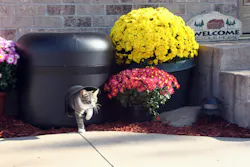
If you ever went on Amazon and looked at some of the reviews, people are just like, “This guy saved my cats’ lives. My cats would not have survived without it.”
When I came up with the Kitty Tube, I'd been thinking about a keg cooler, because if you ever go to a party where they have a keg, usually it's just a plastic bucket, and the keg is sitting in it and there's ice around it. This is much more refined and decorative. It looks nice. It's very well-insulated. It was just a much better mousetrap.
Then, about three years ago, I started working with the [Minnesota] D.O.T. [Department of Transportation], and I invented a product for the D.O.T. I didn't even know I did this; I invented something that nobody else invented. Every D.O.T. has issues with rodents getting into the bases of street lights or signal lights. They chew the wires. It causes an extreme amount of damage,and a lot of money to fix it.
Once I started into the rodent thing, I started learning what they needed, and I would just invent something.
[One of SCVBM’s latest Rodent Barriers] does two things. One: It eliminates mice from getting into the light. And two: It clamps the wire at the end of it; otherwise, if a worker is up on a high lift working on a light, and he lets go with that wire, it's going to fall down a pole [because of] gravity. This product I invented actually holds onto the wire, but keeps mice out at the same time.
Three years ago, we made one model for them; today, I make 28 models.
Besides the Rodent Barriers … I patented a device that goes in the poles to keep people from stealing the copper. [It is a]huge, huge issue in every single state. … It's sold under my Rodent Barrier business, but it's called a copper wire anti-theft device.
I'm approved in many other states. … Minnesota alone says they spend millions upon millions fixing rodent damage, not to mention copper wire theft. That runs in the billions upon billions upon millions of damage. It's kind of weird, I'm an inventor, but I started this company that nobody else has a product for.
… The Ceme-Tube has gotten to a point that it needs someone bigger than me. I'm the inventor. I can't make them fast enough unless I want to expand and put in many more blow molding machines, and I'm looking to move it to somebody who can do a much better job.
You’re hoping to move on from the Ceme-Tube?
Bradac: When you start a company, you start small, and you get what you need to keep growing. But, when it comes to the Ceme-Tube, it's just gotten too big for me. It needs to go to a company that can service distributors nationwide. …
We have about five [people] right now, sometimes six. When we start up the plant — we have to start the plant up next week and manufacture more Ceme-Tubes — I’ll hire a couple more people; if I just need temporary work, I'll get temps.
We're not running around the clock. That takes a lot of manpower, managers and stuff. It's been hard for me to cross that threshold. That's why I decided Ceme-Tube should go to someone who has three shifts, infrastructure and big warehouses.
I want to really concentrate on the Rodent Barriers, and I'm going to keep Kitty Tube awhile, but the Ceme-Tube … I look forward to that being sold.
Now that you’ve been operating SVBM for about a decade, what do you consider yourself — a metal guy, or a plastic guy?
Bradac: I'll always be a steel guy, because that's what I started with. But all my companies involve plastic.
I am an inventor. I have about 12 patents under my belt.
My wife always says, “You probably have more ingenuity than anyone I’ve ever met.” Problem-solving is something I enjoy. I enjoy inventing and product development and figuring out, how can we make this product better? What can we do to make this work?
I’ve heard that you have 10 kids. Is that true?
Bradac: My oldest is 33; my youngest is 12. We still have six at home.
I knew a long time ago I wanted more than two. Part of the reason why I work so hard [is] because I’ve got to support them all. My wife has always been a stay-at-home mom, and she homeschooled [them]. That was a big undertaking, but we really believed in that. I think it was a good choice.
We're a Catholic family, so we wanted to raise them in the Catholic faith, too.
My one son is making Rodent Barriers right now, and he enjoys it.
I will tell you this: When your kids work for you, if they work for someone else, they're not going to try to push the envelope on rules; when they work for Dad, they do push the envelope.
What’s it feel like, knowing that your inventions have found acceptance in the marketplace?
Bradac: I love it. But I've never let my feet come off the ground.
Do you still have more inventions in you?
Bradac: There's other inventions that I'm currently working on. I don't plan on retiring anytime soon.
I invented something else for MinnDOT, and it's getting patented. On your street corners, you have a 4-foot-tall pole with a button that you push to cross the street. In Minnesota, when it's snowing at night and they're plowing the roads, they tend to hit those poles, so, I invented a cap that will be highly reflective. … It’s wrapped with 3M reflective material. It's extremely bright, so they see that pole; they won't hit them.
What do you like to do outside work?
Bradac: I enjoy the outdoors.
I have a little lake place up in northern Minnesota that I like to go to, but I don't make it up there very often, I'm so busy. … I don't go hunting as much as I used to when I was younger, but I love fishing, and I guess my biggest hobby is I love to cook outside over the fire. I call it Big Jim's Cowboy Cookout. … It's fun. Put on a big party, we bring in horses, and kids ride horses while I cook food. I love being outside and spending time with family.
What would you like to have as your legacy?
Bradac: I guess I’d like to be known as an inventor.
If I had to tell you where my strong points are, it's inventing and product development and manufacturing. Eventually, my Ceme-Tubes are going to be at Home Depot and Lowe's and those big box stores, and that's going to be a massive business for somebody. I'm just not the one to do it.
Ceme-Tube will become bigger than me, bigger than I can do.
Just the facts
WHO IS HE: Owner and inventor Jim Bradac, CEO of St. Croix Valley Blow Molding (SCVBM), Hudson, Wis.
AGE: 63
NUMBER OF EMPLOYEES: About 5
PRODUCTS: Ceme-Tube, a one-time-use blow molded tube that forms the mold for concrete light-pole footers and parking-lot bollards
Kitty Tube, a blow molded, insulated structure initially based on the Ceme-Tube and assembled to accommodate outdoor cats
Keg-A-Tube, a blow molded insulated cooler for beverage kegs
Rodent Barriers, blow molded collars and barriers designed to prevent rodent intrusion into state Department of Transportation (D.O.T.) infrastructure, such as light poles. Also, available under the Rodent Barriers brand are similar barriers designed to prevent theft of copper wiring from public infrastructure.
About the Author
Karen Hanna
Senior Staff Reporter
Senior Staff Reporter Karen Hanna covers injection molding, molds and tooling, processors, workforce and other topics, and writes features including In Other Words and Problem Solved for Plastics Machinery & Manufacturing, Plastics Recycling and The Journal of Blow Molding. She has more than 15 years of experience in daily and magazine journalism.